
In This Article
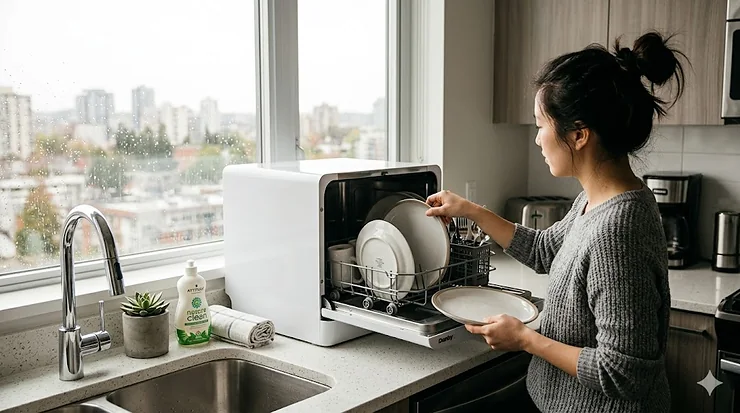
There’s a very specific kind of guilt that comes from running a dishwasher built for a family of six when it’s just you and your partner rinsing off two mugs and a cereal bowl. It feels wasteful. It sounds like a jet engine winding up in the next room. And if you live in a condo, a basement suite, or a bachelor apartment with a kitchen the size of a phone booth, you probably don’t even have the option — there’s no cabinet cutout waiting for a 24-inch built-in unit. That gap is exactly where the countertop dishwasher for 2 people earns its keep.
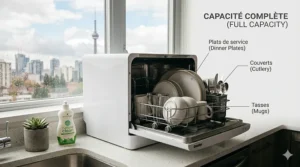
A countertop dishwasher is a scaled-down washing appliance that sits on your kitchen counter, connects to your faucet (or, in some models, fills from an onboard tank), and cleans a small load — typically two to six place settings — using far less water and electricity than a full-size machine. It’s the appliance equivalent of a bicycle instead of a minivan: smaller, cheaper, and built for exactly the job in front of it.
This guide skips the marketing fluff and gets into real specs, real aggregated reviewer sentiment, and honest analysis of seven actual models sold in Canada right now, from bare-bones budget units to genuinely capable mid-range machines. We’ll cover setup, maintenance, common headaches, and how these units compare to hand-washing and full-size dishwashers, so by the end you’ll know exactly which one — if any — deserves a spot on your counter.
Quick Comparison Table
Before the deep dive, here’s the short version for anyone who wants the gist in fifteen seconds.
| Model | Capacity | Best For | Price Range (CAD) |
|---|---|---|---|
| COMFEE’ CDC17P0ABB | 2 place settings | Truly minimal dish load | Under C$260 |
| Farberware FDW05ASBWHA | 6 place settings | No-hookup flexibility | C$300-C$380 |
| Danby DDW631SDB | 6 place settings | Best all-round performance | C$390-C$450 |
| Danby DDW621WDB | 6 place settings | Budget-simple daily use | C$350-C$420 |
| BLACK+DECKER BCD6W | 6 place settings | Design-conscious kitchens | C$380-C$460 |
| Magic Chef MCSCD6W5 | 6 place settings | Flexible delay-start scheduling | C$350-C$430 |
| SPT SD-9263WA/SS | 8 place settings | Premium build, stainless tub | C$480-C$600 |
Looking at the spread, the story here isn’t really about which machine is “best” in the abstract — it’s about matching capacity to how little you actually wash. A two-person household running one small load a day is a completely different use case than two people who cook elaborate dinners and use every pot in the kitchen, and the right model changes accordingly. Budget-conscious buyers cluster around the COMFEE’ and Farberware, while anyone who wants dishwasher-grade drying and a longer cycle list should look toward the Danby or SPT.
According to a mechanical dishwasher cleans by spraying hot water, typically between 45 and 75 °C, at the dishes, with lower temperatures used for delicate items, which is the same basic physics every model on this list relies on — the differences come down to how well each one manages that spray, heat, and drainage in a much smaller footprint. If you’ve never lived with one before, understanding how dishwashers actually work helps explain why cycle length and water temperature matter more than the cycle name printed on the dial.
💬 Just one click — help others make better buying decisions too!😊
Top 7 Countertop Dishwashers for 2 People: Expert Analysis
We picked these seven specifically for two-person households — meaning we weighted small capacity, low water draw, and daily-use durability over sheer place-setting count. Budget, mid-range, and premium options are all represented.
1. COMFEE’ CDC17P0ABB — smallest footprint built for exactly two settings
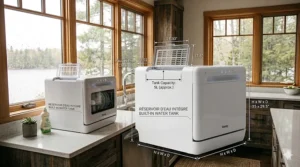
This roughly 17-inch cube is, on paper, the purest expression of “countertop dishwasher for 2 people” you can buy — it’s sized for two place settings and nothing more, which sounds limiting until you realize that’s precisely what most couples actually dirty in a day. The unit runs on a 5-litre built-in water tank, so there’s no faucet hookup required; you fill it like a coffee maker and let it drain into a bucket or the sink afterward. Water heats up to roughly 121°C (250°F) equivalent sanitizing temperature during its cycle, which matters more than most buyers realize — it’s the difference between “rinsed” and “actually sanitized.” Based on the spec comparison with larger six-setting units, this model trades capacity for portability and price, making it the obvious pick for anyone in a bachelor apartment or dorm-style kitchen with zero counter space to spare. Reviewers consistently report that it handles daily light loads — two plates, two mugs, cutlery, a pot or two — without complaint, though several note that dinner plates over 10 inches wedge awkwardly against the spray arm.
Pros:
✅ Smallest, most apartment-friendly footprint on this list
✅ No faucet hookup needed, works almost anywhere
✅ Genuinely sized for two-person daily loads
Cons:
❌ Can’t fit oversized dinner plates or tall glasses
❌ Manual water filling adds a small extra step
Priced under C$260 in most listings, the value case here is straightforward: for a couple who just wants two settings washed daily without babying a giant machine, this is about as efficient a match as the market offers.

2. Farberware FDW05ASBWHA — best for faucet-free flexibility
The Farberware is built around the same reservoir logic as the COMFEE’, with a 5-litre internal tank that lets it run a full wash cycle without ever touching your kitchen faucet. What most buyers overlook about this design is how much it changes where you can actually put the machine — a spare bedroom, a garage, a cottage counter three metres from any tap, even a dorm room down the hall from a shared bathroom. It holds six place settings, a genuinely useful jump from the COMFEE’s two, while staying compact enough to tuck under an upper cabinet. Based on the spec sheet, cycle times run comparable to other reservoir units in this class, typically 60-100 minutes depending on soil level. Aggregated reviewer sentiment is largely positive on cleaning performance for everyday loads, with a recurring theme that heavier baked-on messes need a pre-scrape first, same as any compact unit.
Pros:
✅ Works completely off-grid from any faucet
✅ Six place settings despite the small chassis
✅ Genuinely portable for cottages, dorms, and RVs
Cons:
❌ Manual tank refills for larger loads add time
❌ Drain hose management can be fiddly if no sink is nearby
In the C$300-C$380 range, this is the pick for anyone whose kitchen setup is unconventional — renters without faucet access, or anyone who wants the option to move the dishwasher between rooms.
3. Danby DDW631SDB — best all-round performance
The DDW631SDB is the closest thing on this list to a shrunk-down full-size dishwasher rather than a novelty appliance. It runs eight distinct cycles — Heavy, Normal, BabyCare, Eco, Glass, Speed, Rinse, and Mini Party — and it can handle a half dozen place settings and gives you a choice of 6 cleaning options from short energy-saving cycles for lightly soiled dishes to an intensive setting for heavily soiled loads. That cycle depth matters in practice: the Eco setting is genuinely useful for two people running a light daily load, while Heavy earns its name on pots with dried-on sauce. On paper this means you’re not stuck choosing between “too gentle” and “too aggressive” the way cheaper single-cycle units force you to. Reviewers and independent testers consistently rank this model’s stain removal as comparable to, or better than, some full-size machines, with an extra drying option that noticeably reduces the damp-glass problem common to compact dishwashers.
Pros:
✅ Widest cycle selection of any model on this list
✅ Stain removal performance rivals full-size dishwashers
✅ Digital display and extra-dry option reduce guesswork
Cons:
❌ Sits at the higher end of the countertop price bracket
❌ Louder than the whisper-quiet built-in models it’s competing against
At around C$390-C$450, this is the model to buy if you want a countertop unit that genuinely performs like a real dishwasher rather than a compromise.
4. Danby DDW621WDB — budget-simple daily use
One step down from its sibling above, the DDW621WDB trims the cycle list to six — Heavy, Normal, Light, Glass, Speed, and Rinse — and swaps the digital display for straightforward push-button controls. Here’s what to weigh: if you’re not the type who fusses over eight wash modes, this simplification isn’t a loss, it’s a relief. Two people running the same basic wash every evening rarely touch more than two or three cycle options anyway, so paying extra for BabyCare and Mini Party modes you’ll never use is money left on the table. The white plastic finish won’t win design awards, but it’s easy to wipe down and blends into most rental kitchens without drawing attention. Reviewer sentiment describes cleaning performance as solid though a notch below the DDW631SDB, particularly on stubborn stains like dried spinach or egg.
Pros:
✅ Lower price than the flagship Danby without losing core function
✅ Simple button controls with no learning curve
✅ Reliable for straightforward daily wash routines
Cons:
❌ Cleaning performance trails slightly on tough, dried-on stains
❌ Plain plastic finish looks utilitarian rather than stylish
Typically listed around C$350-C$420, this is the pragmatic choice for anyone who wants Danby’s reliability without paying for cycle options they’ll ignore.
5. BLACK+DECKER BCD6W — design-conscious kitchens
With its stainless steel handle finish and its touchscreen user interface, it’s easily the best-looking dishwasher on this list — and for a couple who has to look at this appliance sitting on their counter every single day, that’s not a trivial detail. The black window and LED display above the handle read more like a countertop espresso machine than a dish-cleaning appliance, which is exactly the point for small-space living where every visible object contributes to the room’s overall feel. Underneath the styling, this model runs seven cycles from Quick Rinse to a rigorous Heavy setting, plus a 24-hour delay start and a child lock. It holds six full place settings, though the manufacturer is upfront that dinner plates over 10 inches won’t fit — worth checking your existing dish set before buying. It’s also Energy Star rated and ranks among the quieter compact units, a genuine advantage in a studio apartment where the kitchen and living room are the same space.
Pros:
✅ Most visually polished design in this price tier
✅ Energy Star rated with notably quiet operation
✅ 24-hour delay start for off-peak scheduling
Cons:
❌ Won’t accommodate dinner plates larger than 10 inches
❌ Touchscreen controls can be less intuitive than physical buttons
Around C$380-C$460, the value verdict here leans on aesthetics as much as function — if your kitchen is small and visible from your living space, that premium is arguably justified.
6. Magic Chef MCSCD6W5 — flexible delay-start scheduling
Most countertop dishwashers cap their delay-start feature at two, four, or six hours. The Magic Chef breaks that mold entirely: the delay option on this Magic Chef runs from 1 to 24 hours and can be set in 1-hour increments. What most buyers overlook about this feature is the electricity-cost angle — in provinces with time-of-use billing, running your wash cycle at 2 a.m. instead of right after dinner can shave real money off your bill over a year, and a full 24-hour window gives you the flexibility to line that up precisely rather than guessing with a blunt six-hour delay. Cycle performance mirrors the other six-setting compact units on this list: solid on everyday loads, a little inconsistent on tougher stains like dried spinach, according to aggregated tester notes. Six cycles cover the basics — Heavy, Normal, Light, Speed, Glass, and Rinse — without extra bells and whistles.
Pros:
✅ Unmatched delay-start flexibility, 1 to 24 hours
✅ Straightforward six-cycle lineup covers daily needs
✅ Solid mid-range reliability at a fair price
Cons:
❌ No standout cleaning-performance edge over competitors
❌ Fewer specialty cycles than the Danby DDW631SDB
Listed around C$350-C$430, this is the pick for anyone specifically chasing off-peak electricity savings or an oddly timed household schedule.
7. SPT SD-9263WA / SD-9263SS — premium build, stainless tub
The SPT sits apart from the rest of this list on two fronts: it’s the widest at 18 inches, and it’s the only model here rated for eight place settings, genuinely more capacity than most two-person households need on a given day — but useful headroom when hosting or batch-washing after a weekend of cooking. The stainless-steel tub, rather than the plastic interiors common on cheaper units, resists hard-water staining and retains heat better through the dry cycle, which is exactly why this model consistently posts stronger drying results in aggregated user feedback. It carries full Energy Star certification and runs six wash programs. Here’s what to weigh: paying a premium for a stainless tub only makes sense if you plan to keep this machine for many years, since the durability payoff compounds over time rather than showing up in the first few washes.
Pros:
✅ Stainless steel tub outlasts plastic-tub competitors
✅ Largest capacity on this list at 8 place settings
✅ Energy Star certified with strong drying performance
Cons:
❌ Highest price point of the seven models here
❌ Larger footprint eats more counter real estate
At roughly C$480-C$600, this is the “buy once, cry once” option — the right call for a couple who wants the last countertop dishwasher they’ll ever need to purchase.
Setting Up Your Countertop Dishwasher as a Daily Washing Solution
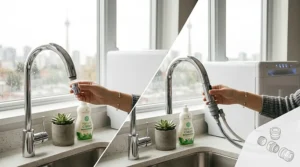
Getting a countertop dishwasher running smoothly as your actual daily washing solution takes more than plugging it in. First, measure your faucet — most hookup-style units (like the Danby and BLACK+DECKER models above) ship with a universal adapter, but pull-down or touchless faucets sometimes need a separate connector, so check your faucet type before your delivery date arrives. Second, run one empty cycle with a cup of white vinegar before the first real load; this clears manufacturing residue and, according to appliance technicians frequently cited across review sites, prevents the plasticky smell some units carry out of the box.
For maintenance, clean the filter basket weekly if you’re running a load daily — food particles that would rinse away in a full-size machine’s larger water volume tend to concentrate faster in these smaller tanks. Once a month, run an empty cycle with dishwasher-safe descaler, especially in hard-water regions like much of Ontario and the Prairies, where mineral buildup can clog spray arms within a season. Common first-30-days mistakes include overloading the small rack (cramming plates in reduces spray coverage and leaves streaky glasses), using regular dish soap instead of dishwasher-specific detergent (this causes a genuinely impressive amount of foam and can trigger a leak), and skipping the rinse-aid compartment, which on hard water leads to visible spotting even after a technically successful cycle.
Real-World Scenarios: Which Countertop Dishwasher Fits Your Life
Picture three different couples. The first: two grad students sharing a 400-square-foot bachelor apartment, cooking mostly one-pot meals, running the dishwasher every second day. For them, the COMFEE’ or Farberware makes sense — minimal footprint, minimal cost, and neither of them is washing more than a plate, a bowl, and a mug at a time.
The second: a working couple in a downtown condo who cook every night and entertain occasionally on weekends. Their dish load fluctuates between light on weekdays and genuinely heavy on Saturday. The Danby DDW631SDB’s eight-cycle range fits this pattern well — Eco for the Tuesday-night two-plate wash, Heavy for the Saturday dinner-party aftermath.
The third: a semi-retired pair in a house who downsized their kitchen after their kids moved out and didn’t want to keep running a half-empty full-size dishwasher. For them, the SPT’s larger capacity and stainless tub earn their keep, since they still host family dinners a few times a year and want a machine that can handle it without reverting to hand-washing for guests.
Common Problems With Countertop Dishwashers (And How to Fix Them)
Problem: Dishes come out with a filmy residue. This is almost always hard water mineral buildup rather than a cleaning failure. Solution: add rinse aid every cycle and run a monthly vinegar or descaler cycle, particularly important with models like the Magic Chef and Danby that lack a built-in water softener.
Problem: The unit won’t drain fully. Reservoir models like the Farberware and COMFEE’ rely on gravity-fed drain hoses; if the hose loops upward at any point, water backs up. Solution: route the drain hose in a continuous downward slope into the sink or bucket.
Problem: Glasses come out streaky. Overloading is the usual culprit — jamming too many items in blocks spray coverage. Solution: load with space between items and avoid nesting bowls or plates.
Problem: A persistent plastic or musty smell. This is typically trapped moisture in the filter or seal. Solution: leave the door cracked between cycles to air out, and clean the filter weekly rather than monthly.
Problem: The wash cycle takes far longer than expected. Some models, notably the Danby DDW631SDB, extend cycle time on the Heavy setting automatically based on internal soil sensors. Solution: use Eco or Speed for lightly soiled everyday loads and reserve Heavy for genuinely dirty cookware.
How to Choose a Countertop Dishwasher for 2 People
Choosing the right countertop dishwasher for 2 people comes down to matching a handful of criteria to your actual habits rather than chasing the highest spec sheet. Here’s the reasoning behind each factor, in order of importance:
- Capacity versus actual daily dish count. Count what you genuinely dirty in a day before assuming you need six place settings — many two-person households top out at two or three.
- Water source. Decide between a faucet-hookup model (better for permanent kitchen use) and a reservoir-tank model (better for renters or unconventional spaces).
- Cycle range. More cycles aren’t automatically better; they’re only useful if they map to real situations you’ll face, like a baby-bottle sanitize setting or a genuine heavy-soil option.
- Tub material. Stainless steel outlasts plastic and dries faster, but it adds cost — worth it for a long-term daily-use appliance, less so for occasional use.
- Noise level. In an open-concept small apartment, a loud dishwasher is audible from every room; check decibel ratings if your kitchen and living space share air.
- Certification. Confirm the unit carries a recognized Canadian electrical safety mark before buying, covered in detail below.
- Delay-start flexibility. Genuinely useful if your utility bills more for peak-hour electricity use.

Countertop Dishwasher vs Traditional Built-In Dishwasher
The comparison Canadian renters and small-space owners actually care about isn’t countertop versus hand-washing — it’s countertop versus a full-size built-in, because plenty of people are choosing between the two when setting up a new kitchen.
| Factor | Countertop Dishwasher | Built-In Dishwasher |
|---|---|---|
| Installation | Plug-and-connect, no plumbing | Requires permanent plumbing hookup |
| Typical capacity | 2-8 place settings | 12-16 place settings |
| Water use per cycle | Roughly 4-12 litres | Under 15 litres for an ENERGY STAR certified model |
| Upfront cost | C$200-C$600 | C$600-C$2,000+ |
| Best for | Renters, small households, 1-2 people | Families, frequent large loads |
The water-use numbers here surprise people: a well-chosen countertop model and a modern full-size Energy Star dishwasher aren’t dramatically different in litres per cycle, since an ENERGY STAR certified dishwasher uses 12% less energy and 30% less water on average than a standard model regardless of size class. The real gap is upfront cost and installation flexibility — a countertop unit skips the plumbing entirely, which matters enormously if you’re renting and can’t modify the kitchen. For two people, the practical math almost always favours the countertop option unless you regularly host large groups.
✨ Don’t Miss These Exclusive Deals!
🔍 Take your countertop dishwasher search to the next level with these carefully selected models. Click on any highlighted item to check current pricing and availability. These compact appliances make daily cleanup effortless for small households.
What to Expect: Real-World Performance With a Minimal Dish Load
Specs on a box only tell part of the story — here’s what actually happens day to day. With a genuinely minimal dish load (two plates, two mugs, some cutlery), most models on this list complete a cycle in 60 to 100 minutes, comparable to or shorter than a full-size dishwasher’s average run time. Reviewers consistently note that lightly soiled items — mugs, cereal bowls, water glasses — come out spotless across nearly every model here, budget or premium. Where performance actually diverges is on baked-on or greasy cookware: the Danby DDW631SDB and SPT’s stainless tub handle this noticeably better than the plastic-tub reservoir units, based on aggregated stain-removal comparisons. Drying is the other differentiator — condensation-dry models (most of the budget units) can leave glassware slightly damp, while heated-dry options like the Danby’s extra-dry setting largely solve this. For a couple running one load daily, expect a machine that quietly becomes part of your routine within a week or two, with the main adjustment period spent learning which cycle matches which mess.
Countertop Dishwashers for Bachelor Apartments and Small Household Living in Canada
A bachelor apartment dishwasher has to clear a different bar than a family kitchen appliance: counter space is often measured in inches, not feet, and there may be no dedicated cabinet space at all. This is where the smallest units on this list — the COMFEE’ and Farberware — genuinely shine as a compact living appliance category unto themselves. Both can be stored under an upper cabinet or even on a rolling cart and wheeled out only when needed, which matters enormously in a studio or bachelor unit where every surface pulls double duty.
For small household dishwasher shopping in Canada specifically, rental restrictions are worth flagging early: most leases prohibit permanent plumbing modifications, which rules out built-in and even some larger portable units that require dedicated drain lines. A faucet-hookup countertop model sidesteps this entirely since it uses your existing kitchen tap, while a reservoir-tank model like the Farberware avoids plumbing questions altogether. Renters should also check with their landlord or property management about weight limits on older countertops — a filled countertop dishwasher can weigh 15-20 kg, which is rarely an issue but worth a quick confirmation on older cabinetry. For the growing number of Canadians in smaller urban units, a countertop dishwasher isn’t a downgrade from a full kitchen appliance lineup — it’s often the only dishwasher option that physically fits at all.
Long-Term Cost & Maintenance: Is a Countertop Dishwasher Worth It?
The upfront price tag is only half the value equation — total cost of ownership over three to five years tells the fuller story. Electricity and water use stay modest across this category: a certified dishwasher uses less than 15 litres of water per cycle, and running one load daily costs a small fraction of what a full-size dishwasher run costs, simply due to the smaller volume being heated and pumped each cycle.
| Cost Factor | Countertop (2-person use) | Hand-Washing | Full-Size Dishwasher |
|---|---|---|---|
| Annual water cost estimate | Low | Moderate-High | Moderate |
| Annual electricity cost estimate | Low | None | Moderate |
| Detergent cost | Low (pod or tab-based) | Low (dish soap) | Low-Moderate |
| Time investment | Minimal (load & start) | High (daily scrubbing) | Minimal |
Looking at the table, hand-washing is often assumed to be the cheapest option, but a running faucet can use up to 15 litres every 2 minutes — meaning a slow, thorough hand-wash session can actually burn through more water than a full countertop dishwasher cycle. The real long-term cost driver isn’t utilities at all; it’s maintenance neglect. Skipping filter cleaning or descaling shortens a unit’s lifespan from a realistic five-to-seven years down to two or three, which erases any savings from buying a cheaper model in the first place. Buyers who treat maintenance as optional consistently report shorter appliance life in aggregated review threads, regardless of brand.
Safety, Certification & Regulations: What Canadian Buyers Should Know
Before buying any countertop dishwasher in Canada, confirm it carries a recognized electrical safety certification. Products sold on Amazon.ca, like all electrical items in Canada, are required to have a certification from a body accredited by the Standards Council of Canada — look for a CSA, cUL, or cETL mark directly on the unit or its packaging, not just a generic “CE” label, which isn’t recognized for Canadian electrical compliance. The federal government is explicit on this point: Health Canada advises against buying or using electrical products without a certification mark, since uncertified units may pose shock or fire risks that certified models are specifically tested against.
On the efficiency side, checking for an Energy Star rating is worth the extra few minutes of research, particularly given dishwashers are subject to Canada’s Energy Efficiency Regulations, which set a minimum performance standard for their energy efficiency. Among the seven models covered here, the BLACK+DECKER BCD6W and SPT SD-9263 carry Energy Star certification outright, which is a meaningful marker of build quality even beyond the energy savings themselves, since certification requires third-party testing rather than a manufacturer’s self-reported claim.
Frequently Asked Questions
❓ What size countertop dishwasher do I need for 2 people?
❓ Does a countertop dishwasher use less water than washing by hand?
❓ Can I use a countertop dishwasher without connecting it to my sink?
❓ Is a countertop dishwasher worth it for a bachelor apartment?
❓ How long do countertop dishwashers typically last?
Conclusion
A countertop dishwasher for 2 people isn’t a compromise appliance — for the right household, it’s genuinely the smarter choice over a full-size machine that spends most of its life half-empty. The seven models covered here span a real range: the COMFEE’ and Farberware for the smallest kitchens and lightest loads, the Danby pair for households that want dependable daily performance without overpaying, the BLACK+DECKER for anyone who cares how their kitchen looks, the Magic Chef for flexible scheduling around utility rates, and the SPT for buyers who want a premium, long-lasting build with room to spare for the occasional dinner party.
The honest takeaway from all this research is that capacity, not brand prestige, is the single biggest factor in satisfaction — buyers who match the machine to their actual dish load report the best long-term experience, while those who overbuy or underbuy tend to be the ones leaving lukewarm reviews. Measure your daily dishes, check your faucet setup, confirm the certification mark, and the right pick from this list becomes fairly obvious.
Recommended for You
- 7 Best Countertop Dishwashers in Canada (2026): Real Picks for Small Kitchens
- 7 Best Portable Dishwashers Under $500 CAD — Canada’s Top Picks for 2026
- Best Full Size Portable Dishwasher in Canada 2026: Top 7 Expert Picks
Disclaimer: This article contains affiliate links. As an Amazon Associate, I earn from qualifying purchases. If you purchase products through these links, we may earn a small commission at no additional cost to you.
✨ Found this helpful? Share it with your friends! 💬🤗
