
In This Article
Here’s the thing nobody tells you when you’re standing in the appliance aisle, credit card in hand: the sticker price on a dryer is only half the story. The other half — the part that actually determines whether this is a smooth Saturday afternoon or an expensive headache — is gas dryer installation cost. It’s the line item that catches Canadian homeowners off guard, especially anyone switching over from an electric unit for the first time.
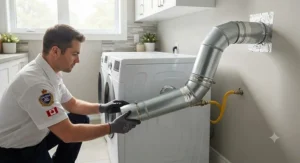
I get why. Electric dryers feel almost plug-and-play by comparison. Gas dryers ask a bit more of your home: a dedicated gas line, proper venting, and — this is non-negotiable — a licensed technician who actually knows what they’re doing with combustible fuel. Skip that step and you’re not saving money, you’re gambling with carbon monoxide.
This guide breaks down what gas dryer installation cost actually looks like across Canada in 2026, walks through converting electric to gas dryer setups, explains gas connection requirements in plain English, and profiles seven real gas dryers currently sold through Amazon.ca — from budget-friendly workhorses to the kind of commercial-grade machine that outlives your mortgage. Whether you’re renovating a laundry room or just replacing a dryer that finally gave up the ghost, you’ll leave here knowing exactly what to budget, what to ask a technician, and which machine actually fits your household.
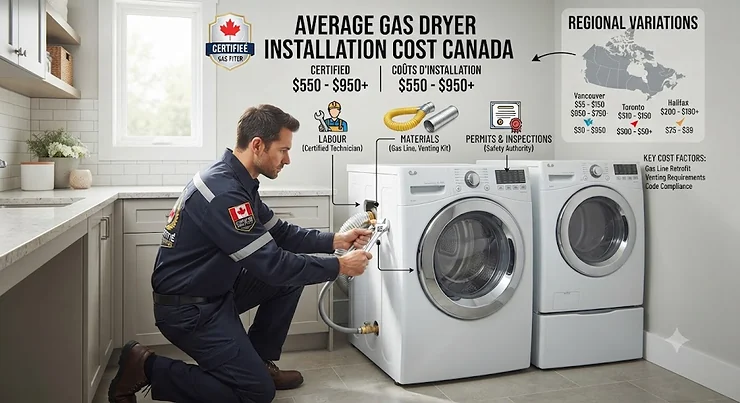
Quick Comparison: Gas Dryer Installation Cost in Canada at a Glance
| Scenario | Typical Cost Range (CAD) | What’s Included |
|---|---|---|
| Existing gas line + vent already in place | C$150–C$650 | Appliance hookup, leak test, basic connector |
| New gas line run (short distance from meter) | C$400–C$1,200 | Piping, fittings, shut-off valve, permit, pressure test |
| Longer run or wall/floor penetration required | C$800–C$2,000+ | Extended piping, drywall access, inspection scheduling |
| Full electric-to-gas conversion (line + vent + hookup) | C$900–C$2,500 | New gas line, exterior venting, appliance connection |
A pattern jumps out fast: the appliance itself is rarely the expensive part — it’s the plumbing behind the wall. If your home already has a functioning gas line and exhaust vent from a previous dryer, you’re mostly paying for labour, a connector kit, and a safety check, which keeps things toward the lower end of that range. But if you’re converting from electric, or your laundry room has never seen a gas appliance, you’re paying for new pipe, a permit, and — depending on your province — a Technical Standards and Safety Authority (TSSA) inspection or provincial equivalent, which pushes costs toward the top of the range and sometimes past it.
💬 Just one click — help others make better buying decisions too!😊
Top 7 Gas Dryers for Canadian Homes: Expert Analysis
Picking a dryer before you understand the installation math is putting the cart before the horse. So here are seven real, currently available gas dryers — organized from budget to premium — with honest analysis of who each one actually suits, based on published specs and aggregated review sentiment.
1. Whirlpool WGD5010LW — best budget entry point
The Whirlpool WGD5010LW keeps things refreshingly simple, and that simplicity is exactly its appeal. With a 7.0 cu. ft. drum and dual moisture sensors, it measures both humidity and temperature inside the drum rather than relying on a single sensor guessing at dryness — the practical result is fewer over-dried towels and less wasted gas per cycle. The Wrinkle Shield option keeps clothes tumbling for up to two and a half hours after the cycle ends, which matters more than it sounds like if you’re the type who forgets laundry in the dryer (no judgment). Based on the spec sheet, this is a dryer built for households who want reliable drying without paying for features they won’t touch. Reviewers consistently note strong performance-for-price and straightforward Dial-A-Cycle controls that don’t require a manual to operate, though some mention the exterior finish feels basic compared to pricier siblings. It’s also LP-convertible, meaning propane households aren’t locked out. At a price generally landing in the mid-C$800s to just over C$1,000, it delivers real value for first-time gas dryer buyers or anyone furnishing a rental property.
Pros:
- ✅ Dual moisture sensors reliably curb overdrying
- ✅ Simple Dial-A-Cycle controls, zero learning curve
- ✅ LP-convertible for propane-fuelled homes
Cons:
- ❌ No Wi-Fi or app connectivity at this price
- ❌ 7.0 cu. ft. capacity feels tight for larger families
Price sits around C$850–C$1,050 depending on retailer promotions — check current price on Amazon.ca, as this segment moves quickly. For the money, it’s tough to beat as a no-drama daily driver.
2. GE GTD65GBSJWS — best value for mixed laundry loads
What most buyers overlook about the GE GTD65GBSJWS is its venting flexibility — GE rates this model for up to 120 feet of duct run, which is a genuine advantage if your laundry room sits far from an exterior wall (a common layout problem in older Canadian homes with basement laundry). The 7.4 cu. ft. capacity and HE Sensor Dry system, which uses dual thermistors to track both moisture and airflow temperature, mean the drum can handle mixed loads — towels next to delicates — without the delicates getting scorched. Twelve dry cycles cover more ground than most budget-tier competitors, including dedicated settings for sanitize, bulky items, and speed dry. Aggregated review sentiment on this model skews positive for reliability and quiet operation, with the recurring critique being a fairly plain control panel and no smart features. Here’s what to weigh: this is the dryer for someone who wants genuine cycle variety and long venting range without stepping into smart-appliance pricing. Typical listings land between roughly C$750 and C$1,050 CAD.
Pros:
- ✅ HE Sensor Dry uses dual thermistors for even results
- ✅ Vents up to 120 ft, ideal for basement laundry rooms
- ✅ Twelve cycles cover most fabric and load types
Cons:
- ❌ No Wi-Fi or remote monitoring features
- ❌ Control layout feels dated next to newer rivals
3. Maytag MGD6230HW — best for chronically damp loads
If your household regularly runs into “still slightly damp” laundry — bulky hoodies, jeans, anything with a waistband — the Maytag MGD6230HW solves that specific annoyance with its Extra Power button, which extends time, heat, and tumbling with a single press rather than forcing you to guess at a longer cycle. Advanced Moisture Sensing uses multiple sensors (not just one) to track drying progress across the whole load, which on paper means more even results on mixed fabric loads than single-sensor competitors. The 7.4 cu. ft. drum, combined with an optional connected subscription for remote start and cycle alerts, positions this as a step above entry-level without going full premium. Reviewers consistently praise drying speed and quiet operation; a recurring complaint is that full smart functionality requires signing up for Maytag’s connected service rather than being free out of the box. What the spec sheet won’t tell you, but reviewers note, is that the Wrinkle Control cycle genuinely reduces ironing time on cotton-blend workwear. Expect a price generally in the C$1,000–C$1,300 range.
Pros:
- ✅ Extra Power button rescues stubbornly damp loads
- ✅ Multi-sensor Advanced Moisture Sensing improves consistency
- ✅ Wrinkle Control cycle cuts down on ironing
Cons:
- ❌ Full smart features require a paid subscription
- ❌ Priced noticeably above basic gas dryers
4. LG DLG7301WE — best for smart-home households
The LG DLG7301WE is built around one genuinely clever hardware decision: the EasyLoad door opens two different ways, which sounds minor until you’re wrestling a king duvet into a front-load opening at an awkward angle. Beyond that, the 7.3 cu. ft. drum pairs with LG’s Sensor Dry technology and ThinQ app connectivity, letting you start, stop, and monitor cycles remotely — genuinely useful for anyone running laundry between work meetings. The FlowSense Duct Clogging Indicator deserves more attention than it gets: it alerts you when exhaust airflow drops, which is one of the more overlooked fire-safety features on this list, since clogged dryer vents are a documented cause of house fires. Based on the spec comparison against rivals in this price bracket, the LG DLG7301WE punches above its weight on smart features specifically. Reviewers note the ThinQ app works reliably with both Google Assistant and Amazon Alexa, though a stable home Wi-Fi signal is required for full functionality — a legitimate frustration for rural Canadian households on weaker connections. Pricing typically runs C$1,050–C$1,400.
Pros:
- ✅ EasyLoad dual-opening door genuinely eases loading
- ✅ ThinQ app enables remote start and monitoring
- ✅ FlowSense flags duct clogging before it’s a fire risk
Cons:
- ❌ Smart features depend on a stable Wi-Fi connection
- ❌ Priced above comparable non-connected models
5. Samsung DVG45B6300W — best for allergy-conscious households
Where the Samsung DVG45B6300W separates itself is the Steam Sanitize+ cycle, which Samsung states eliminates 99.9% of germs and bacteria and a substantial share of pollen and dust mites — a genuinely useful feature for households with pet allergies, new babies, or anyone who’s had a rough allergy season. The Multi-Steam technology doing double duty on wrinkle removal means fewer trips to the iron, and the reversible door direction is a practical touch for laundry rooms where door swing genuinely matters. At 7.5 cu. ft., the drum comfortably handles a king comforter, and Sensor Dry technology automatically optimizes time and temperature to avoid over-drying and heat damage to fabric. Reviewers consistently report the steam functions work as advertised, with the honest trade-off being slightly longer cycle times when steam options are engaged — worth knowing if speed is your top priority. The SmartThings app rounds things out with remote alerts and scheduling. Expect pricing in the C$1,150–C$1,500 range, positioning this firmly as a premium pick rather than a budget one.
Pros:
- ✅ Steam Sanitize+ meaningfully reduces allergens and germs
- ✅ Reversible door adapts to awkward laundry layouts
- ✅ Sensor Dry protects fabric from heat damage
Cons:
- ❌ Premium price relative to capacity versus rivals
- ❌ Steam cycles add extra time per load
6. Electrolux ELFG7637AW — best for large families and bulky loads
At 8.0 cu. ft., the Electrolux ELFG7637AW has the largest capacity on this list — Electrolux specifically markets it as fitting a king-size comforter in one load, and for a family running multiple loads of towels, bedding, and sports gear weekly, that extra headroom translates into real time saved. Predictive Dry is the standout feature here: about 90 seconds into a cycle, the dryer calculates and displays a more accurate remaining-time estimate, which sounds small but genuinely changes how you plan your day around laundry. The LuxCare Dry system uses humidity sensors to avoid both over- and under-drying, and the LuxCare Lint Shield traps lint so it doesn’t scatter when you empty the trap mid-cycle. On paper, this means less mess and less guesswork than dryers relying on a single timer-based cycle. Reviewers highlight the Instant Refresh cycle — a 10-minute wrinkle-and-odour pass that skips a full wash — as an unexpectedly useful feature for revamping worn-once outfits. The trade-off is a larger physical footprint that may not suit a tight laundry closet. Pricing generally runs C$1,300–C$1,650.
Pros:
- ✅ 8.0 cu. ft. drum handles king comforters in one load
- ✅ Predictive Dry gives an accurate time estimate early
- ✅ LuxCare Lint Shield keeps lint contained on unload
Cons:
- ❌ Larger footprint may not fit compact laundry closets
- ❌ Among the pricier options in this roundup
7. Speed Queen DR3000WG — best long-term investment
The Speed Queen DR3000WG takes a completely different philosophy from everything else on this list: fewer cycles, fewer electronics, and dramatically more mechanical durability. Speed Queen builds these with commercial-grade components — a heavy-duty fan system, a galvanized cylinder resistant to rust and corrosion, and Extreme Tested electronic controls — because the same basic platform is used in coin laundromats that run dryers dozens of times a day for years on end. Here’s what most buyers overlook about the value proposition: a dryer with fewer things to break electronically tends to need fewer service calls over a 15-to-20-year lifespan, which is a genuinely different cost calculation than comparing sticker prices alone. The Eco Cycle uses an advanced heating algorithm to conserve energy, and Moisture Sensing stops the load precisely at your selected dryness level rather than running a fixed timer. Reviewers and appliance technicians alike consistently point to Speed Queen’s reputation for parts availability and repairability as a genuine long-term advantage over disposable-feeling competitors. The honest catch: you’re paying a premium upfront, and you won’t get app connectivity or steam cycles. Pricing typically lands between C$1,400 and C$1,800, positioning it as the priciest entry here — but arguably the one with the lowest cost-per-year of ownership if it lives up to its reputation.
Pros:
- ✅ Commercial-grade components built for decades of service
- ✅ Galvanized cylinder resists long-term rust and corrosion
- ✅ Fewer electronics mean fewer potential failure points
Cons:
- ❌ No smart features or steam cycles at this price
- ❌ Highest upfront cost of the seven models here
Top 7 Gas Dryers: Side-by-Side Specs
| Model | Capacity | Standout Feature | Price Range (CAD) | Best For |
|---|---|---|---|---|
| Whirlpool WGD5010LW | 7.0 cu. ft. | Dual moisture sensors | C$850–C$1,050 | Budget-conscious first-timers |
| GE GTD65GBSJWS | 7.4 cu. ft. | 120 ft venting range | C$750–C$1,050 | Basement laundry rooms |
| Maytag MGD6230HW | 7.4 cu. ft. | Extra Power button | C$1,000–C$1,300 | Bulky, chronically damp loads |
| LG DLG7301WE | 7.3 cu. ft. | ThinQ smart app | C$1,050–C$1,400 | Smart-home households |
| Samsung DVG45B6300W | 7.5 cu. ft. | Steam Sanitize+ | C$1,150–C$1,500 | Allergy-conscious families |
| Electrolux ELFG7637AW | 8.0 cu. ft. | Predictive Dry | C$1,300–C$1,650 | Large families, bulky bedding |
| Speed Queen DR3000WG | 7.0 cu. ft. | Commercial-grade build | C$1,400–C$1,800 | Long-term durability seekers |
Looking at the table above, there’s a clear split between feature-forward models like the LG DLG7301WE and Samsung DVG45B6300W, which prioritize connectivity and fabric care, versus durability-forward machines like the Speed Queen DR3000WG, which prioritizes surviving a decade of heavy use with minimal repairs. Households juggling big loads — bedding, sports uniforms, towels for a full house — should weight capacity heavily, which puts the Electrolux ELFG7637AW and Samsung DVG45B6300W ahead of the pack. Budget-focused buyers converting from electric for the first time should note that the Whirlpool WGD5010LW and GE GTD65GBSJWS deliver dependable drying without inflating an already-significant installation bill.
Practical Usage Guide: Getting the Most Out of Your New Gas Dryer
Getting the dryer installed is only step one — the first 30 days set the tone for how well it performs over its whole lifespan. Right after installation, run one empty cycle on a normal setting before your first real load. This burns off manufacturing residue and any lingering odour from packaging materials, and it lets you (or your technician) confirm there’s no gas smell, unusual noise, or error code before you trust it with your favourite sweater.
Clean the lint trap after every single load, not “when it looks full.” A clogged lint trap forces the dryer to work harder, which burns more gas and shortens the life of the heating element. Once a year — mark it on a calendar, because nobody remembers otherwise — disconnect the exhaust duct and vacuum it out from both ends. Lint buildup inside the vent, not just the trap, is a leading cause of dryer fires and a common reason gas dryers lose drying efficiency over time. If your home has a long duct run (anything over 15–20 feet), consider a professional duct cleaning every couple of years, since gravity and airflow patterns mean lint accumulates unevenly along the length of the pipe.
A common first-month mistake: overloading the drum because “it looked like it had room.” Gas dryers dry more efficiently with airflow around the load — packing it tight actually increases drying time and gas usage, the opposite of what people expect. Finally, keep at least a few inches of clearance behind the dryer for the gas connector and exhaust duct; pushing it flush against the wall can kink flexible venting and choke airflow.
✨ Ready to browse current gas dryer listings and lock in today’s pricing? Take a look before availability shifts!
Real-World Scenarios: Who Should Actually Convert from Electric to Gas
Not every household benefits equally from converting electric to gas dryer setups, so here are three realistic profiles to help you see where you fit.
The growing family in an older suburban home. Say you’ve got three kids, a dog, and a laundry room in the unfinished basement that’s never had a gas line. You’re doing six-plus loads a week and your electricity bill already spikes every winter. For this household, the upfront installation cost (likely C$900–C$2,000 for a full conversion) pays itself back faster than a smaller household would see, because gas dryers typically cost less per cycle to run than electric ones over high-volume use. A large-capacity option like the Electrolux ELFG7637AW fits the bulky-bedding, big-load reality of family life.
The condo or townhouse owner replacing a dying dryer. If your unit already has a gas hookup from a previous owner’s dryer, you’re in the cheapest scenario — often C$150–C$650 for a straightforward swap. This is the ideal case for a value-focused pick like the GE GTD65GBSJWS or Whirlpool WGD5010LW, since you’re not paying for new plumbing, just a solid, reliable machine.
The renovator doing a full laundry room overhaul. If you’re already opening walls for a kitchen or basement renovation, this is genuinely the cheapest time to run a gas line, since labour and drywall access costs are already baked into the project. This is also the moment to consider a long-term investment like the Speed Queen DR3000WG — you won’t want to reopen that wall again in five years.
Problem → Solution: Common Gas Dryer Installation Headaches
Problem: No existing gas line in the laundry room. Solution: a licensed gas technician runs new piping from the meter or nearest branch line, which typically adds C$400–C$1,200 depending on distance and whether walls or floors need to be opened.
Problem: Vent duct is too long or has too many bends. Solution: models like the GE GTD65GBSJWS, rated for runs up to 120 feet, handle longer ducting better than average, but excessive bends still choke airflow regardless of brand — a technician may recommend rigid metal duct instead of flexible vinyl to improve flow.
Problem: Uncertainty about whether your existing connector is safe to reuse. Solution: never reuse an old flexible gas connector on a new appliance. Codes in most provinces require a new connector rated for the appliance, and a qualified technician will replace it as part of a proper installation rather than reconnect the old one.
Problem: Budget shock when quotes come back higher than expected. Solution: get two to three quotes from licensed technicians before committing, and ask specifically whether the quote includes the permit, pressure test, and final inspection — some lowball quotes quietly exclude these and add them later.
Problem: Uncertainty about propane versus natural gas compatibility. Solution: most gas dryers, including several on this list, ship natural-gas-ready with an LP conversion kit available separately — confirm with the retailer before purchase if your home runs on propane.
What Is Gas Dryer Installation Cost?
Gas dryer installation cost is the total price of professionally connecting a gas clothes dryer to a home’s gas supply and exhaust venting, including labour, materials, permits, and safety testing. In Canada, this typically ranges from C$150 for a simple hookup to an existing line, up to C$2,500 for a full new gas line and vent installation…
How to Choose Between Professional Installation and DIY
- Check your provincial licensing requirements first. In Ontario, for example, only technicians certified by the TSSA are legally permitted to connect gas appliances — DIY gas work isn’t just risky, it’s often illegal.
- Confirm your home insurance won’t be voided. Many Canadian home insurance policies exclude damage from unlicensed gas work, meaning a DIY leak or fire could leave you paying out of pocket regardless of fault.
- Weigh the real time savings. A licensed technician typically completes a straightforward hookup in one to two hours; a DIY attempt, especially a first one, often takes far longer once you factor in sourcing the right fittings and troubleshooting leaks.
- Factor in the pressure test. Professional installers use manometers and electronic leak sniffers to verify a gas-tight connection — equipment most homeowners don’t own and shouldn’t need to buy for a one-time job.
- Consider resale and inspection implications. An uncertified gas connection can complicate a future home sale, since buyers’ inspectors increasingly flag gas work without documentation.
- Get the final sign-off in writing. A reputable technician provides documentation confirming the installation passed inspection — keep this with your appliance records.
- Compare quotes, not just prices. The cheapest quote isn’t always the best value if it skips the pressure test or permit — ask what’s included before comparing numbers.
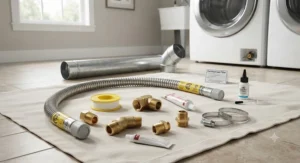
Converting Electric to Gas Dryer: What It Actually Involves
Converting electric to gas dryer setups is a bigger project than most people expect walking in. It’s not simply “swap the appliance” — it’s closing out an electrical circuit that may no longer be needed, running an entirely new gas supply line, and adding exterior venting if your home has never had a vented gas appliance in that location. Budget-wise, this is consistently the most expensive installation scenario, generally C$900–C$2,500, because it combines new piping, a permit application, and often some drywall or flooring work to route the line.
The upside that makes this worth it for many households: gas dryers typically cost less to operate per cycle than electric models over the appliance’s lifetime, since natural gas is often priced lower than electricity per unit of heat generated in many Canadian markets — though this varies by province and utility rates, so it’s worth checking your own energy bills before assuming the math works in your favour. It’s also worth asking your gas utility whether they offer any conversion incentives, since some regional programs periodically offer rebates to encourage the switch. Before committing, confirm your laundry room has (or can accommodate) a standard 120-volt outlet, since gas dryers still need electricity to run the drum motor, timer, and igniter — only the heating function itself runs on gas.
Gas Line Dryer Hookup: Connection Requirements Explained
A proper gas line dryer hookup follows a specific sequence, and understanding it helps you sanity-check a quote or a technician’s work. First, the technician identifies the nearest suitable branch off the main gas line and runs new pipe — typically black steel, copper, or flexible corrugated stainless steel tubing (CSST) — to the appliance location. A dedicated shut-off valve gets installed within reach of the dryer, letting you cut gas supply instantly during maintenance or emergencies without shutting off gas to the whole house. The line then gets pressure-tested with air or an inert gas before anything is connected, confirming there are no leaks in the new piping before it’s ever exposed to live gas.
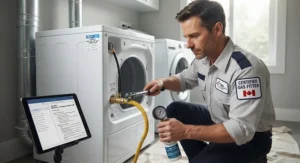
Once the pressure test passes, the technician connects a flexible appliance connector — rated specifically for dryers, not a generic connector — between the shut-off valve and the dryer’s gas inlet. A final leak test, usually with an electronic gas sniffer or a soap-and-water solution on every joint, confirms the connection itself is sealed. Only after this is the dryer run through a test cycle to confirm proper ignition and burner function. Skipping any one of these steps is exactly how gas leaks happen, which is why this entire hookup is genuinely not a reasonable weekend DIY project.
Gas Connection Requirements & CSA Certification in Canada
Every gas appliance installed in Canada must meet the CSA B149.1 Natural Gas and Propane Installation Code, the national safety standard that governs pipe sizing, materials, testing procedures, and appliance clearances. This code isn’t optional guidance — it’s the legal baseline that provincial regulators like Ontario’s TSSA enforce, and licensed gas technicians are trained and examined specifically against it. According to industry guidance from HVAC professionals, gas work in provinces like Ontario requires a licensed gas technician holding the appropriate certification level, with different tiers covering everything from basic appliance service to full system installation.
Safety certification matters beyond the initial hookup. A properly documented installation typically includes a signed confirmation that the work passed inspection, which protects you in three concrete ways: it satisfies most home insurance requirements for gas appliance coverage, it provides a paper trail if you sell your home, and — most importantly — it confirms an independent, licensed professional verified there’s no carbon monoxide risk before you and your family start using the appliance daily. If a technician can’t produce licensing credentials on request, that’s a legitimate reason to ask for another quote elsewhere.
Common Mistakes When Budgeting for Gas Dryer Installation
The most frequent mistake is budgeting only for the appliance and forgetting installation entirely — homeowners walk into an appliance store, see a price tag, and don’t realize a C$1,200 dryer can come with an additional C$400–C$2,000 installation bill depending on their home’s setup. A second common error is assuming “gas line already exists” without confirming it’s actually functional and up to current code; older homes sometimes have disconnected or outdated gas lines that still require significant work to bring into service. Third, some homeowners skip getting multiple quotes, which according to NRCan’s ongoing work harmonizing dryer efficiency standards, matters increasingly as newer, more efficient gas dryer models enter the Canadian market at a range of price points worth comparing. Finally, people frequently underestimate venting costs — assuming the exhaust vent is a minor add-on when, in older homes without existing ductwork, it can rival the gas line installation in cost and complexity.
Long-Term Cost & Maintenance: Gas vs. Electric Dryer Ownership
| Factor | Gas Dryer | Electric Dryer |
|---|---|---|
| Upfront installation cost | Higher (C$150–C$2,500) | Lower (often C$0–C$300 if outlet exists) |
| Typical cost per cycle | Generally lower in most markets | Generally higher in most markets |
| Drying speed | Often slightly faster | Slightly slower on average |
| Required maintenance | Annual vent + gas connector check | Annual vent check only |
| Lifespan (well-maintained) | 13–15 years typical | 10–13 years typical |
The table makes the trade-off clear: gas dryers demand a bigger upfront investment but tend to cost less to run over time, which is why the payback period matters more than the sticker price for anyone doing serious cost analysis. A household running four to six loads weekly could see the installation cost offset within three to six years through lower per-cycle energy costs, though your actual savings depend heavily on local gas and electricity rates. On maintenance, gas dryers add one extra annual task — a quick visual and smell check of the gas connector for wear — but this takes minutes and is worth the trade-off given the operating savings.

Frequently Asked Questions
❓ How much does it cost to install a gas dryer in Canada?
❓ Can I install a gas dryer myself to save money?
❓ How long does gas dryer installation take?
❓ Do I need a permit to install a gas dryer in Canada?
❓ Is converting from electric to gas dryer worth the installation cost?
Conclusion
Gas dryer installation cost in Canada isn’t a single number — it’s a range shaped almost entirely by what’s already behind your laundry room wall. A straightforward hookup to an existing line might run you C$200, while converting a home from electric to gas from scratch can reasonably hit C$2,000 or more once piping, venting, permits, and inspection are all accounted for. Knowing that range before you shop changes how you budget, and it should change which dryer you buy, too.
Among the seven models covered here, there’s genuinely something for every situation: the Whirlpool WGD5010LW and GE GTD65GBSJWS for anyone keeping total costs tight, the Maytag MGD6230HW and LG DLG7301WE for households wanting smarter, more capable machines, the Samsung DVG45B6300W and Electrolux ELFG7637AW for families needing capacity and fabric care, and the Speed Queen DR3000WG for anyone thinking in decades rather than years. Whichever you choose, the one step that isn’t optional is hiring a licensed gas technician — it’s the difference between a dryer that quietly does its job for fifteen years and a preventable safety incident.
Recommended for You
- Best Gas Dryer 2026: 7 Top Picks That Actually Deliver
- Most Energy Efficient Electric Dryer: 7 Top Picks for 2026
- Best Electric Dryer Under 1000 in Canada
Disclaimer: This article contains affiliate links. As an Amazon Associate, I earn from qualifying purchases. If you purchase products through these links, we may earn a small commission at no additional cost to you.
✨ Found this helpful? Share it with your friends! 💬🤗
