
In This Article
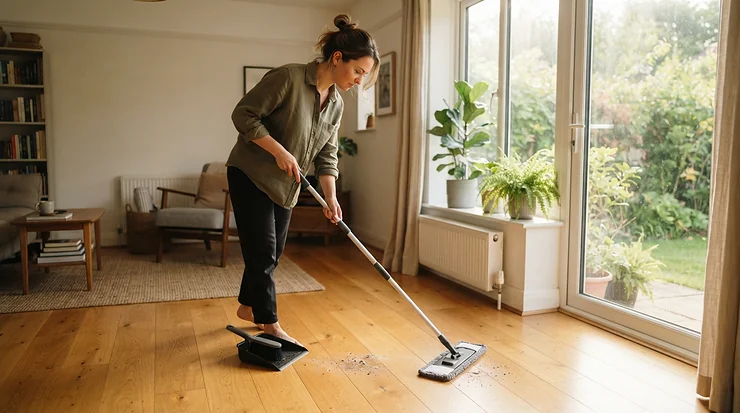
Hardwood is a diva. It looks stunning in a Toronto semi or a Calgary bungalow, and it shows every bit of lint, pet hair and tracked-in grit the moment the afternoon sun hits it. The broom most of us grew up with just flicks fine dust into the air. A damp string mop is worse: it’s a moisture gamble that finished boards don’t love.
That’s why a microfibre dust mop for hardwood floors has become the quiet workhorse of Canadian homes. Used dry, it’s the single gentlest, fastest way to lift what’s loose before it turns into sandpaper underfoot.
What is a microfibre dust mop for hardwood floors? It’s a flat or fringed mop head covered in ultra-fine synthetic fibres, usually polyester and polyamide blends. The fibres carry a slight static charge and a huge surface area, so they grip dust, hair and allergen-bearing particles instead of pushing them around. You use it dry, glide it across sealed hardwood, and then wash the pad and reuse it.
Here’s the practical bit that matters. Research on Canadian homes has linked low floor-cleaning frequency, carpeting, pets and indoor humidity above 45% with higher loads of dust-borne allergens and other biocontaminants. You can read the details in this Health Canada–collaborative study of household dust in four Canadian cities. Regular dry mopping isn’t glamorous, but it’s one of the cheapest levers you have.
This guide goes through seven real models, how to choose between them, the technique that actually works, and how to keep washable dust mop pads performing for years. Everything here comes from spec sheets and aggregated retailer-review summaries, not staged “I tested it” stories. Let’s get to it. 🧹
Quick Comparison: 7 Microfibre Dust Mops at a Glance
| Model | Head Style | Pad Setup | Best For |
|---|---|---|---|
| Bona Microfiber Dust Mop | Flat, floor-care brand system | Washable microfibre pad (rated for around 500 washes by the retailer) | Hardwood purists who want a floor-finish-friendly brand |
| O-Cedar Hardwood Floor ‘N More Microfiber Dust Mop | Flat, washable pad | Reusable microfibre, replacement heads sold separately | Everyday dry mopping on a budget |
| Libman Multi-Surface Microfibre Dust Mop | Wide head with microfibre “fingers” | Washable refill, about 47.6 cm (18.75″) wide | Pet hair, thanks to the included cleaning comb |
| CLEANHOME 24″ Commercial Dust Mop | 24″ (about 61 cm) flat head, metal handle | Microfibre pads | Open-concept rooms and long hallways |
| MASTERTOP Double-Sided Flat Mop | About 17″ (43 cm) clip-on flat head | 4 reusable pads | Households that rotate pads and want spares |
| Eyliden FC-06 Dust Mop | Snap-on flat head | 2 washable pads | Small budgets and tight spaces |
| Microfiber Wholesale 18″ Professional Mop | 18″ (46 cm) head, stainless handle | Multiple pads plus cloths | Dry-then-damp routines in one kit |
Here’s what the table says. If your priority is covering ground, the CLEANHOME 24″ Commercial Dust Mop gives you roughly a third more width per pass than the 18-inch heads. If hair is the enemy, the Libman Multi-Surface Microfibre Dust Mop brings a comb for pad cleanup that most flat mops don’t. Budget buyers should note that the Eyliden FC-06 Dust Mop and O-Cedar Hardwood Floor ‘N More Microfiber Dust Mop sit at the gentler end of pricing, but pad count and replacement-head availability matter more than the sticker.
💬 Just one click — help others make better buying decisions too!😊
Top 7 Microfibre Dust Mop for Hardwood Floors: Expert Analysis
1. Bona Microfiber Dust Mop — built around a floor-care brand’s finish know-how
The Bona name carries weight in hardwood care, and its dust mop leans on that reputation. The headline spec is the reusable pad, which retailer listings rate for hundreds of washes. In practice, that means the pad should outlast several years of weekly use if you wash it properly.
The head is a lightweight flat design. That matters on hardwood because a light head rides on the floor rather than pressing grit into the finish. Some listings also describe a pad option that lets you alternate between microfibre and disposable pads. That’s handy if you’re dealing with something nasty (a muddy-boot week in March) and don’t want to wash it.
Who is it for? Anyone with a high-value finished floor who’d rather buy from a brand focused on hardwood. The review picture is positive: summaries on a major retailer’s page say buyers praise its pickup of dust, pet hair and allergens, though at least one reviewer felt it just pushed dust around. That split is a reminder that technique matters as much as the tool.
Pros:
- ✅ Pad rated for very long service life
- ✅ Lightweight head glides across sealed boards
- ✅ Disposable-pad option for nasty messes
Cons:
- ❌ Brand premium over generic flat mops
- ❌ Some reviewers report dust being pushed, not lifted
Pricing sits roughly in the C$30–C$50 range at the time of research. Value verdict: a smart pick if you want a hardwood-focused brand, and the long pad life helps justify the premium.
2. O-Cedar Hardwood Floor ‘N More Microfiber Dust Mop — the no-drama everyday option
O-Cedar has made household mops for ages, and this model is its straightforward answer to dry dusting hardwood, laminate and tile. The attraction is simplicity: a washable microfibre pad, a flat head you can slide under furniture, and replacement heads you can buy rather than replacing the whole mop.
That last point is more important than it sounds. A mop that lets you refresh only the pad costs less over five years than one that’s a disposable unit. Reviewer summaries on a big-box retailer’s page describe buyers appreciating that the washable pads trap debris well and cut down on disposable refills. A handful of the replacement-head reviews mention a little residual dust when used strictly dry, which is typical of any flat pad and usually fixed by a slower, overlapping pass.
Who should buy it? People who want something dependable, easy to find, and easy to restock. It’s less specialized than a brand built for hardwood, but it makes up for that by being familiar and widely available. Confirm current availability on Amazon.ca before ordering.
Pros:
- ✅ Washable pad cuts disposable refills
- ✅ Replacement heads sold separately
- ✅ Flat head slides under furniture
Cons:
- ❌ Dry-only use can leave a little residual dust
- ❌ Fewer included pads than multi-pad kits
Expect roughly C$25–C$40. Value verdict: strong everyday value, especially if you stock a spare head.
3. Libman Multi-Surface Microfibre Dust Mop — the comb that rescues the pet-hair household
Libman is a name many Canadians know from the cleaning aisle, and this is one of its better dust-mop designs. The head uses microfibre “fingers” rather than a flat pad. Think of a tidy mop head that’s mostly little fibre tendrils. Those fingers excel at snagging hair and long threads, which flat pads can skate over.
The standout extra is the comb. Hair-laden pads are a pain; run the comb through the fingers and the clump comes away in seconds. The refill head is about 47.6 cm (18.75 inches) wide and weighs just 0.11 kg, so it’s both generous in coverage and light in the hand. The refill is machine washable, according to the retailer’s spec listing.
Canadian shopper comments on a national retailer’s page describe it sweeping dust without launching it airborne the way a broom does, and one called it better than a vacuum at picking up dust. Treat that as enthusiastic opinion rather than measurement. The manufacturer says it’s best used dry; for wet work, you’d look at Libman’s separate wet-dry models.
Pros:
- ✅ Included comb strips hair from the head
- ✅ Wide head covers floor quickly
- ✅ Washable refill is easy to swap
Cons:
- ❌ Dry use only
- ❌ Fingers can drag on very rough or unsealed wood
Pricing was in the mid-C$30s at the retailer I checked, and may differ on Amazon.ca. Value verdict: great for pets, and the comb justifies a place in your cleaning closet.
4. CLEANHOME 24″ Commercial Dust Mop — the wide-load option for big floors
When someone says “my open-concept main floor takes forever,” this is the type of mop I’d point them to. The 24-inch (about 61 cm) head is wide enough to roughly halve your passes compared with a 13-inch household flat mop. Roundups of dust mops for hardwood repeatedly single this model out for balancing coverage with control.
The pad is microfibre rather than cotton loop. That’s a meaningful distinction, because cotton loops can shed lint and, if gritty, behave more abrasively than fine synthetic fibres on a smooth clear coat. Listings mention a metal handle and a swivel head. A rigid handle with a swivel is the right combination for keeping the head flat so the edge doesn’t dig in.
The trade-off is size. A big head struggles with chair legs, stair edges and the underside of low furniture. I’d treat this as a main-floor and hallway tool, paired with something smaller for tight corners.
Pros:
- ✅ Wide 61 cm head means fewer passes
- ✅ Microfibre pad is kinder than cotton loops
- ✅ Sturdy metal handle stays rigid
Cons:
- ❌ Awkward around furniture and stairs
- ❌ More to store than a compact flat mop
Expect roughly C$35–C$55. Value verdict: best value for large or open floor plans; skip it if your home is all small rooms.
5. MASTERTOP Double-Sided Flat Mop — four pads, so you’re never caught out
The headline here is the pad count. This flat mop comes with four reusable double-sided pads, and the clip-on design makes swapping them quick. Why does that matter? Because dry mopping is a rotation game. One pad on the floor, one in the wash, a third drying and a fourth spare means you never end up pushing a clogged pad around out of laziness.
The head is about 17 inches (43 cm), a good middle size that tackles both open floors and room edges. Reviewers of comparable round-ups note the MASTERTOP delivers solid daily dusting on sealed hardwood and the best long-term value on pad replacements. That’s the useful lens: you’re buying a system, not just a stick.
I’d recommend it for busy households, rentals where you share one tool, or anyone who likes to batch laundry. One thing to watch: clip-on designs can be fussy if the pad isn’t seated evenly, so check that it lies flat before every session.
Pros:
- ✅ Four reusable pads in the box
- ✅ Clip-on swaps are quick
- ✅ Mid-size head balances coverage and reach
Cons:
- ❌ Pads must lie flat or performance drops
- ❌ More laundry to manage
Pricing sits roughly in the C$30–C$45 range. Value verdict: excellent when you value spare pads and routine over novelty.

6. Eyliden FC-06 Dust Mop — the compact, budget-minded snap-on
If you rent a condo, live in a small flat or simply don’t want to spend much, the Eyliden FC-06 is the sort of tool that earns its keep. It comes with two washable pads, and a snap-on mounting system lets you press and lift them on and off without bending over.
Its sales pitch is dual use, wet or dry. For hardwood, I’d lean on the dry mode and treat damp use cautiously. Retailer listings show a strong average rating across several hundred reviews, though those scores come from a different store than Amazon.ca and shouldn’t be treated as a guarantee. Reviewer themes include picking up pet hair and dust, along with a sturdy feel. A claim like “strong and sturdy” is reassuring but impossible to verify from spec sheets alone, so I’d weigh it modestly.
Who is it for? First-time buyers, dorm and apartment dwellers, and anyone who wants a decent second mop for the basement stairs.
Pros:
- ✅ Two washable pads included
- ✅ Snap-on pads swap without bending
- ✅ Light and easy to store
Cons:
- ❌ Fewer pads than four-pad kits
- ❌ Lesser-known brand with thinner track record
Expect roughly C$25–C$40. Value verdict: good entry-level value, with the caveat that long-term durability is harder to confirm.
7. Microfiber Wholesale 18″ Professional Mop — the pad-fringe design built for dry pickup
This one comes from a company that sells microfibre cleaning products to professionals, and the design shows it. The dust pad uses a fringe yarn on the outside to grab bigger debris like crumbs and pet hair, while the interior microfibre grabs the finer dust. It’s a two-stage approach, and on paper it makes sense for floors that see both hair and fine powdery dust.
The adjustable stainless-steel handle and 18-inch (46 cm) head put it in the same size class as most household flat mops. Because the kit also includes wet pads and cloths, it’s a good fit if you want one handle for both a dry sweep and an occasional barely-damp pass. For hardwood, the order matters: always dust first, then go damp only if your finish manufacturer approves it.
The company says the pad is machine washable and designed for dry use. As always, treat manufacturer claims as a starting point, and wash according to the care label.
Pros:
- ✅ Fringe plus inner fibre handles hair and dust
- ✅ Adjustable stainless handle suits different heights
- ✅ Kit includes extra pads and cloths
Cons:
- ❌ Wet pads tempt overuse on hardwood
- ❌ Check Canadian shipping and stock first
Pricing sits roughly in the C$35–C$50 range. Value verdict: a flexible kit for people who like having options.
How the Seven Compare Side by Side
| Model | Approx. Width | Best Use | Standout |
|---|---|---|---|
| Bona Microfiber Dust Mop | Standard flat | Finished hardwood | Long-rated pad life |
| O-Cedar Hardwood Floor ‘N More Microfiber Dust Mop | Standard flat | Everyday dry mopping | Replacement heads |
| Libman Multi-Surface Microfibre Dust Mop | About 47.6 cm | Pet hair | Included comb |
| CLEANHOME 24″ Commercial Dust Mop | About 61 cm | Large floors | Coverage |
| MASTERTOP Double-Sided Flat Mop | About 43 cm | Routine rotation | Four pads |
| Eyliden FC-06 Dust Mop | Compact | Small spaces | Snap-on pads |
| Microfiber Wholesale 18″ Professional Mop | About 46 cm | Dry-then-damp | Fringe design |
Reading this, the CLEANHOME 24″ Commercial Dust Mop wins on speed, while the Libman Multi-Surface Microfibre Dust Mop wins on pet-hair handling. If you want long-term pad economics, the Bona Microfiber Dust Mop and MASTERTOP Double-Sided Flat Mop are strongest, one for pad lifespan and the other for pad quantity. The Eyliden FC-06 Dust Mop is the gentlest on the wallet but leaves you with the least information about long-term wear.
Dry Mopping Technique: The Method That Actually Picks Up Dust
Here’s the unglamorous truth: the best mop in the world still fails with sloppy technique. A good dry mopping technique is about keeping contact, avoiding flicks and finishing with the right pad hygiene. Here’s a routine you can adopt this week.
Before you start. Shake the pad outdoors or over a bin to dislodge loose debris, and check for grit stuck in the fibres. A single embedded pebble can scratch a clear coat.
The pass itself. Push the mop forward with the head flat, and never lift it off the floor mid-stroke. Use long, overlapping strokes that follow the grain of the boards, working from the farthest corner back toward the door. This keeps what you collect from being tracked back across clean wood.
Corners and edges. Use the narrow end of the head along baseboards. Skip the “sweep and flick” motion: it launches fine dust into the air, which defeats the purpose.
Mid-session check. If the pad is dragging or leaving a dusty trail, it’s saturated. Swap to a fresh pad rather than scrubbing harder.
After. Shake out the pad, then clean it as described in the maintenance schedule below.
A weekly rhythm. For high-traffic zones, daily dry passes beat one massive weekly session. Light, frequent dusting keeps grit from building into a layer you’d otherwise grind in with your socks. Several Canadian health researchers have found that higher floor-cleaning frequency is associated with fewer biocontaminants in the home, which backs up the “little and often” approach.
Common first-30-day mistakes: pressing too hard, using a pad that’s too small for the room, and skipping the pre-shake. Fix those and you’ve already improved results without spending a loonie.
Washable Dust Mop Pads: Care and Maintenance Schedule
Washable dust mop pads are where long-term value lives, and where most people quietly sabotage themselves. Microfibre works because of its tiny, split fibres. Anything that clogs or flattens them reduces performance.
Wash cycle. After every few uses (or whenever the pad looks grey), wash on a gentle cycle in cool or warm water with a small amount of mild detergent. Always follow the manufacturer’s care label, since some brands specify different temperatures.
Skip the fabric softener. Softener and dryer sheets coat fibres with a waxy film that leaves them less able to grab dust. Skip bleach too, unless the care label allows it.
Wash them separately. Cotton towels shed lint that tangles in microfibre, so keep pads in their own load.
Dry. Air-dry or tumble on low. High heat can damage the fibres and the hook-and-loop backing.
Rotate. If you own multiple pads (like the MASTERTOP Double-Sided Flat Mop set), cycle them so each one gets time to dry fully. Damp pads can pick up musty odours.
Retire when needed. When a pad stays dull after washing, or the fibres look matted and thin, replace it. The Bona Microfiber Dust Mop pad is rated for a long service life by the retailer’s listing, but real-world lifespan depends on how you wash it.
A simple schedule works: shake after each use, wash every one to two weeks for regular homes, weekly for pet households, and inspect monthly. Put it in your phone calendar and forget it. 📅
Real-World Scenarios: Matching the Mop to the Home
Spec tables are tidy; homes are not. Here are three profiles to show how the reasoning plays out.
The Winnipeg family with a golden retriever. About 90 square metres of finished oak, heavy shedding, and kids tracking in winter grit. The Libman Multi-Surface Microfibre Dust Mop makes sense here: its fingers snag hair and its comb makes cleanup quick. Pair it with a second pad or head so one is always clean. Daily passes in the entryway, and a weekly full-house sweep.
The Vancouver condo renter. Compact living space, one cleaning closet, no desire to spend big. The Eyliden FC-06 Dust Mop or O-Cedar Hardwood Floor ‘N More Microfiber Dust Mop both fit. The deciding factor is replacement availability: if you want to refresh the pad cheaply in a year, the O-Cedar’s separate replacement heads help.
The Ottawa open-concept bungalow. Large kitchen-to-living-room flow, long hallway, and a partner who hates cleaning. The CLEANHOME 24″ Commercial Dust Mop cuts the time dramatically, and the wide head means fewer passes through the same dust. Add a small flat mop for corners and under the couch.
The lesson? Your floor plan, pets and time budget decide the winner more than any spec sheet. Budget C$30 to C$50 and you’re covered in nearly every case.
How to Choose a Microfibre Dust Mop for Hardwood Floors
Here are the steps I’d work through, in order of importance:
- Check the pad material. Choose microfibre over cotton loops for sealed, smooth hardwood. Fine synthetic fibres glide where coarse loops can scuff, according to dust-mop round-ups focused on hardwood.
- Pick the head width for your space. About 43–47 cm (17–18″) suits most rooms; 61 cm (24″) is for large open floors.
- Confirm the pads are washable. Look for explicit machine-washable language and a stated wash count.
- Inspect the handle. A rigid, adjustable handle keeps the head flat. Wobbly handles tilt edges into the finish.
- Count the pads. Two is workable; four lets you rotate without laundry panic.
- Check replacement availability. A mop you can refresh is cheaper over time than one you must replace whole.
- Match to your floor. If your boards are sealed, you’re fine. If they’re oiled, waxed or unsealed, follow your installer’s guidance first.
That’s the framework. If you only remember two, make it pad material and pad count.
Dust Mop for Wood Floors Canada: Climate, Salt and Shopping Notes
Searching for a dust mop for wood floors Canada brings a few uniquely Canadian wrinkles worth noting.
Winter grit. Road salt and sand are brutal on finishes. Dry mopping your entry zone daily during the cold months stops that grit from migrating across the house. Keep a boot tray, and dust the first two metres inside the door more often than the rest.
Dry winter air. Heated homes can get very dry, and dry air can make microfibre static-prone. That’s often helpful for grabbing dust, but you may notice more cling. Don’t add fabric softener to fix it, as that undermines the fibres.
Humidity swings. Shoulder seasons bring dampness. Health Canada–linked research found indoor humidity above 45% associated with more biocontaminants, which is another reason to keep floors dry and dusted. For a broader evidence overview, see the National Collaborating Centre for Environmental Health review of indoor air interventions, which notes that Canadians spend roughly 90% of their time indoors.
Shopping notes. Always confirm that a listing ships to Canada, check CAD pricing and watch for pad-size compatibility, since some replacement pads are sold in different dimensions. Spelling variants like “microfibre” and “microfiber” can show different listings, so search both.
Dust and Allergen Control: What a Dust Mop Can (and Can’t) Do
Let’s be honest about dust and allergen control. A dust mop is a tool, not a cure. But it’s a useful tool.
House dust is a mix of skin flakes, fibres, outdoor particles, pet dander and dust-mite debris. A Canadian medical journal review notes that furry pets and dust mites are the most common indoor sources of allergens, and that dust-mite allergens can worsen asthma. You can read that in the CMAJ review on indoor residential air quality and health.
What does that mean for your mop? Dry microfibre captures settled dust from hard floors rather than redistributing it, which is the advantage over a broom. But hardwood isn’t where most mites live. Mattresses, upholstery and carpet carry the heavier load, so pair mopping with other steps.
A practical allergen routine:
- Dust mop hard floors on a regular schedule, ideally before vacuuming rugs.
- Wash pads promptly. A pad full of dander is a reservoir, not a solution.
- Control humidity, ideally with a dehumidifier in damp months.
- Wash bedding in hot water weekly.
The Asthma Society of Canada’s guide to creating an allergy-free home also stresses that completely eliminating allergen sources isn’t realistic, but steady reduction helps. If someone in your home has asthma or severe allergies, talk to your doctor. A mop is a helper, not medical treatment.
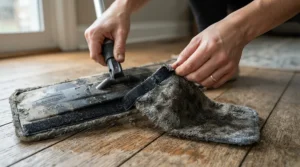
Dry Dust Mop Hardwood: Microfibre vs Cotton vs Disposable
Choosing a dry dust mop hardwood setup comes down to three main materials. Here’s how they compare.
| Type | Strength | Weakness | Best For |
|---|---|---|---|
| Microfibre (e.g., Bona Microfiber Dust Mop) | Grips fine dust, washable | Needs proper laundering | Most sealed hardwood homes |
| Cotton loop (e.g., commercial wedge heads) | Durable, big-debris pickup | Can shed lint, may be rougher | Large or workshop-style spaces |
| Disposable sweeper sheets | Zero laundry, convenient | Ongoing cost, waste | Occasional touch-ups |
The written verdict? Microfibre wins for most homes because it balances gentle contact, fine-dust capture and reusability. Cotton still has a place in big, rugged spaces, but on a home’s finished boards it can be more abrasive. Disposable sheets are a decent backup for guests-arriving-in-an-hour moments, but costs and waste add up.
And a traditional broom? It’s fine for the garage. On hardwood, it tends to scatter fine dust, which is why a dry microfibre mop is usually the better daily habit.
Common Mistakes When Buying a Dust Mop for Hardwood
Most buyers make one of these errors:
Buying by width alone. A 61 cm head is wonderful in a hall and miserable in a galley kitchen. Measure the rooms you clean most.
Ignoring pad count. One pad means you either wash constantly or push a dirty pad around. Neither is good.
Treating “wet and dry” as a licence to soak. Hardwood doesn’t like standing water. Even finished floors can suffer if moisture sits in seams. If a mop is marketed as dual-use, use the dry mode as your default.
Skipping replacement availability. A mop that you can’t re-pad becomes landfill when the first pad dies.
Overlooking handle quality. A flimsy handle flexes and tilts the head edge into the finish.
Forgetting your finish. Sealed polyurethane, waxed and oiled floors have different care needs. Check what you have before buying.
Avoid these and you’ve dodged most of the regret.
Features That Actually Matter (And Those That Don’t)
Features that matter:
- Pad material and weave. This determines pickup and scratch risk.
- Washability and wash-count claims. Longevity equals value.
- Head swivel and handle rigidity. They keep the head flat.
- Comb or cleaning tool. Underrated for hair-heavy homes, as with the Libman Multi-Surface Microfibre Dust Mop.
- Replacement heads. They cut lifetime cost.
Features that matter less:
- Colour. Pretty, but irrelevant.
- “Commercial” labels. Often just marketing; judge by width, pad type and handle.
- Extra wet pads for hardwood. Nice to have, but not the reason to buy.
- Dozens of included accessories. Unless you’ll use them, they’re clutter.
If I had to rank the factors: pad quality, pad count, head width, handle rigidity, then everything else.
Long-Term Cost and Maintenance: What You’ll Really Spend
Sticker price is only part of the story. Over three years, the real cost is the mop plus pad replacements, laundry and your time.
| Cost Factor | Lower-Cost Path | Higher-Value Path |
|---|---|---|
| Initial purchase | Eyliden FC-06 Dust Mop (roughly C$25–C$40) | Bona Microfiber Dust Mop (roughly C$30–C$50) |
| Pad lifespan | Unknown or shorter | Rated for a long service life |
| Replacements | Buy new kit | Buy pad or head only |
| Laundry | Washing machine, minimal extra cost | Same |
The analysis here is simple. A slightly pricier mop with a long-lived pad and available replacements can cost less per year than a cheaper kit you’d replace outright. Washable pads also beat disposable sheets over time. Even a modest weekly use of sheets can exceed the one-time cost of a good mop within a year or two.
Prices are approximate and change often, so check current price listings on Amazon.ca before buying.
Frequently Asked Questions
❓ What is the best microfibre dust mop for hardwood floors in Canada?
❓ Can I use a microfibre mop on unsealed or waxed wood?
❓ How often should I wash my mop pads?
❓ Is a dust mop better than a vacuum on hardwood?
❓ Will a dust mop help with allergies?
Conclusion: Pick the Mop, Build the Habit
A microfibre dust mop for hardwood floors is one of the cheapest upgrades you can make to a home. It’s quiet, fast, gentle and reusable. The seven models above cover most Canadian situations: the Bona Microfiber Dust Mop for hardwood-focused buyers, the O-Cedar Hardwood Floor ‘N More Microfiber Dust Mop for everyday value, the Libman Multi-Surface Microfibre Dust Mop for pets, the CLEANHOME 24″ Commercial Dust Mop for big floors, the MASTERTOP Double-Sided Flat Mop for pad rotation, the Eyliden FC-06 Dust Mop for tight budgets, and the Microfiber Wholesale 18″ Professional Mop for flexible kits.
But the mop is only half the story. Technique, pad care and consistency do the rest. Dry pass daily where grit lands, wash pads regularly, and let your floors breathe between cleanings. Do that, and the shine you paid for stays put.
Recommended for You
- Microfibre Wet Mops: 7 Best Budget-Friendly Picks For 2026
- Microfibre Spray Mop For Hardwood Floors: 7 Best Picks 2026
- Flat Mop For Laminate Floors: 7 Best Safe Picks In Canada 2026
Disclaimer: This article contains affiliate links. As an Amazon Associate, I earn from qualifying purchases. If you purchase products through these links, we may earn a small commission at no additional cost to you.
✨ Found this helpful? Share it with your friends! 💬🤗
