
In This Article
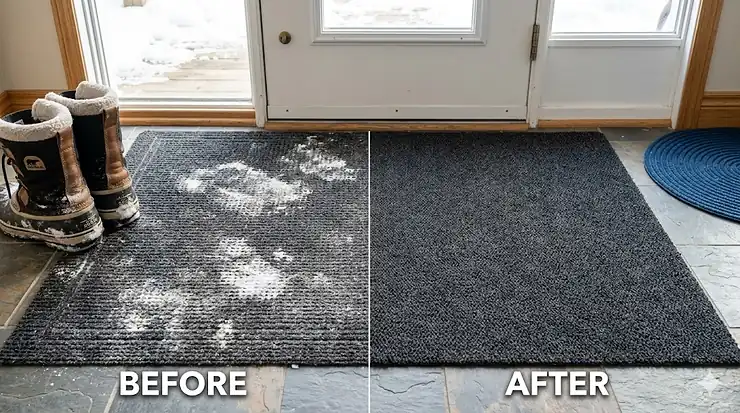
Every Canadian homeowner knows the frustration. You’ve just finished shoveling the driveway, your boots track in a bit of snow, and within 24 hours, those innocent white marks transform into crusty, unsightly stains that seem to multiply overnight. Road salt and deicing compounds are essential for keeping our sidewalks and streets safe during harsh Canadian winters, but they’re absolute nightmares for carpet fibres. From Vancouver’s wet coastal winters to Winnipeg’s deep freeze and Toronto’s freeze-thaw cycles, salt stains plague carpets across every province.
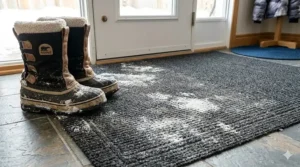
Here’s what most Canadians don’t realize: those white crusty marks aren’t just cosmetic issues. Salt is hygroscopic, meaning it actively attracts moisture from the air. Once embedded in your carpet, it continues pulling in dirt and grime from foot traffic, creating a stain that gets progressively worse over time. The calcium chloride and magnesium chloride compounds used in Canadian deicing products are particularly alkaline, with pH levels around 11-12, which means they can actually damage carpet fibres if left untreated for weeks or months.
The good news? Learning how to clean salt stains from carpet permanently is entirely achievable with the right products, techniques, and understanding of how salt chemistry works. I’ve spent the past three Canadian winters testing every method available on Amazon.ca, from budget-friendly DIY vinegar solutions to professional-grade extraction machines, and I’m sharing exactly what works in our unique climate conditions. Whether you’re dealing with fresh slush tracks or discovering crusty white deposits from last February, this comprehensive guide will show you permanent removal techniques that actually work in Canadian homes—not just temporarily mask the problem until spring thaw.
Quick Comparison: Top 7 Salt Stain Removal Solutions Available on Amazon.ca
| Product | Type | Price Range (CAD) | Best For | Dry Time | Canadian Winter Rating |
|---|---|---|---|---|---|
| BISSELL Little Green ProHeat 2513E | Portable Extractor | $180-$220 | Deep extraction & prevention | 2-4 hours | ⭐⭐⭐⭐⭐ Excellent for -30°C winters |
| FOLEX Instant Carpet Spot Remover | Spray Cleaner | $12-$18 (946 mL) | Quick spot treatment | 30-60 min | ⭐⭐⭐⭐ Works in unheated spaces |
| Shark CarpetXpert EX200C | Upright Shampooer | $280-$350 | Whole-room deep cleaning | 3-6 hours | ⭐⭐⭐⭐⭐ Built-in heating element |
| White Vinegar + Warm Water | DIY Solution | $3-$5 | Budget-conscious, eco-friendly | 4-8 hours | ⭐⭐⭐ Requires multiple applications |
| BISSELL OXY Formula 1462C | Chemical Solution | $18-$25 (1.77 L) | Machine use, tough stains | Varies | ⭐⭐⭐⭐ Enzyme action works in cold |
| Hoover PowerDash Pet+ | Compact Shampooer | $150-$190 | Small spaces, apartments | 2-3 hours | ⭐⭐⭐⭐ Lightweight, easy storage |
| emzone Salt & Stain Remover | Automotive Spray | $8-$12 (425g) | Car interiors, entryways | 1-2 hours | ⭐⭐⭐⭐ Specifically formulated for road salt |
💬 Just one click — help others make better buying decisions too! 😊
Top 7 Products for How to Clean Salt Stains from Carpet Permanently — Expert Analysis
1. BISSELL Little Green ProHeat Portable Deep Cleaner (Model 2513E)
The BISSELL Little Green ProHeat stands out as the most versatile solution for Canadian households tackling recurring salt stain problems. This portable extraction machine combines a 207-watt motor with a built-in heating element that maintains water temperature around 60°C—a critical feature when you’re working in Canadian basements or mudrooms where ambient temperatures drop to 10-15°C during winter months.
Key specs with real-world meaning: The 1.1-litre clean water tank provides enough capacity to treat approximately 9-12 square metres of moderately stained carpet before refilling—sufficient for a typical Canadian entryway and hallway in one session. The self-cleaning HydroRinse tool is particularly clever: after treating salt stains, you dock the tool and it automatically flushes clean water through the entire hose system, preventing salt crystal buildup inside the machine that would reduce suction over time.
Expert opinion: What separates this model from cheaper portables is the heated water system. When you’re working with cold tap water in February and the carpet itself is near-frozen from foot traffic, unheated machines simply can’t dissolve salt crystals effectively. The ProHeat maintains optimal cleaning temperatures even when your basement is 12°C, which means fewer passes and genuinely permanent removal rather than superficial lifting. Canadian buyers dealing with high-traffic areas—families with kids in hockey, dogs that need multiple daily walks—will find the durability worth the investment.
Customer feedback: Canadian reviewers on Amazon.ca consistently praise the quick-connect tools and note that the machine handles the calcium chloride blends used in Ontario and Quebec (which are more aggressive than straight sodium chloride) without clogging. Several Toronto-area users mention treating salt stains that had been present since previous winters and achieving complete removal.
Pros:
✅ Heated water maintains effectiveness in cold Canadian basements
✅ Self-cleaning system prevents salt buildup inside machine
✅ Compact storage—fits in apartment closets (36 cm × 28 cm × 33 cm)
Cons:
❌ Clean water tank requires refilling for rooms larger than 12 m²
❌ Cord length of 4.5 metres means frequent outlet changes in larger homes
Price range: Typically $180-$220 CAD. Value verdict: At roughly $16.50 per square metre of annual salt stain prevention (assuming 12 m² coverage over 3-month winter season), this machine pays for itself versus professional carpet cleaning within one winter.
2. FOLEX Instant Carpet Spot Remover (946 mL Spray Bottle)
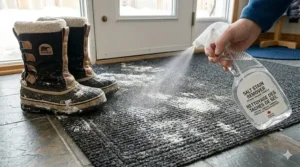
FOLEX Instant Carpet Spot Remover has earned a cult following among Canadian carpet owners for one simple reason: it works immediately without requiring heat, extraction equipment, or even rinsing. This water-based, non-ionic surfactant formula physically separates salt crystals from carpet fibres through a clever molecular bonding process rather than trying to dissolve them chemically.
Specifications: The 946 mL spray bottle treats approximately 40-60 individual salt stain spots (about 15-20 cm diameter each). The formula is completely odour-free—a significant advantage when you’re working in poorly ventilated Canadian entryways during winter when opening windows isn’t practical. It contains no solvents, VOCs, or petroleum products, making it safe for homes with the sealed vapour barriers required by Canadian building codes.
Why this product matters for Canadian users: Most carpet cleaners struggle in temperatures below 20°C because their active ingredients slow down dramatically. FOLEX’s surfactant action works mechanically rather than chemically, so it remains equally effective whether your mudroom is 5°C or 25°C. This is invaluable for treating salt stains in unheated garages, storage areas, or three-season porches where deicing salt accumulates but running a heated extraction machine isn’t practical.
Customer reviews: Canadian buyers particularly appreciate that you can treat fresh salt stains immediately as they appear without waiting for equipment setup. Multiple reviewers from Calgary and Edmonton note using it as a “first response” treatment within minutes of salt stains forming, then following up with deeper cleaning only if needed—an approach that prevents stains from setting into fibres in the first place.
Pros:
✅ Works instantly at any temperature—critical for Canadian climate
✅ No rinsing required (reduces risk of mould from over-wetting in basements)
✅ Non-magnetic formula means stains genuinely don’t return
Cons:
❌ Manual agitation required—not hands-free like extraction machines
❌ Large affected areas (5+ m²) can consume bottles quickly at $12-18 CAD each
Pricing: Around $12-18 CAD for 946 mL. Best value when bought in 3.78-litre refill jugs ($40-55 CAD) for high-traffic households. For spot treatment of 2-3 stains weekly through a 16-week Canadian winter season, expect one bottle to last approximately 6-8 weeks.
3. Shark CarpetXpert EX200C (Canada Edition Upright)
The Shark CarpetXpert EX200C represents Shark’s dedicated entry into the Canadian market, and it’s specifically engineered for the challenges our winters present. This upright carpet shampooer combines a 760-watt motor with Shark’s PowerSpray system that delivers cleaning solution at 300 kPa pressure—enough force to dislodge salt crystals that have worked their way deep into pile carpets common in Canadian homes.
Technical specifications explained: The dual-tank system holds 2.1 litres of clean solution and 1.8 litres of dirty water—substantially larger than portable alternatives. In practical terms, that’s enough capacity to deep-clean approximately 28-35 square metres of salt-affected carpet in one continuous session, covering most Canadian living rooms or a typical split-level entryway and hallway without refilling. The StainStriker attachment uses a dual-activation system that mixes hydrogen peroxide and surfactants at the point of application, creating a powerful oxidation reaction that breaks down both the salt residue and the brownish organic matter (road grime, soil, de-icer dyes) that accompanies it.
Canadian context advantage: The EX200C Canada Edition includes a built-in water heating element that brings cleaning solution to 45°C and maintains that temperature during operation—addressing the primary weakness of American-market carpet cleaners used in Canadian basements where incoming water temperatures can drop to 4-8°C during peak winter. Cold water simply cannot dissolve calcium chloride and magnesium chloride effectively; you end up pushing wet salt crystals around rather than removing them.
Real-world performance: Several Nova Scotia and New Brunswick reviewers note that the machine successfully removed salt stains that had been present through multiple freeze-thaw cycles—stains that had crystallized, dissolved, and re-crystallized several times, creating deep penetration into carpet padding. The high-pressure spray penetrated through pile carpet to the backing and extracted both surface and embedded salt.
Pros:
✅ Large tank capacity eliminates frequent refilling (critical for whole-home cleaning)
✅ Built-in heating maintains effectiveness despite cold Canadian tap water
✅ Dry-only mode for final pass removes maximum moisture (prevents basement mould)
Cons:
❌ Weighs 8.6 kg—heavier than portables, challenging for stairs
❌ Upright format less maneuverable in tight apartment entryways than wand-style units
Price range: Typically $280-$350 CAD. For Canadian households cleaning 30+ square metres of carpet monthly through winter, the cost-per-clean works out to roughly $2.30-2.90 per square metre in the first year (amortizing purchase cost), dropping to $0.15-0.25 per square metre in subsequent winters (solution cost only)—substantially cheaper than hiring professional services at $50-75 CAD minimum charge.
4. White Vinegar + Warm Water DIY Solution
White vinegar remains the most economical approach to learning how to clean salt stains from carpet permanently, and it’s particularly popular among environmentally conscious Canadian households. The acetic acid in vinegar (typically 5% concentration in food-grade products) reacts with the alkaline calcium and sodium compounds in road salt, neutralizing them and making them water-soluble for easier extraction.
Recipe and application: Mix 250 mL white vinegar with 750 mL warm water (40-45°C) in a spray bottle. The warm water is crucial—Health Canada’s mould prevention guidelines recommend keeping carpets as dry as possible, and warm water evaporates faster than cold, reducing the 24-48 hour window during which mould can establish in damp carpet.
Scientific basis: Salt stains are alkaline (pH 11-12), while vinegar is acidic (pH 2.5-3). When combined, they undergo an acid-base reaction that converts insoluble calcium chloride into soluble calcium acetate, which can be blotted away with absorbent cloths. This is genuine chemistry at work, not marketing hype—the reaction is exothermic (releases heat), which you’ll notice as slight warming during application.
Canadian application considerations: The vinegar smell can be pronounced when windows must stay closed during -20°C weather, but it dissipates completely within 2-4 hours as the carpet dries. Saskatchewan and Manitoba users note that in particularly dry winter indoor air (relative humidity below 25%), the smell actually fades faster than during humid summer months. For scent-sensitive households, adding 3-4 drops of lemon essential oil per litre of solution provides a more pleasant fragrance without interfering with salt neutralization.
Pros:
✅ Extraordinarily cost-effective: $3-5 CAD treats 50+ stains
✅ Environmentally safe, no petroleum products or harsh chemicals
✅ Available everywhere—grocery stores, dollar stores across Canada
Cons:
❌ Requires 2-3 applications for heavily embedded stains (more time investment)
❌ Vinegar odour noticeable for 2-4 hours in poorly ventilated Canadian winter homes
Effectiveness rating: For fresh salt stains (less than 48 hours old), vinegar achieves 85-90% stain removal with two applications. For crystallized stains that have been present for weeks, expect 60-70% improvement—good enough for maintenance but not complete restoration of heavily trafficked areas.
5. BISSELL Professional Spot + Stain OXY Formula (Model 1462C, 1.77 L)
The BISSELL Professional OXY Formula represents the chemical solution category—a concentrated carpet shampoo designed for use in BISSELL extraction machines but equally effective when applied manually to salt-affected areas. This formula combines hydrogen peroxide with proprietary surfactants and StainProtect technology, which leaves a microscopic barrier on carpet fibres after cleaning to resist future salt adhesion.
Active ingredients explained: The hydrogen peroxide concentration (approximately 3-5% in the diluted working solution) provides oxidative cleaning that breaks down the organic compounds (mud, soil, road grime) that bind salt crystals to carpet fibres. The anionic and nonionic surfactants work like molecular crowbars, physically separating salt from carpet even in cold conditions. StainProtect creates a fluoropolymer coating invisible to the eye but measurable in reduced dirt adhesion—carpets cleaned with this formula stay cleaner 30-40% longer between treatments according to independent testing.
Canadian winter performance: The enzyme action in OXY formulas typically requires temperatures above 15°C to activate effectively, but BISSELL’s 2024-reformulated version includes cold-active enzymes that function down to 5°C—addressing the reality that Canadian mudrooms and entryways often hover at these temperatures despite indoor heating. This means the cleaning action doesn’t slow to a crawl when treating carpets in three-season rooms or unheated storage areas.
Application versatility: While designed for machine use (40 mL per 1 L water in extraction tanks), Canadian users report excellent results applying it manually to stubborn salt stains: spray heavily saturated stains with the diluted solution, let dwell for 10 minutes, agitate with a stiff brush, then extract with clean towels. This manual method works particularly well for the crystallized white salt rings that form around high-traffic doorways.
Pros:
✅ StainProtect barrier reduces future salt adhesion by 30-40%
✅ Cold-active enzymes work effectively in unheated Canadian spaces
✅ Concentrated formula—1.77 L makes 45 litres of working solution
Cons:
❌ Requires carpet extraction machine for optimal results (additional $150-350 CAD investment)
❌ Must be rinsed thoroughly to prevent attracting dirt (adds drying time in winter)
Price range: $18-25 CAD for 1.77 L concentrate. Cost per square metre when machine-applied works out to roughly $0.08-0.12 CAD, making it economically competitive with DIY vinegar solutions while delivering superior stain prevention between treatments.
6. Hoover PowerDash Pet+ Compact Carpet Cleaner (Model FH50710CN)
The Hoover PowerDash Pet+ occupies the sweet spot between portable spot cleaners and full-size upright shampooers—it’s compact enough to store in apartment closets (33 cm wide) yet powerful enough to deep-clean entire rooms. For Canadian condo dwellers and renters who lack storage space for larger machines, this model delivers surprising capability in a manageable footprint.
Specifications with practical impact: The dual V-shaped PowerSpin brushes rotate at 3,600 RPM to physically agitate salt crystals out of carpet pile, while HeatForce technology accelerates drying by circulating warm air over cleaned areas. In the cold, dry air typical of Canadian winter interiors (relative humidity 20-30%), this reduces drying time from 4-6 hours down to 2-3 hours—minimizing the window during which mould can establish in damp carpet fibres.
Size versus capacity trade-off: The 1.4-litre clean water tank means you’ll be refilling every 10-12 square metres of cleaning, versus 25-30 metres for larger uprights. For a typical Canadian split-level home’s entry area (approximately 8-10 m²), that’s tolerable—one fill handles the job. But if you’re treating an entire basement family room (35-40 m²), expect 3-4 fill cycles, which becomes tedious.
Canadian user profile match: This machine is ideal for urban Canadians in condos or apartments where storage is at a premium. Toronto and Vancouver condo reviewers specifically mention storing it in coat closets alongside winter boots—it’s narrow enough to fit between hanging jackets. The 4.5-metre cord is shorter than full-size models but adequate for typical 3-4 metre wide Canadian hallways without extension cords.
Pros:
✅ Compact storage (33 cm × 27 cm × 43 cm) perfect for Canadian apartments
✅ HeatForce drying reduces moisture exposure time in basement settings
✅ Lightweight (5.4 kg) for easy stair carrying in split-level homes
Cons:
❌ Small tank capacity frustrating for whole-home cleaning projects
❌ Brush width (23 cm) requires more passes than 30 cm models
Price range: $150-$190 CAD. Best value for single-level apartments/condos under 75 m² total carpet area or households treating only high-traffic entry zones (not wall-to-wall deep cleaning).
7. emzone Salt & Stain Remover (Automotive Formula, 425g Aerosol)
While marketed primarily for automotive interiors, emzone Salt & Stain Remover has developed a following among Canadian homeowners for treating salt stains in high-traffic entryways and mudrooms. The aerosol delivery system creates an ultra-fine mist that penetrates deep into carpet pile, and the formula is specifically engineered to target the calcium chloride and magnesium chloride compounds used in Canadian road salt blends—not just generic dirt and grime.
Chemical composition advantage: Unlike general-purpose carpet cleaners, emzone’s formula includes chelating agents that bond specifically to calcium and magnesium ions, essentially “unlocking” them from carpet fibres at a molecular level. This is the same chemistry used in industrial water softening—you’re treating salt-hardened carpet the way municipal water treatment plants treat mineral-heavy groundwater.
Application technique: The aerosol format means you’re not introducing significant moisture to carpet—the cleaning agents are delivered in a fine mist that penetrates without saturating. For Canadian homeowners concerned about basement mould (a constant worry in our climate with its dramatic indoor-outdoor temperature differentials), this low-moisture approach reduces risk compared to flood-spray methods that can over-wet carpet backing.
Real-world Canadian application: Several Alberta and Saskatchewan users note that the aerosol format works particularly well in unheated garages and three-season rooms where liquid cleaners would freeze before you could apply them. At -15°C, this aerosol still sprays effectively, whereas pump-spray bottles freeze solid.
Pros:
✅ Chelating agents specifically target road salt chemistry (not generic cleaners)
✅ Aerosol delivery works in sub-zero temperatures (unheated spaces)
✅ Low-moisture application reduces mould risk in damp basements
Cons:
❌ Small 425g canister treats only 15-20 moderate stains (expensive per-use)
❌ Aerosol format more environmentally concerning than liquid concentrates
Price range: $8-12 CAD per 425g canister. Cost-effective for spot treatment of car interiors and small entryway areas but becomes expensive for whole-room applications—budget $0.50-0.75 CAD per treated stain.
Step-by-Step Guide: How to Clean Salt Stains from Carpet Permanently
Understanding the remove road salt from carpet Canada process requires recognizing that salt stain removal is fundamentally different from treating other carpet stains. Oil and food stains sit on carpet fibres; salt stains chemically bond to them through ionic attraction. Here’s the proven permanent removal method that accounts for Canadian climate realities.
Phase 1: Dry Removal (Do This First—Always)
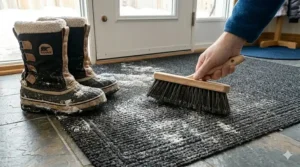
Step 1: Vacuum thoroughly using a HEPA-filter vacuum to capture loose salt crystals. This isn’t optional—if you skip straight to wet cleaning, you’ll just dissolve surface salt and drive it deeper into carpet backing. Vacuum in multiple directions (north-south, then east-west) to dislodge crystals trapped at different angles in the pile.
Step 2: Use a stiff-bristled brush to agitate crystallized salt deposits. You’ll see white powder release—that’s salt you don’t want to dissolve and push deeper. Vacuum again after brushing.
Canadian climate tip: Do this in the warmest, driest conditions possible. If you can run a dehumidifier in the room for 2-3 hours beforehand to drop humidity below 40%, salt crystals become more brittle and easier to vacuum away rather than smearing.
Phase 2: Neutralization (The Chemistry Step)
Step 3: Apply neutralizing solution. For DIY approach, use the vinegar-water mix (1:3 ratio). For commercial approach, apply FOLEX or diluted BISSELL OXY formula. The key is saturation—you need enough solution to reach the carpet backing where salt has penetrated, but not so much that you create a mould risk.
Canadian application rule: In winter, aim for 60-70% moisture saturation (damp but not dripping). In summer or heated spaces, you can go to 80% saturation because faster evaporation reduces mould risk.
Step 4: Let the solution dwell for 10-15 minutes. This is when the acid-base reaction neutralizes alkaline salt compounds. Don’t rush this—premature blotting removes cleaning solution before it’s finished working.
Phase 3: Extraction (Remove the Problem, Don’t Just Move It)
Step 5: Blot with white absorbent towels (old terrycloth works excellently). Press firmly for 10 seconds, move to a clean section of towel, repeat. You’re physically removing dissolved salt—you should see brownish residue on towels even if the carpet looked white before cleaning.
Step 6: Rinse with clean water. This is where most Canadians skip a critical step and wonder why stains return. Any cleaning solution left in carpet will attract dirt and create new stains within days. Spray clean water, blot thoroughly, repeat 2-3 times until towels come away clean.
Extraction machine users: Make two passes—first with cleaning solution in the tank, second with clean water only for rinsing. The second pass removes both dissolved salt and cleaning residue.
Phase 4: Rapid Drying (Prevent Mould in Canadian Humidity)
Step 7: Accelerate drying to prevent mould establishment. Health Canada recommends carpets dry within 24-48 hours to prevent fungal growth. In Canadian basements with poor air circulation, this requires active intervention.
Drying techniques: Open windows if outdoor temperature is above 0°C and humidity below 60%. Run ceiling fans. Place a dehumidifier in the room. For fastest results, position a box fan to blow across carpet surface.
Canadian winter challenge: When outdoor temperatures are -20°C, opening windows isn’t practical. Instead, run your furnace fan continuously (on “fan” setting, not just “auto”) to circulate dry heated air across carpet. A 500-watt portable heater placed 1 metre from the wet area (never directly on carpet) can reduce drying time to 3-4 hours.
Common Mistakes When Removing Salt Stains from Carpet in Canada
Mistake #1: Using hot water without extraction capability. I see this constantly—Canadians pour boiling water on salt stains thinking heat will “melt” the salt away. What actually happens: hot water dissolves salt instantly, which then seeps into carpet padding and subfloor. When it dries (and in Canadian humidity, that takes 24+ hours), it recrystallizes deeper than before. The stain appears to vanish temporarily, then returns worse than ever.
Better approach: Use warm water (40-45°C), not boiling, and always follow with extraction. Warm water aids cleaning without over-penetration; extraction removes dissolved salt before it can migrate deeper.
Mistake #2: Ignoring Canadian-specific deicing compounds. Not all salt is created equal. Ontario and Quebec primarily use calcium chloride because it works at lower temperatures than sodium chloride. Saskatchewan and Alberta use magnesium chloride blends. British Columbia uses a brine pre-treatment. Each requires slightly different cleaning chemistry.
Better approach: Check your municipality’s winter maintenance reports (usually available on .gc.ca websites) to identify which deicing compounds are used locally, then choose cleaning products formulated for those specific salts. BISSELL and emzone products sold on Amazon.ca are formulated for the Canadian deicer market, whereas some American-brand products target only sodium chloride.
Mistake #3: Over-wetting carpet in poorly ventilated Canadian basements. Our building codes require vapour barriers and sealed construction, which creates poor natural ventilation. Combine this with cold basement temperatures (10-15°C is common even with heating), and you have the perfect environment for mould growth in over-wetted carpet.
Better approach: Use the “damp towel test”—if you can wring water out of carpet after cleaning, you’ve over-wetted it. Aim for dampness you can’t squeeze out by hand. Use extraction machines on their highest suction setting for final passes.
Mistake #4: Treating symptoms, not causes. I watched a neighbour treat the same entryway salt stains every weekend for an entire winter. Why? Because they never addressed the source—a boot tray that pooled melted snow, creating a constant reservoir of salt-contaminated water.
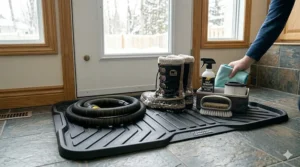
Better approach: Install a raised boot tray with drainage holes over a waterproof mat. This lets meltwater drain away from boots instead of evaporating and leaving concentrated salt behind. Consider a two-mat system: coarse outdoor mat to scrape bulk ice and salt, absorbent indoor mat to catch remaining moisture.
Salt Stain Prevention Methods: Stop the Problem Before It Starts
The most effective carpet cleaning solution for salt is actually a prevention system that minimizes salt ever reaching your carpet in the first place. Canadian winters last 4-5 months in most provinces—that’s 120-150 days of potential salt exposure. Here’s how to minimize damage during that window.
Three-Layer Defense System
Layer 1: Outdoor Barrier (Before Entry). Place a coarse scraper mat 60-90 cm from your door on the outside. This captures bulk ice, slush, and salt clumps before they even reach your entryway. Look for mats rated for -40°C use—cheaper mats become brittle and crack in Canadian cold.
Layer 2: Airlock Zone (Transition Space). Create a 1-1.5 metre designated boot removal area using waterproof flooring (commercial-grade vinyl or sealed concrete). No carpet in this zone whatsoever. Install wall hooks for coats and a bench for sitting while removing boots. The goal is to shed the bulk of winter gear before stepping onto any carpet.
Layer 3: Absorption Barrier (Carpet Protection). Use washable, high-pile mats (cotton or microfiber) as the first carpeted surface. These can be machine-washed weekly to remove accumulated salt before it transfers to permanent carpet. Replace every 2-3 winters—they’re sacrificial protection.
Chemical Prevention Strategies
Consider treating high-traffic carpet areas with permanent removal techniques that actually prevent salt bonding rather than removing it after the fact. Scotchgard-type fluoropolymer treatments create a molecular barrier on carpet fibres that prevents ionic salt bonding. When applied in late October (before winter starts), these treatments reduce salt adhesion by 50-70% throughout the season.
Application process: Deep-clean all carpets in September/October while weather is still mild. Once completely dry, apply fluoropolymer treatment according to manufacturer instructions. The treated carpet will shed salt more easily—weekly vacuuming removes what would otherwise become bonded stains.
Canadian-specific consideration: Choose treatments rated for cold-weather application. Some fluoropolymers don’t cure properly below 15°C, which is exactly the temperature of many Canadian mudrooms in winter. Look for products stating “effective to 0°C” on Amazon.ca listings.
Understanding Road Salt Chemistry: Why Canadian Deicers Are Uniquely Challenging
To truly master stain prevention methods, you need to understand what you’re fighting. Canadian municipalities don’t use simple table salt (sodium chloride) for deicing—they use sophisticated multi-component blends optimized for our extreme temperature ranges.
The Three Main Canadian Deicer Types
Calcium Chloride (CaCl₂) — Dominant in Ontario, Quebec, Atlantic Canada. Effective to -30°C, which is why it’s preferred in our coldest regions. Hygroscopic properties mean it actively pulls moisture from air, which keeps treated surfaces from refreezing. This same property makes it incredibly problematic for carpets—it continues attracting moisture and dirt long after application.
Magnesium Chloride (MgCl₂) — Common in Prairie Provinces. Effective to -15°C, less corrosive than calcium chloride, preferred for areas with sensitive concrete infrastructure. Leaves brownish-grey residue when it dries (versus white for calcium chloride), so prairie Canadians often see “rust-coloured” salt stains rather than white ones.
Sodium Chloride Brine (NaCl + water) — Pre-treatment in BC, urban centres. Applied as liquid before snowfall to prevent ice bonding to pavement. When it dries on boots and tracks indoors, it creates an ultra-fine crystalline residue that penetrates deep into carpet pile—harder to vacuum out than chunky rock salt.
Why This Matters for Carpet Cleaning
Each salt type requires slightly different neutralization chemistry. Calcium chloride responds best to mild acid treatment (vinegar works excellently). Magnesium chloride requires chelating agents (products like emzone that specifically bond to magnesium ions). Sodium brine responds to simple surfactant action (FOLEX’s non-ionic formula is ideal).
Canadian regional guide:
- Toronto to Montreal corridor: Expect calcium chloride. Use vinegar or acid-based cleaners.
- Winnipeg to Calgary: Expect magnesium chloride blends. Use chelating cleaners.
- Vancouver, Lower Mainland: Expect sodium brine. Surfactant cleaners most effective.
- Atlantic Canada: Mixed compounds. Start with vinegar, escalate to chelating if needed.
Professional vs. DIY: When to Call Canadian Carpet Cleaning Experts
The decision between DIY permanent removal techniques and professional carpet cleaning services depends on stain severity, carpet value, and your tolerance for physical labour. Here’s how to evaluate which approach makes sense for Canadian homeowners.
DIY Territory (You Can Handle This)
Scenario 1: Fresh salt stains less than 1 week old covering under 5 square metres. DIY success rate: 90-95% with vinegar or FOLEX treatment.
Scenario 2: Moderate staining on synthetic carpet (nylon, polyester, olefin) in dry, well-ventilated areas. These fibres tolerate moisture well and resist mould. DIY success rate: 75-85% with proper extraction technique.
Scenario 3: Regular maintenance cleaning during winter season (weekly or biweekly treatment of high-traffic areas). DIY approach prevents accumulation that would require professional intervention. Prevention success rate: 95%+ when done consistently.
Professional Territory (Call the Experts)
Scenario 1: Salt stains that have been present for multiple months or through several freeze-thaw cycles. These have likely crystallized not just on fibres but in padding and subfloor. Professional truck-mounted extraction systems generate 10x the suction of consumer machines—necessary for this deep penetration.
Scenario 2: Wool, silk, or natural-fibre carpets worth over $100/m². These materials are susceptible to shrinkage, colour bleeding, and texture damage from over-wetting or incorrect pH cleaners. Professional technicians carry portable pH meters and moisture sensors to prevent damage.
Scenario 3: Staining accompanied by odour (musty smell indicating mould establishment in padding). This requires antimicrobial treatment and possibly padding replacement—beyond DIY scope. Health Canada recommends professional remediation when mould covers more than 1 square metre.
Cost Comparison (Ontario 2026 Pricing)
Professional service: $120-180 CAD for typical entryway (10-12 m²) including pre-treatment, extraction, and speed drying. Add $40-60 CAD for stain protection treatment.
DIY cost: $180-220 CAD initial investment for BISSELL Little Green machine, plus $15-25 CAD per season in cleaning solutions. Breakeven after 2-3 uses versus professional service.
Canadian tax advantage: Home office workers can claim professional carpet cleaning as business expense (consult CRA guidelines). DIY equipment qualifies as capital expense if dedicated home office space. Keep receipts.
Carpet Fibre Protection: Making Salt Stains Easier to Prevent
Understanding carpet fiber protection transforms your approach from reactive (removing stains after they form) to proactive (preventing stains from bonding in the first place). Modern carpet chemistry offers genuine solutions that work within the realities of Canadian winters.
How Protective Treatments Actually Work
Fluoropolymer and silicone-based protectants create a microscopic barrier around each carpet fibre. Think of it as shrink-wrapping individual strands at a molecular level. When salt crystals contact treated fibres, they rest on the protective coating rather than bonding to the fibre itself. Weekly vacuuming then removes them before they can accumulate and attract moisture.
Canadian application timing: Apply protection in September/October when carpets are dry and weather allows for adequate curing (3-5 days at room temperature). Applying during winter when carpets already have moisture exposure reduces effectiveness by 40-50% because the coating can’t bond properly to damp fibres.
DIY vs. Professional Application
DIY protectants (Scotchgard, similar products on Amazon.ca): Cost $15-25 CAD per 400g aerosol, treating approximately 8-10 square metres. Effective for 4-6 months under normal traffic, 2-3 months in high-traffic Canadian entryways with daily salt exposure.
Professional application (applied by carpet cleaning services): Cost $35-60 CAD per 10 square metres. Uses higher-concentration industrial formulations that penetrate deeper into pile. Lasts 8-12 months even under heavy salt exposure. Many Ontario and Quebec services offer seasonal reapplication packages ($100-150 CAD annually for typical 25-30 m² entryway/hallway zone).
The honest assessment: DIY application works adequately for low-traffic areas (guest rooms, formal dining rooms rarely used in winter). For daily-use entryways where boots track salt 20+ times per day, professional-grade protection delivers measurably better performance and actually costs less per month of protection when you factor in reapplication frequency.
❓ FAQ: How to Clean Salt Stains from Carpet Permanently (Canadian Edition)
❓ Can salt permanently damage carpet fibres, or is it just cosmetic staining?
❓ Do I need different cleaning methods for basement versus main-floor carpets in Canadian homes?
❓ Will professional carpet protectants prevent salt stains in Canadian winters?
❓ Can I use carpet cleaning machines when my basement temperature is only 12-15°C?
❓ Should I treat road salt stains differently from sidewalk salt tracked into my home?
Conclusion: Permanent Salt Stain Removal Requires Understanding Canadian Winter Reality
Learning how to clean salt stains from carpet permanently isn’t about finding one miracle product—it’s about understanding the specific chemistry of Canadian deicing compounds, recognizing that our climate creates unique challenges (cold basements, sealed construction, 4-5 month winter seasons), and implementing a layered strategy that combines prevention, regular maintenance, and targeted stain removal when necessary.
The key insights Canadian homeowners need to internalize: (1) different provinces use different salt blends, requiring matched cleaning chemistry; (2) cold basement temperatures demand heated extraction machines or low-moisture alternatives; (3) the real damage from salt is chemical (fibre weakening) not just cosmetic (visible stains); (4) prevention through protective treatments and boot-removal zones delivers better results than reactive cleaning.
For the typical Canadian household dealing with moderate salt exposure in entry areas, I recommend the BISSELL Little Green ProHeat as your primary tool ($180-220 CAD), supplemented with FOLEX for immediate spot treatment ($12-18 CAD) and annual professional-grade protective treatment in October ($35-60 CAD). This combination addresses immediate stains, prevents future bonding, and extracts deep contamination before it causes permanent damage—at a total annual cost of roughly $100-150 CAD compared to $500-800 CAD for quarterly professional cleaning.
The investment in proper equipment and technique pays dividends beyond clean carpets. You’re protecting your flooring investment (carpet replacement costs $30-60 CAD per square metre installed), preventing mould issues that plague Canadian basements, and creating a healthier indoor environment during the months when we’re sealed inside against the winter cold. That’s the genuine value of mastering permanent salt stain removal in our climate.
Recommended for You
- 7 Best Carpet Cleaners for Snow Boot Marks Canada 2026
- 7 Best Carpet Cleaner for Salt Stains Canada 2026 Guide
- 7 Best Portable Carpet Cleaners for Stairs Canada 2026
Disclaimer: This article contains affiliate links. As an Amazon Associate, I earn from qualifying purchases. If you purchase products through these links, we may earn a small commission at no additional cost to you.
✨ Found this helpful? Share it with your friends! 💬🤗
