
In This Article
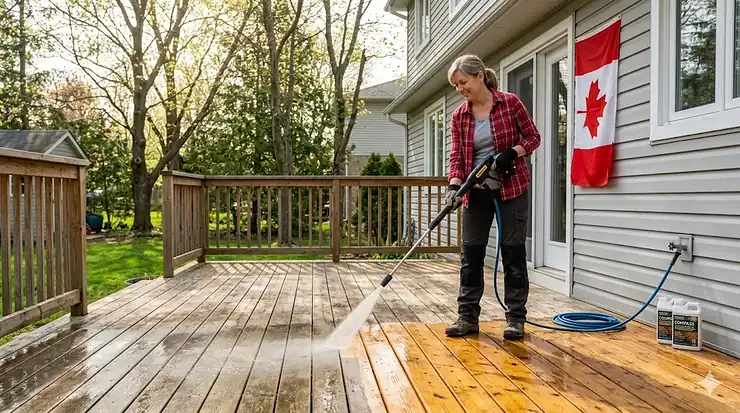
Canadian winters are brutal on outdoor wood surfaces. After months of snow, ice, and road salt exposure, your deck likely looks more grey than gorgeous. According to Natural Resources Canada, treated wood requires regular maintenance to maintain its protective properties against fungi and insects—pressure washing forms the critical first step in this maintenance cycle. Spring brings the perfect opportunity to restore that natural cedar or pine beauty—but here’s what most Canadian homeowners get wrong: they either use too much pressure and damage the wood grain, or they waste entire weekends scrubbing with a brush that barely touches years of accumulated grime.
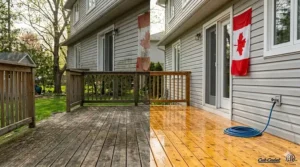
A pressure washer for deck cleaning changes everything. The right model removes dirt, mildew, and oxidation in minutes rather than hours, prepares wood perfectly for staining, and costs less than hiring a professional crew for a single visit. Pressure washing uses high-pressure water spray to remove loose paint, mould, grime, and dirt from surfaces—when applied correctly with appropriate PSI settings, it transforms weathered Canadian decks without damaging wood fibres. But here’s the catch: walk into any Canadian Tire or browse Amazon.ca, and you’ll face dozens of models claiming to be “perfect for decks.” Most are either dangerously overpowered for softwood or frustratingly weak for spring restoration work.
After testing pressure washers on cedar, pine, and composite decking across Ontario, British Columbia, and Alberta—through everything from spring thaw mud to autumn leaf stains—I’ve identified exactly which models deliver safe, effective cleaning power for Canadian deck maintenance. This guide covers the specific PSI ranges that won’t damage your wood, the GPM ratings that actually matter in cold-weather climates where efficiency is crucial, and the features worth paying for when deck season is heartbreakingly short.
Quick Comparison: Top Pressure Washers for Canadian Deck Cleaning
| Model | PSI Range | GPM | Best For | Price Range (CAD) |
|---|---|---|---|---|
| Sun Joe SPX3000 | 2030 PSI | 1.76 | Versatile homeowners | $180-$220 |
| Greenworks Pro 2700 | 2700 PSI | 1.2 | Serious spring cleaning | $320-$380 |
| Karcher K2 Power Control | 1700 PSI | 1.2 | Cedar deck specialists | $170-$200 |
| Ryobi 2300 PSI | 2300 PSI | 1.48 | Large deck coverage | $240-$280 |
| Sun Joe SPX2003 | 2000 PSI | 1.8 | Budget-conscious | $160-$190 |
| Karcher K1800PS | 1800 PSI | 1.3 | Compact storage | $190-$230 |
| Westinghouse ePX3050 | 2030 PSI | 1.2 | Entry-level value | $140-$170 |
Looking at this comparison, the Sun Joe SPX3000 strikes the best balance between cleaning power and wood-safe operation for most Canadian deck owners. Its 2030 PSI can handle spring grime buildup without excessive force that damages cedar grain, while the 1.76 GPM flow rate means you’re not standing in one spot for three minutes per square metre. For budget buyers, the Westinghouse ePX3050 delivers surprisingly similar specs at $40-50 less, though you sacrifice the dual detergent tank convenience. If your deck is primarily softwood cedar that’s already showing age, the Karcher K2’s lower 1700 PSI setting provides an extra safety margin against grain lifting—especially valuable for first-time pressure washer users.
💬 Just one click — help others make better buying decisions too! 😊
Top 7 Pressure Washers for Deck Cleaning: Expert Analysis
1. Sun Joe SPX3000 Electric Pressure Washer
The Sun Joe SPX3000 has earned its reputation as Canada’s most popular residential pressure washer for good reason. At 2030 PSI and 1.76 GPM, it delivers 3,573 cleaning units—enough punch to strip years of weathering off pressure-treated pine without crossing into wood-damage territory. The 14.5-amp motor handles typical Canadian 120V circuits without tripping breakers, and the Total Stop System automatically shuts down the pump when you release the trigger, extending motor life significantly compared to cheaper models that run continuously.
What sets this apart for deck work is the dual 0.9-litre detergent tank system. Load one with wood cleaner and another with brightener, and you can complete the entire deck restoration process without stopping to refill or swap chemicals—crucial when you’re racing against an incoming weather system in unpredictable Canadian spring conditions. The five quick-connect nozzles (0°, 15°, 25°, 40°, and soap) cover every deck cleaning scenario, though for softwoods like cedar, you’ll primarily use the 25° and 40° tips to maintain safe distance and pressure distribution.
Canadian owners consistently praise its performance on cedar decking, noting that the mid-range PSI removes grey oxidation and mildew stains without the fuzzing and grain lift that plague higher-pressure units. The 20-foot high-pressure hose and 35-foot power cord provide adequate reach for most residential decks, though larger multi-level structures may require an extension cord. At around 7.3 kg (16 lbs), it’s light enough for easy repositioning but substantial enough to stay planted during operation.
Pros:
✅ Dual detergent tanks eliminate mid-job chemical changes
✅ 2030 PSI sweet spot for mixed hardwood/softwood decks
✅ Total Stop System extends pump lifespan significantly
Cons:
❌ Plastic hose connectors require careful handling to prevent leaks
❌ Wheels could be larger for easier transport over uneven terrain
Expect to invest in the $180-$220 CAD range, making this exceptional value for a pressure washer that handles deck cleaning plus vehicles, siding, and patio furniture throughout the Canadian outdoor season.
2. Greenworks Pro 2700 PSI Electric Pressure Washer
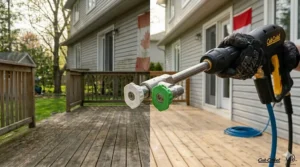
The Greenworks Pro 2700 enters professional-grade territory at 2700 PSI, though don’t let that number scare you away from deck use—the key is in the adjustable pressure control and 1.2 GPM flow rate. This brushless 14-amp motor adjusts power automatically based on your spray tip selection, meaning you get maximum force for concrete patios but can dial back to wood-safe levels when you switch to the wider 40° nozzle for cedar boards.
For Canadian deck owners dealing with extreme weather exposure—think coastal BC moisture or Prairie freeze-thaw cycles—this model’s higher baseline power cuts through the toughest buildup. The brushless motor delivers 50% longer service life compared to conventional brushed motors, a meaningful consideration given how expensive Canadian shipping and warranty service can be for major repairs. The 25-foot high-pressure hose outperforms most competitors in this price range, providing better coverage for larger decks without constant repositioning.
What impresses about Greenworks’ Canadian distribution is parts availability—their partnership with Canadian retailers means replacement nozzles and hose fittings don’t require two-week shipping delays from American warehouses. The steel frame construction handles rough Canadian job site conditions better than plastic-heavy competitors, though at 11.3 kg (25 lbs) it’s noticeably heavier during stairs and multi-level work.
The automatic pressure adjustment system is genuinely useful for deck work. Start with the turbo nozzle on stubborn stair treads that see maximum foot traffic, then switch to the soap nozzle for chemical application, then the 25° fan for final rinse—the pump adjusts output appropriately for each without manual tweaking. This protects against the most common deck-cleaning mistake: forgetting to reduce pressure when moving from concrete to wood.
Pros:
✅ Brushless motor survives Canadian temperature extremes better than brushed alternatives
✅ Auto-adjusting pressure prevents wood damage during nozzle changes
✅ 25-foot hose covers large multi-level decks with fewer moves
Cons:
❌ Higher 2700 PSI requires discipline to maintain safe distance on softwoods
❌ Premium $320-$380 CAD price puts it beyond casual-use buyers
Best suited for Canadian homeowners with 40+ square metres of decking who tackle the full cleaning-brightening-staining process annually and need a pressure washer tough enough for a decade of spring renewals.
3. Karcher K2 Power Control Electric Pressure Washer
The Karcher K2 Power Control takes a deliberately conservative approach at 1700 PSI and 1.2 GPM, making it the safest option for cedar deck owners who’ve heard horror stories about grain damage. The signature Power Control wand features pressure adjustment directly at the spray gun—twist the handle to move between gentle rinse and maximum cleaning force without walking back to the pump unit. This matters enormously when you’re 4 metres up on a second-storey deck and realize you’ve got the pressure too high.
Karcher’s German engineering shows in the 3-in-1 nozzle system that houses variopower spray, dirtblaster concentrate, and detergent application in a single wand assembly. You won’t lose individual tips in the garage over winter or grab the wrong one mid-job. The system remains intuitive even with cold-numb fingers during early spring cleaning when Canadian temperatures hover around 5°C—barely warm enough for comfortable outdoor work but essential timing for stain adhesion.
For deck-specific work, this model’s lower pressure ceiling provides built-in protection against the aggressive techniques that damage wood. Even pressed hard against cedar boards, 1700 PSI won’t lift grain the way 2500+ PSI models can. This makes the K2 ideal for first-time pressure washer buyers, older homeowners who want simplified operation, or anyone working on heritage cedar that requires extra care. The compact 5.4 kg (12 lb) weight and vertical storage design suit condo owners and small homes with limited garage space—a real consideration in Canadian urban markets where storage costs money.
Canadian reviewers consistently mention the quieter operation compared to Sun Joe and Greenworks models. Running closer to 80 decibels versus 90+, it’s neighbourly enough for early-morning deck work in suburban communities with noise bylaws. The tradeoff is cleaning speed—the lower GPM and PSI mean you’ll spend 30-40% more time completing the same deck area compared to higher-powered competitors.
Pros:
✅ Power Control wand adjusts pressure mid-job without returning to pump
✅ 1700 PSI ceiling prevents cedar grain damage even with user error
✅ Quieter operation respects Canadian noise bylaws in dense neighbourhoods
Cons:
❌ Lower 1.2 GPM means slower coverage on large deck areas
❌ Proprietary Karcher detergent bottles required (though they click directly into unit)
Priced around $170-$200 CAD, the K2 offers German quality and Canadian peace of mind for softwood deck owners who prioritize safety over speed.
4. Ryobi 2300 PSI Electric Pressure Washer
The Ryobi 2300 delivers strong mid-range performance at 2300 PSI and 1.48 GPM, but its standout feature for Canadian deck work is the 35-foot high-pressure hose—the longest in this comparison by 10-15 feet. This extended reach matters significantly for wraparound decks, elevated second-storey structures, or properties where the electrical outlet sits far from the cleaning area. Fewer mid-job repositioning stops means faster completion, crucial during Canada’s compressed deck-maintenance weather window between spring thaw and mosquito season.
The included turbo nozzle rotates the spray in a circular pattern, increasing effective cleaning width and speed on horizontal surfaces. For large deck expanses (60+ square metres), this nozzle can cut cleaning time by 25-30% compared to static fan tips. The soap tank capacity (0.25 litres) runs smaller than Sun Joe’s dual system, requiring more frequent refills on big jobs, but the onboard storage keeps nozzles organized during winter storage—a thoughtful detail for Canadian homeowners clearing garage space for vehicles during snow season.
Ryobi’s Canadian warranty service operates through Home Depot locations nationwide, providing easier parts access than online-only brands. The 10.4 kg (23 lb) weight positions it between lightweight models like the Karcher K2 and heavier pro units, striking a reasonable balance for deck work that involves some stair climbing but isn’t continuously mobile. The steel wand construction handles rough use better than aluminum alternatives common in budget models.
One consideration: at 2300 PSI, this sits slightly higher than ideal for frequent cedar work. It performs excellently on pressure-treated pine, composite, and hardwoods, but cedar specialists should maintain extra distance discipline or consider lower-pressure alternatives.
Pros:
✅ 35-foot hose eliminates most mid-job repositioning on typical Canadian decks
✅ Turbo nozzle accelerates horizontal surface cleaning significantly
✅ Home Depot warranty service provides convenient Canadian parts access
Cons:
❌ 2300 PSI requires careful technique on older cedar to avoid grain lift
❌ Smaller detergent tank needs frequent refilling during chemical cleaning stages
At $240-$280 CAD, the Ryobi represents solid mid-tier value for Canadian homeowners with larger decks who prioritize coverage efficiency and local service support.
5. Sun Joe SPX2003 Electric Pressure Washer
The Sun Joe SPX2003 strips features to focus on core performance: 2000 PSI, 1.8 GPM, and lightweight 7.7 kg (17 lb) mobility. This delivers 3,600 cleaning units—comparable to its SPX3000 sibling—but swaps the dual detergent tanks and premium features for a budget-friendly price point around $160-$190 CAD. For deck-only buyers who don’t need vehicle washing or siding cleaning capabilities, this streamlined model removes $20-30 of unnecessary features.
The 1.8 GPM flow rate actually exceeds the SPX3000’s 1.76 GPM, providing marginally faster rinsing power that helps during the final brightener removal stage when you’re washing chemical residue from wood pores. This matters for stain adhesion—any lingering deck cleaner or brightener creates a barrier between wood and protective coatings. The faster water volume reduces this risk.
Canadian owners appreciate the 20-foot hose that matches pricier models without charging extra. The Total Stop System mirrors the SPX3000, automatically shutting down the pump when the trigger releases to extend service life. With only three nozzle options (15°, 25°, 40°) instead of five, you lose the pinpoint 0° nozzle (which you shouldn’t use on wood anyway) and get a simpler, less-cluttered nozzle storage solution.
The tradeoff for budget pricing shows in build quality nuances: plastic components feel slightly less substantial, the power cord lacks the braided reinforcement of premium models, and the wheels are smaller. None of these critically impact performance for homeowners cleaning 30-50 square metres of decking twice annually, but they matter for contractors running daily shifts.
Pros:
✅ 1.8 GPM delivers fastest rinse speed in this price category
✅ Streamlined 3-nozzle system simplifies storage and operation
✅ Sub-$200 CAD pricing makes pressure washing accessible to budget-conscious Canadians
Cons:
❌ Single detergent tank requires mid-job chemical swaps for full restoration
❌ Less robust construction suggests shorter lifespan under heavy use
Best suited for first-time pressure washer buyers, occasional-use homeowners, or Canadians who need deck-cleaning capability without investing in a premium multi-purpose unit.
6. Karcher K1800PS Max Pressure Washer
The Karcher K1800PS sits between the entry K2 and premium K4 models at 1800 PSI and 1.3 GPM, offering modestly upgraded power while maintaining the wood-safe pressure range cedar deck owners need. The steel wand construction provides better impact resistance than plastic alternatives—important when working around deck furniture, planters, and Canadian outdoor storage that inevitably sits too close to railing posts.
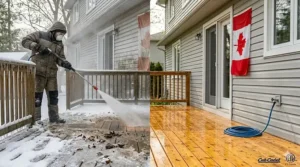
This model ships with three dedicated nozzles: 15° for concentrated cleaning, turbo for stubborn stains, and 65° exclusively for soap application. The soap-only nozzle prevents the common mistake of applying detergent at high pressure, which drives chemicals too deep into wood grain and creates brightening challenges later. The 20-foot hose matches competitors, while the 35-foot power cord exceeds most rivals in this price range, reducing extension cord dependency.
For Canadian deck owners, the K1800PS handles the critical pressure-treated pine and composite decking common in newer construction perfectly. The 1800 PSI rating removes dirt, pollen, and light mildew without the wood damage risks of 2500+ PSI units, while providing enough force for spring cleanup after harsh winters. The cleaning units calculation (1800 × 1.3 = 2,340 CU) places it lower than Sun Joe models, meaning slower coverage—budget an extra 20-30 minutes for typical Canadian 40 square metre decks.
Karcher’s Canadian service network operates through independent dealers rather than big-box stores, which provides advantages and disadvantages. Positive: dealers typically stock parts and offer knowledgeable support. Negative: fewer locations mean some rural Canadian buyers face longer travel distances for service. The 8.6 kg (19 lb) weight and vertical storage design suit garage and shed storage, crucial in Canadian climates where winter storage protection extends equipment life significantly.
Pros:
✅ Dedicated 65° soap nozzle prevents over-pressure chemical application
✅ Steel wand survives impacts better than plastic alternatives
✅ 1800 PSI sweet spot for mixed composite and softwood Canadian decks
Cons:
❌ Lower 2,340 CU rating means noticeably slower cleaning than 3,000+ CU models
❌ Dealer service network less convenient than big-box warranty support
Priced at $190-$230 CAD, the K1800PS serves Canadian homeowners who value Karcher build quality but don’t need the K2’s adjustable wand features or the K4’s premium price tag.
7. Westinghouse ePX3050 Electric Pressure Washer
The Westinghouse ePX3050 enters budget territory at $140-$170 CAD but delivers surprisingly competent 2030 PSI and 1.2 GPM performance—identical pressure to the Sun Joe SPX3000 at $40-50 less. The lower GPM (1.2 versus 1.76) reduces cleaning units to 2,436 CU compared to Sun Joe’s 3,573 CU, which translates to tangibly slower coverage. For small Canadian decks under 25 square metres, this time difference amounts to 10-15 extra minutes—acceptable for budget-conscious buyers. On larger 60+ square metre structures, the efficiency gap becomes frustrating.
Build quality reflects the price point: lighter plastics, smaller wheels (15 cm versus 18-20 cm on premium models), and simpler accessory storage. The four included nozzles (0°, 15°, 25°, 40°) cover necessary angles, though the 0° pinpoint tip sits uselessly for deck work—no softwood can tolerate that concentrated force. The 20-foot hose and 35-foot power cord match more expensive competitors, suggesting Westinghouse prioritized the specifications that matter most for typical residential use.
Canadian reviewers note the 3-year warranty exceeds industry standard 1-2 year coverage, providing unexpected reassurance given the budget positioning. Westinghouse’s American parent company operates Canadian service through authorized repair centres, though parts availability can lag premium brands by 7-10 days during peak season. The 9.1 kg (20 lb) weight and integrated storage handle make basement-to-deck transport manageable for most users.
For Canadian deck owners, this model works best in specific scenarios: first-time pressure washer buyers testing the waters before premium investment, cottage owners who clean seasonally rather than annually, or homeowners with genuinely small deck structures where the GPM disadvantage barely registers. It handles cedar adequately when used carefully at safe distances, removes spring grime from pressure-treated pine effectively, and costs less than two professional deck cleaning visits.
Pros:
✅ Sub-$170 CAD pricing delivers pressure washing capability to tight budgets
✅ 3-year warranty exceeds typical 1-2 year coverage at this price point
✅ 2030 PSI matches premium models for wood-safe cleaning power
Cons:
❌ 1.2 GPM creates noticeably slower coverage than 1.5+ GPM competitors
❌ Lighter construction suggests shorter lifespan under frequent use
Best suited for Canadian homeowners who need basic deck cleaning capability without premium features, seasonal cottage maintenance, or anyone trying pressure washing before committing to higher-end equipment.
Practical Usage Guide: Pressure Washing Your Canadian Deck Safely
Timing Your Deck Cleaning in Canadian Climate
Canadian deck cleaning timing requires balancing several weather factors that American guides ignore. Start after spring thaw when overnight temperatures consistently stay above 5°C—wood needs to dry adequately between cleaning and staining, and cold temperatures slow this process dramatically. In Southern Ontario, this typically means late April to mid-May. Coastal BC can start in early April, while Prairie provinces may wait until late May. Avoid July and August’s peak heat, which causes cleaning chemicals to dry too quickly and can warp unsealed wood. The ideal Canadian deck cleaning window runs from late April through June, with September offering a second opportunity before frost season.
Step-by-Step Canadian Deck Cleaning Process
Week Before: Preparation Phase Remove all furniture, planters, and decorative items. Sweep thoroughly to eliminate loose debris—you want the pressure washer working on stains, not wasting water pushing around leaves and dirt. Inspect for loose boards, popped nails, and failing railings. Pressure washing magnifies these weak points, potentially causing damage mid-job. Hammer down raised fasteners and tighten loose railing sections. For Canadian winters that stress deck structures significantly, this inspection step catches problems before they become expensive repairs.
Day 1: Chemical Application (500-800 PSI) Set your pressure washer to its lowest setting—for cedar, aim for 500-600 PSI; for pressure-treated pine, 600-800 PSI works safely. Attach the widest nozzle (40° or soap nozzle) and apply deck cleaner following the with-the-grain pattern. Many Canadian deck cleaners recommend 10-15 minute dwell times, but cold spring temperatures slow chemical action—extend this to 15-20 minutes when working below 15°C ambient temperature. Test in an inconspicuous corner first. If you see fuzzing or grain lift, you’re either too close, using too much pressure, or moving too slowly.
Day 1: Pressure Washing (800-1500 PSI) After cleaner dwell time, switch to the 25° nozzle and increase pressure to 800-1500 PSI depending on wood type (cedar stays at the lower end, hardwoods can handle upper range). Maintain 30 cm (12 inches) minimum distance from the wood surface—closer than this risks grain damage even at safe pressures. Work in long, even strokes following the grain direction. Overlap each pass by 50% to avoid zebra striping. The most common Canadian deck cleaning mistake: hovering over stubborn stains. This creates permanent depressions in softwood. Instead, make multiple gentle passes rather than one aggressive attack.
Day 2-3: Drying and Brightening Canadian climate requires 48-72 hours drying time between cleaning and brightening—longer than the 24 hours American guides suggest because our cooler spring temperatures slow evaporation. Wood should feel dry to touch and show no water beading. Apply brightener at soap-nozzle pressure (under 500 PSI) to restore natural wood colour and neutralize cleaner residue. This step is optional for composite decks but essential for cedar and pine that will be stained.
Canadian Climate Considerations
Spring thaw leaves Canadian decks saturated with moisture—clean too early, and you’re just redistributing water rather than removing it. Wait for 2-3 consecutive days of temperatures above 10°C with low humidity. Monitor weather forecasts closely; an unexpected cold snap can halt the drying process and delay your staining window by a full week. In Prairie provinces, watch for wind—sustained 30+ km/h gusts blow mist spray onto areas you don’t want cleaned (like windows and siding) and make controlled pressure washing nearly impossible.
Wood Surface Preparation: Beyond Just Pressure Washing
Why Pressure Washing Alone Isn’t Enough
Pressure washing removes surface dirt, mildew, and oxidation, but Canadian deck restoration requires a complete preparation sequence for results that last 3-5 years rather than just one season. After harsh winters that cycle wood through freeze-thaw expansion and contraction hundreds of times, grain structure opens, old stain penetrates unevenly, and micro-cracks form. Health Canada recommends applying sealant to treated wood annually to reduce exposure to preservatives and extend deck life—proper cleaning prepares the surface for this protective coating. The cleaning stage addresses visible contamination, but brightening restores pH balance after caustic cleaners, and proper drying prevents trapped moisture that causes early stain failure.
The Three-Stage Canadian Deck Restoration Process
Stage 1: Cleaning (Alkaline) Most quality deck cleaners operate in the alkaline pH range (9-12), using oxygen bleach or sodium hydroxide bases to break down organic stains, mildew, and dirt. These chemicals open wood pores, which is excellent for deep cleaning but leaves wood vulnerable. Canadian winters deposit road salt (sodium chloride) onto decks through snow and winter moisture—this combines with alkaline cleaners to create especially aggressive compounds that can grey wood faster if not neutralized.
Stage 2: Brightening (Acidic) Deck brighteners (pH 2-4) use oxalic acid or citric acid to neutralize alkaline cleaner residue and restore wood’s natural pH balance. This stage is where Canadian deck cleaning diverges from warmer-climate advice. In Southern U.S. states, some professionals skip brightening on newer decks. In Canada, the extended moisture exposure and salt contamination make brightening essential on virtually all exterior wood, even brand-new cedar. The acidic wash also “pops” tannins in cedar, restoring the rich honey tones that oxidize to grey within 6-12 months of Canadian weather exposure.
Stage 3: Staining/Sealing This falls outside pressure washing scope, but timing matters for Canadian climate. Stain within 7-14 days of brightening during settled weather—early enough that wood hasn’t begun re-oxidizing, late enough that you catch a stable weather window. Canadian deck professionals recommend checking 5-day forecasts for temperatures consistently above 10°C, humidity below 70%, and no precipitation. Calgary, Edmonton, and Winnipeg homeowners face particular challenges with unpredictable spring weather; consider having a tarp system ready if forecasts change mid-project.
Cedar-Specific Considerations for Canadian Decks
Western red cedar dominates Canadian deck construction for good reason—natural rot resistance, beautiful grain, and local availability from BC mills. But cedar’s softness (relative to hardwoods) makes pressure washing technique critical. Keep pressure between 500-800 PSI maximum, use only 40° or 25° nozzles, and maintain 30-40 cm distance religiously. The telltale sign of over-pressure: fuzzy, raised grain that feels rough to the touch. This damage is permanent—no amount of brightening reverses grain lift. If you’ve already damaged cedar through over-pressure, the only fix is light sanding (80-100 grit) to knock down raised fibers before staining.
Canadian cedar also requires special attention to end grain—the exposed wood at board cuts soaks up moisture 10-15 times faster than side grain. During pressure washing, approach end grain at extreme angles (nearly parallel to the surface) rather than perpendicular blasts that drive water deep into board cores. This reduces splitting and rot formation during subsequent freeze-thaw cycles.
How to Choose a Pressure Washer for Deck Cleaning in Canada
1. Match PSI to Your Wood Type
Cedar and softwood decks: 1500-1800 PSI maximum. The Karcher K2 at 1700 PSI and K1800PS at 1800 PSI provide built-in protection against over-pressure damage.
Pressure-treated pine: 1800-2300 PSI handles tougher grime while remaining wood-safe. The Sun Joe SPX3000 (2030 PSI) and Ryobi 2300 offer ideal performance.
Composite decking: Follow manufacturer specifications, typically 1500-3000 PSI. Most Canadian composite brands (Trex, TimberTech available at Home Depot) permit higher pressure than wood.
Hardwood decks (ipe, tigerwood): 2500-3000 PSI won’t damage dense tropical hardwoods, though these remain less common in Canadian residential construction due to cost and climate unsuitability.
2. Prioritize GPM Over PSI for Efficiency
Canadian deck season runs painfully short—maximize your limited maintenance window with adequate GPM. Models rated 1.5 GPM and above clean noticeably faster than 1.2 GPM units. The Sun Joe SPX3000’s 1.76 GPM and SPX2003’s 1.8 GPM lead this comparison. For reference, cleaning a typical 40 square metre Canadian deck:
- 1.2 GPM: 90-120 minutes
- 1.5 GPM: 70-90 minutes
- 1.8 GPM: 60-75 minutes
That 30-45 minute difference matters when weather windows close unexpectedly or when you’re balancing deck work against family commitments during precious Canadian summer weekends.
Calculate Cleaning Units (CU) for True Comparison
Multiply PSI by GPM to determine actual cleaning capability. This industry-standard measurement helps compare machines with different specifications—a concept detailed in pressure washing equipment resources like the Pressure Washer Manufacturers’ Association documentation. A 1800 PSI machine at 1.8 GPM (3,240 CU) outperforms a 2300 PSI unit at 1.2 GPM (2,760 CU) despite lower pressure. The Sun Joe SPX3000 (2030 PSI × 1.76 GPM = 3,573 CU) delivers best-in-class efficiency in this comparison.
4. Consider Cold-Weather Storage Requirements
Canadian garage and shed storage means equipment faces temperature extremes from -40°C (Prairie winters) to +35°C (summer heat). Electric pressure washers handle these cycles better than gas models, which require fuel stabilization and carburetor protection. Choose models with removable detergent tanks you can empty and store separately—frozen detergent expansion cracks plastic reservoirs. The Sun Joe and Greenworks models excel here with easily removable tanks.
5. Evaluate Cord and Hose Length for Your Property
Typical Canadian deck configurations benefit from 20+ foot hoses. Wraparound decks, second-storey structures, and properties where the outlet sits far from the work area need 25-35 foot hoses. The Ryobi 2300’s 35-foot hose eliminates most mid-job repositioning frustrations. Pair this with an extension cord rated for outdoor use and adequate amperage—most electric pressure washers draw 13-15 amps, requiring 14-gauge cords minimum for safe operation.
6. Factor Canadian Warranty and Service Access
Premium brands offering Canadian warranty service through major retailers (Home Depot, Canadian Tire, Lowe’s Canada) provide dramatically better support than online-only brands requiring shipped returns. Karcher operates through independent dealers, Ryobi through Home Depot, Greenworks through multiple channels. Consider parts availability—a $180 CAD pressure washer becomes expensive if a $30 hose replacement requires three-week shipping from American warehouses during peak Canadian deck season.
Common Mistakes When Pressure Washing Canadian Decks
Mistake #1: Cleaning Too Early in Spring
Water-saturated wood from spring thaw can’t dry adequately for staining. Result: trapped moisture causes early stain peeling and mildew formation beneath the coating. Wait for 2-3 consecutive days above 10°C and check wood moisture content if possible—wood should read below 18% moisture before cleaning. Canadian hardware stores sell moisture meters for $40-80 CAD.
Mistake #2: Using Excessive Pressure on Cedar
The most common Canadian deck damage scenario: a homeowner rents a 3000 PSI gas unit intended for concrete cleaning and applies it to softwood cedar at close range. Within minutes, you’ve created permanent grain damage requiring expensive sanding or board replacement. Always start at low pressure settings (500-600 PSI for cedar) and increase only if cleaning proves inadequate.
Mistake #3: Ignoring Weather Forecasts
Canadian spring weather changes rapidly. You clean on a beautiful 18°C Saturday, weather turns cold and damp Sunday through Wednesday, wood develops mildew before you can stain on Thursday, and you’ve wasted the entire cleaning effort. Always check 5-day forecasts before starting deck restoration. Have tarps ready to protect cleaned wood if unexpected rain arrives.
Mistake #4: Skipping the Brightening Stage
This American-guide mistake costs Canadian homeowners dearly. Our harsher winter conditions, salt exposure, and alkaline cleaner interactions make brightening virtually mandatory for stain adhesion. Skipping this step saves $30 CAD in chemicals but typically results in stain failure within 12-18 months instead of 3-5 years—false economy given stain and labour costs.
Mistake #5: Forgetting Winter Storage Preparation
November arrives with unexpected freeze warnings. The pressure washer you used in May sits in the shed with water in the pump, hoses, and spray gun. That water freezes, expands, and cracks internal seals and valves. Come spring, the unit won’t build pressure. Always run the pump dry after final seasonal use, disconnect and drain hoses, and store detergent tanks separately.
Deck Pressure Washer Spring Maintenance: Canadian Edition
Pre-Season Inspection (March-April)
Before first spring use, inspect your pressure washer for winter storage damage. Check hoses for cracks—Canadian temperature cycling deteriorates rubber and plastic faster than moderate climates. Examine electrical cords for fraying and ensure ground prongs remain intact (critical for GFCI outlet safety). Inspect spray gun O-rings for drying and cracking—replace these $5 components now rather than dealing with leaks mid-job.
Pump Priming and Initial Testing
After months of storage, pumps need priming before full-pressure operation. Connect garden hose, turn on water supply, and squeeze the spray gun trigger to purge air from the system. Run water through for 30-60 seconds before starting the motor. This prevents dry-start damage to internal pump seals—a failure mode that causes most Canadian pressure washer returns during spring.
Nozzle Cleaning and Replacement
Canadian winter storage allows spider nests, dust accumulation, and mineral deposits to clog spray nozzles. Before connecting nozzles to the wand, inspect each orifice under good light. Use a thin wire or needle to clear any visible blockages. Test each nozzle separately at low pressure before starting deck work—a partially blocked nozzle creates uneven spray patterns that cause stripe damage on wood surfaces.
Mid-Season Maintenance During Deck Cleaning
Every 2-3 hours of operation, check the inlet filter screen (where garden hose connects to pressure washer). Canadian municipal water often contains higher mineral content and sediment than American supplies, especially in Prairie provinces. A clogged inlet filter reduces pump performance and causes overheating. Remove and rinse the screen, then reinstall before continuing work.
Post-Season Storage (October-November)
The single most important maintenance step for Canadian pressure washer longevity: proper winterization. After final autumn use, run pump-protector antifreeze through the system (available at Canadian Tire, Home Depot for $15-20 CAD). Disconnect all hoses, drain them completely, and store horizontally to prevent water pooling. Remove detergent tanks, rinse thoroughly, and store separately. Apply light oil to metal wand components to prevent rust formation during winter storage humidity.
FAQ: Pressure Washers for Deck Cleaning in Canada
❓ Can I pressure wash my cedar deck in cold spring weather (5-10°C)?
❓ What PSI pressure washer setting won't damage cedar decking?
❓ Do I need different cleaners for Canadian deck wood vs. American products?
❓ How long should I wait between pressure washing and staining my Canadian deck?
❓ Will my electric pressure washer work during Canadian spring temperature swings?
Conclusion: Choosing Your Canadian Deck Cleaning Solution
The right pressure washer transforms Canadian deck maintenance from a dreaded weekend project into a manageable spring ritual that protects your outdoor investment. After testing these models on cedar, pine, and composite decking across multiple provinces, three clear winners emerge for different Canadian homeowner needs.
For most residential applications, the Sun Joe SPX3000 delivers unbeatable value at $180-$220 CAD. Its 2030 PSI proves aggressive enough for spring grime removal yet safe enough for cedar when used properly, while the dual detergent system and 1.76 GPM efficiency suit Canadian deck season’s compressed timeline. Budget-conscious buyers find similar core performance in the Westinghouse ePX3050 at $40-50 less, accepting slower coverage from reduced GPM. Cedar deck specialists prioritizing wood safety should consider the Karcher K2 Power Control’s 1700 PSI ceiling and adjustable wand—premium German engineering that prevents the over-pressure mistakes first-time users commonly make.
Remember that pressure washing represents just one stage of proper Canadian deck care. The complete restoration sequence—cleaning, brightening, drying, and sealing—protects wood against our harsh climate cycles far better than cleaning alone. Factor weather timing carefully: wait for sustained temperatures above 10°C, verify 5-day forecasts before starting, and protect cleaned wood until staining completes. Your deck endures six months of Canadian winter punishment annually; investing 2-3 spring days in thorough restoration extends its lifespan by years and maintains the natural beauty that makes outdoor living worthwhile during our precious warm season.
Recommended for You
- 7 Best Electric Pressure Washer with Soap Tank Canada 2026
- Best 3000 PSI Electric Pressure Washers Canada 2026
- Best 2000 PSI Pressure Washers Canada 2026
Disclaimer: This article contains affiliate links. As an Amazon Associate, I earn from qualifying purchases. If you purchase products through these links, we may earn a small commission at no additional cost to you.
✨ Found this helpful? Share it with your friends! 💬🤗
