
In This Article
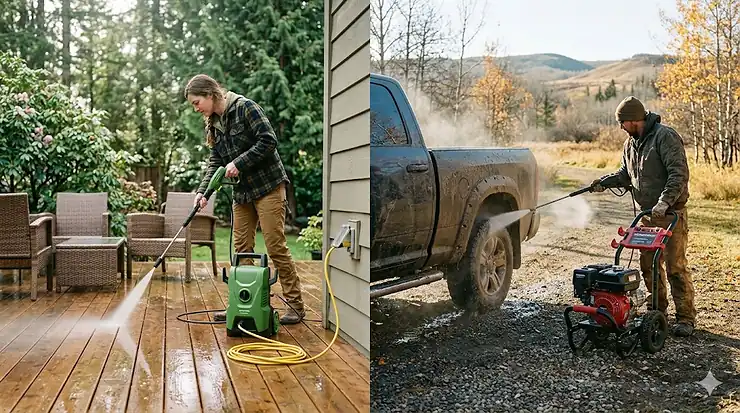
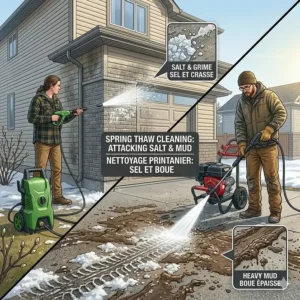
Spring arrives in Canada like a slow exhale after a long held breath — and if you’re like me, the first thing you notice isn’t the tulips. It’s the grime. Salt-caked driveways, mud-splashed siding, moss-covered decks that spent six months under snow — welcome to the annual ritual of post-winter cleanup that every Canadian homeowner knows too well.
That’s exactly when the question hits: do I go electric or gas?
When it comes to choosing between an electric vs gas pressure washer in the Canadian climate, the stakes are a bit higher than in warmer countries. Our seasons are extreme. Temperatures in Winnipeg can swing 60°C between January and July. Coastal British Columbia throws salt air and perpetual rain at your equipment year-round. Ontario homeowners need something that powers through spring mud and fall leaf stains, then survives a heated garage all winter.
So the electric vs gas pressure washer Canadian climate debate isn’t just about cleaning power — it’s about what survives our climate, fits our garages, respects our electrical standards, and actually delivers value in CAD.
In short: an electric pressure washer runs off a standard household outlet (120V in Canada), weighs less, and costs less upfront. A gas pressure washer runs on petrol, generates significantly more PSI and GPM (gallons per minute), and isn’t tied to an extension cord. Both have a real place in the Canadian market — the difference is knowing your scenario.
By the end of this guide, you’ll know exactly which type fits your property, your budget in CAD, and your climate zone. I’ve researched every product on Amazon.ca, prioritised models with strong Canadian reviewer feedback, and included practical cold-weather advice that the product listings simply won’t tell you.
Quick Comparison: Electric vs Gas Pressure Washer at a Glance
| Feature | Electric | Gas |
|---|---|---|
| Typical PSI Range | 1,500–3,000 PSI | 2,700–4,200 PSI |
| Typical GPM | 1.2–1.76 GPM | 2.3–4.0 GPM |
| Starting Price (CAD) | $150–$500 range | $400–$900+ range |
| Weight | 10–18 kg (22–40 lbs) | 25–40 kg (55–88 lbs) |
| Noise Level | Moderate (quiet motor) | Loud (engine noise) |
| Emissions | Zero | Yes (CO — outdoor use only) |
| Maintenance | Minimal | Regular (oil, spark plugs, fuel) |
| Winter Storage | Easier | Requires fuel stabiliser |
| CSA Certification | Common | Less common — verify before buying |
| Best For | Urban/suburban residential | Large properties, farms, contractors |
The numbers above tell part of the story, but here’s what they don’t tell you: in a Canadian context, the weight difference matters enormously when you’re hauling equipment from a basement storage shelf to a frost-heaved driveway. Electric models also run on standard 15-amp household circuits — no extension cord worries unless the unit specifies a GFCI outlet, which most Canadian residential outlets near garages already provide. Gas models deliver roughly 30–50% more cleaning units (PSI × GPM) than comparably priced electric models, which is transformative for concrete and masonry work, but genuinely overkill for washing a Honda CR-V.
💬 Just one click — help others make better buying decisions too!😊
✨ Don’t Miss These Exclusive Deals!
🔍 Take your cleaning game to the next level with these carefully selected pressure washers. Click on any highlighted product name to check current pricing and availability on Amazon.ca — most are Prime-eligible for fast, free shipping across Canada!
Top 7 Pressure Washers for the Canadian Climate: Expert Analysis
1. Sun Joe SPX3000 Electric High-Pressure Washer — The People’s Champion of Amazon.ca
If you’ve spent any time on Amazon.ca’s pressure washer listings, you already know this name. With over 40,000 reviews and consistently topping Amazon Canada’s best-seller list, the Sun Joe SPX3000 has earned its reputation the old-fashioned way: by working reliably for tens of thousands of Canadian homeowners.
The 14.5-amp motor delivers 2,030 PSI and 1.76 GPM, which translates to a cleaning unit (CU) rating of approximately 3,572 — enough to strip stubborn algae from a wood deck, blast road salt off a concrete driveway, and clean a mid-sized SUV without risking paint damage. The dual detergent tanks are a feature most buyers underestimate: you can pre-load two different soap solutions and switch between them depending on the surface, without stopping to refill. For Canadians dealing with both vehicle undercarriage cleaning (road salt!) and deck care in the same session, that’s genuinely time-saving.
What I particularly like about this model for Canadian buyers is the 35-foot GFCI-protected power cord. In a typical Canadian garage-to-driveway scenario, that cord length means you’re reaching the end of your laneway without an extension cord — critical, since daisy-chaining extension cords with a pressure washer can trip your breaker on older homes. The Total Stop System (TSS) also shuts the pump down automatically when the trigger is released, extending pump life significantly in our stop-start cleaning style.
Canadian reviewers consistently praise its out-of-box simplicity and performance in spring cleanup, though some note that it can struggle with heavily stained concrete that’s been under ice for months — for that, the turbo nozzle is your best friend.
✅ Five colour-coded quick-connect nozzles included
✅ TSS pump protection system
✅ 35-foot GFCI cord — great Canadian garage reach
❌ Plastic connectors can feel fragile in very cold temperatures
❌ GPM is on the lower end for large-surface concrete cleaning
Price range: Around $200–$280 CAD — exceptional value for what you get. Prime-eligible on Amazon.ca.
2. Kärcher K5 Premium Electric Pressure Washer — The German-Engineered Upgrade
There are two types of pressure washer buyers in Canada: those who buy a Sun Joe and are happy, and those who buy the Kärcher K5 Premium and never look back. This is the upgrade pick, and it earns that title through one standout feature: the water-cooled induction motor.
At 2,000 PSI and 1.4 GPM, the K5 Premium’s raw numbers look slightly lower than some competitors, but the water-cooled induction motor means it can run continuously far longer without overheating than air-cooled motors in cheaper electric units. That matters enormously in Canada when you’re doing a full autumn blitz — cleaning gutters, washing the car, scrubbing the patio, and rinsing the garage floor all in one Saturday session. Standard air-cooled motors start thermally throttling after 30–40 minutes of sustained use; the K5 Premium just keeps going.
The Vario Power Spray (VPS) wand allows you to dial pressure continuously from a light rinse to full blast without switching nozzles. For Canadian buyers who are new to pressure washing, this dramatically reduces the risk of accidentally blasting off deck staining, stripping window caulking, or etching soft cedar siding — all common first-timer mistakes that end up being expensive repairs.
Kärcher also has a solid Canadian service and warranty network, which is worth noting. Parts and accessories are readily available through Canadian Tire and specialty tool retailers, so you’re not stranded if something needs servicing.
Canadian reviewers love the Smart Control variant (a step up from the base K5 Premium) for its app connectivity, though most note that the basic K5 Premium offers the best value-to-performance ratio in the lineup.
✅ Water-cooled induction motor — built for long Canadian cleaning sessions
✅ Continuous pressure adjustment with VPS wand
✅ Strong Canadian parts and service network
❌ Higher upfront cost than budget electric options
❌ Hose and wand connections are Kärcher-proprietary — accessories cost more
Price range: $350–$500 CAD range, depending on variant. Available on Amazon.ca, Prime-eligible.
3. Greenworks Pro 2700 PSI Electric Pressure Washer — The Brushless Powerhouse
When Greenworks introduced a brushless motor to a consumer electric pressure washer at this price point, it was a genuine shift in what Canadian homeowners could expect from a plug-in unit. The Greenworks Pro 2700 PSI is the closest thing to a gas-replacement that electric technology currently offers.
The 14-amp brushless motor generates up to 2,700 PSI — competitive with entry-level gas units — and automatically adjusts pressure based on the nozzle installed. Swap to the turbo nozzle and you’re rotating at 2,700 PSI against concrete; switch to the soap nozzle and pressure drops appropriately to protect painted surfaces. That automatic adjustment isn’t just convenient — it actively prevents the kind of surface damage that happens when Canadian homeowners use the wrong tip on aged cedar fencing that’s already been through five freeze-thaw cycles.
For Canadian urban homeowners in cities like Calgary, Ottawa, or Halifax with a modest driveway and a vehicle to wash, this machine punches above its weight class without the noise, fumes, or fuel storage requirements of a gas unit. It weighs around 13 kg (28.6 lbs) and its compact footprint fits easily in a standard Canadian closet or against a garage wall without eating into your winter tire storage space.
Canadian reviews highlight its exceptional performance on salt-stained driveways in particular — the higher PSI versus standard electric models makes noticeably quicker work of road salt and calcium chloride deposits that Canadian winters love to leave behind.
✅ Brushless motor — longer lifespan, quieter operation
✅ Automatic pressure adjustment by nozzle type
✅ High PSI for an electric — approaches gas-level performance
❌ Heavier than budget electric options
❌ Higher price point than Sun Joe or entry-level Kärcher models
Price range: $280–$380 CAD range. Available on Amazon.ca.
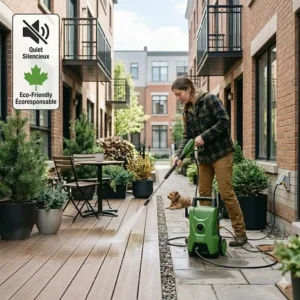
4. Kärcher K2 Power Control Electric Pressure Washer — The Budget Hero for Canadian Apartments and Condos
Not everyone needs to blast a century-old concrete barn foundation. For the growing number of Canadians living in condos, townhomes, or semi-detached houses with small patios and one vehicle, the Kärcher K2 Power Control is genuinely all the pressure washer you’ll ever need — at a price that won’t make you flinch.
At 1,600 PSI and 1.4 GPM, this compact unit won’t strip paint off a steel bridge, but it absolutely handles a balcony clean-up, a car wash, a small deck, or patio furniture restoration. What makes it stand out at this price point is the Power Control system — a dial on the gun that adjusts pressure on the fly without changing nozzles. For Canadian condo dwellers who may be new to pressure washing and are understandably nervous about accidentally marking up shared surfaces or blasting water into a neighbour’s unit, that fine control is a meaningful safety feature.
The K2 weighs under 5 kg (11 lbs) — light enough for someone to carry up from a condo storage unit in one hand. It stores in a box the size of a small suitcase. For Canadians in urban centres like Toronto, Vancouver, or Montréal who are space-constrained, this is the clear choice.
Canadian Tire stocks Kärcher accessories, so you’re never far from a compatible nozzle tip or detergent bottle. The 2-year warranty covers you well for a budget unit.
✅ Extremely lightweight — ideal for condo/apartment storage
✅ Pressure control dial on the gun
✅ Budget-friendly without sacrificing the Kärcher build quality
❌ 1,600 PSI limits heavy-duty cleaning capability
❌ Hose is shorter than some competitors (5 m/16 ft)
Price range: $150–$220 CAD range. Widely available on Amazon.ca, often Prime-eligible.
5. Westinghouse ePX3500 Electric Pressure Washer — The Anti-Tipping Innovator
Westinghouse may be best known in Canada for its gas units, but the Westinghouse ePX3500 has carved out a strong niche in the electric category by solving a problem nobody talks about enough: stability on uneven terrain.
The ePX3500’s proprietary anti-tipping design with a wide-stance base is more relevant to Canadian buyers than it might seem. Our driveways aren’t flat — frost heaving, cracked concrete, interlocking brick paths, and sloped garage aprons are standard features of Canadian residential properties. A pressure washer that tips over mid-use and yanks the hose across a freshly-cleaned surface is maddening. The ePX3500 was clearly designed with this in mind, and Canadian reviewers consistently note that it stays planted even on uneven ground.
At 2,500 PSI and 1.76 GPM, it sits between the Sun Joe SPX3000 and the Greenworks Pro in terms of raw power, with a 4,400 CU cleaning rating that handles most residential Canadian tasks comfortably. The onboard soap tank and five quick-connect nozzles (including a turbo nozzle that’s particularly effective on road-salt buildup) round out a strong package.
The steel wand is worth highlighting because budget electric pressure washers often come with plastic wands that become brittle in cold weather and can crack if left in an unheated garage over a Canadian winter. The ePX3500’s metal wand handles temperature cycling much better.
✅ Anti-tipping design — outstanding on Canadian frost-heaved driveways
✅ Steel wand survives cold-weather storage cycles
✅ 2,500 PSI — strong mid-tier electric performance
❌ Slightly heavier than the Sun Joe SPX3000
❌ Westinghouse electric service network in Canada is smaller than Kärcher’s
Price range: $220–$320 CAD range. Available on Amazon.ca, Prime-eligible.
6. Westinghouse WPX2700 Gas Pressure Washer — The Best Value Entry into Gas Power
Here’s where the conversation shifts. If your property includes a long driveway, a detached garage, an acreage, or surfaces that an electric unit simply can’t clean efficiently — the Westinghouse WPX2700 is the most sensible entry point into gas-powered pressure washing in Canada.
At 2,700 PSI and 2.3 GPM, this Westinghouse unit delivers 6,210 cleaning units — nearly double what the Sun Joe SPX3000 produces. That’s not incremental — it’s transformative. A cleaning task that takes 45 minutes with an electric unit can realistically be done in 20 minutes with the WPX2700. For Canadians with short summers and cramped outdoor cleaning windows, that efficiency matters.
The unit runs on a Westinghouse OHV (overhead valve) engine, which starts consistently — an important feature for Canadians who may be attempting a spring startup after 6 months of cold storage. Westinghouse includes a 3-year warranty on this model, which compares favourably to many competitors at this price tier.
The four quick-connect nozzles cover 0°, 15°, 25°, and 40° spray patterns, plus a soap nozzle — everything a Canadian homeowner needs to tackle driveways, decks, vehicles, fencing, and gutters in a single session. At approximately 32 kg (70.5 lbs), it’s not a machine you’re going to carry up a flight of stairs, but the never-flat tyres and folding handle make garage storage manageable.
One honest caveat: before buying any gas pressure washer, verify that your municipality permits their use in residential zones. Some Canadian urban municipalities have noise bylaws that restrict gas-powered outdoor equipment to certain hours.
✅ 2,700 PSI / 2.3 GPM — genuine heavy-duty residential cleaning power
✅ 3-year warranty — strong coverage for Canadian buyers
✅ Consistent cold-start performance after winter storage
❌ Loud operation — check local noise bylaws
❌ Requires winterization with fuel stabiliser each autumn
Price range: $450–$600 CAD range. Available on Amazon.ca.
7. Simpson Cleaning MegaShot MSH3125 Gas Pressure Washer — The Honda-Powered Long-Term Investment
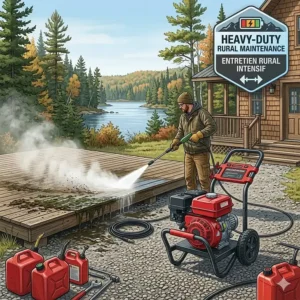
There’s a segment of Canadian buyers — rural homeowners, hobby farmers, contractors, or anyone maintaining more than half an acre — for whom the Simpson MegaShot MSH3125 isn’t a luxury. It’s the tool that makes every other cleaning task faster.
The defining feature of this machine is the Honda GCV160 engine. Honda small engines have an extraordinary reputation for cold-start reliability and longevity — a reputation earned over decades across Canadian farms, construction sites, and properties from Prince Edward Island to British Columbia. In practical terms, this engine is going to start on the first or second pull, even after a properly winterized six-month storage, year after year. That reliability has a real dollar value that a spec sheet doesn’t reflect.
At 3,100 PSI and 2.5 GPM, the MSH3125 generates 7,750 cleaning units — enough to strip old paint from masonry, deep-clean a gravel driveway, blast mould from composite decking, or prepare concrete for resealing. The AAA industrial triplex pump is another standout: unlike the axial pumps found in most residential gas pressure washers (including the Westinghouse WPX2700), a triplex pump is rated for professional-level hourly use and can last 15–20 years with proper maintenance.
For Canadian buyers in rural areas or with large properties in provinces like Alberta, Saskatchewan, or Ontario’s cottage country, the total cost of ownership calculation strongly favours the Simpson. Yes, it costs more upfront — but a machine that lasts 15 years at $600 CAD amortises to $40 per year, which is outstanding value.
✅ Honda GCV160 engine — legendary cold-start reliability
✅ AAA triplex pump rated for professional-level longevity
✅ 3,100 PSI for heavy-duty Canadian rural and farm applications
❌ Highest price point in this list
❌ Heavier and bulkier — requires dedicated storage space
Price range: $600–$800 CAD range. Available on Amazon.ca — confirm shipping to your province, as large/heavy items may have extended delivery windows to remote areas.
Canadian Climate Usage Guide: Maximising Your Pressure Washer Through All Four Seasons
Canada doesn’t have a pressure washing season — it has a narrow pressure washing window, and squeezing maximum value out of it requires a different approach than buyers in warmer climates.
Spring: The First Run After Winter
Before you fire up any pressure washer on April 1st in Saskatoon, do a quick pump inspection. Squeeze the trigger briefly before switching the unit on to release any residual pressure. For gas models, check the oil level and fuel stability — if you added fuel stabiliser properly in October, you should be good to start. For electric models, check the power cord for cracking from cold storage; PVC insulation can become brittle after six months in an unheated garage.
Start your spring clean on a day above 5°C (41°F). Operating a pressure washer when ambient temperatures are near or below freezing risks freezing water in the pump mid-session, which can cause seal damage. Wait for a mild spring day — they come, even in Calgary.
Summer: Peak Performance
Electric pressure washers run most efficiently in warm, dry summer conditions. Use this window for your highest-value projects: deck stripping and re-staining prep, vehicle detailing, and concrete driveway cleaning. For Canadians in humid provinces like Ontario and Quebec, summer is also your best window for removing mould and mildew from north-facing siding — which can build up aggressively in our climate.
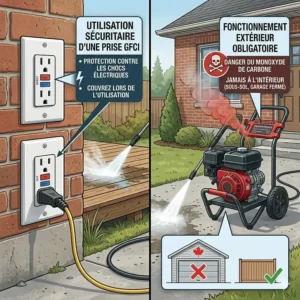
Gas models should not be operated in enclosed spaces in summer or any season. Health Canada guidelines on carbon monoxide safety are clear: CO from gas engines is odourless and lethal in confined spaces. Always run gas pressure washers in open, well-ventilated outdoor areas.
Autumn: The Preparation Season
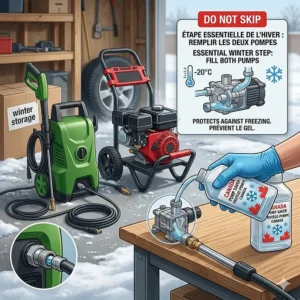
October is your last reliable window for outdoor cleaning in most of Canada, and it’s also the time to prepare your pressure washer for winter storage. Run a pump saver solution (available at Canadian Tire and Home Hardware) through both electric and gas pumps. For gas models, add fuel stabiliser to fresh gasoline, run the engine for 2 minutes to circulate it, then drain the remaining fuel or run the engine until it starves — opinions differ on which is better, but fuel stabiliser is the safest bet for most Canadian buyers.
According to Canadian Tire’s winterization guide, using a pump saver specifically releases antifreeze content that protects internal pump seals — a step that’s particularly important in provinces where garage temperatures can still drop below freezing overnight even in October.
Winter: Proper Storage Matters More Than You Think
Electric pressure washer storage in winter is simpler than gas — no fuel system to worry about. Store the unit with drained hoses and a pump saver applied, in a space that stays above -5°C where possible. A basement, heated garage, or insulated garden shed works well.
Gas models need more care. Leftover ethanol-blend fuel sitting in a cold carburetor over a Canadian winter leads to gum deposits, corrosion, and a very frustrating spring startup. A quality fuel stabiliser — Canadian Tire’s house brand or STA-BIL — prevents this. Note that in Canada, most gasoline at the pump contains 10% ethanol (E10), which degrades faster than pure gasoline; this makes fuel stabiliser especially important for Canadian gas pressure washer owners.
Canadian Buyer Profiles: Which Pressure Washer Fits Your Life?
Every product recommendation I make above is only as useful as it is relevant to your specific situation. Here are three real Canadian scenarios that map to different choices.
Profile 1: The Urban Toronto Condo Owner — Meet Jennifer
Jennifer owns a two-bedroom condo on the 3rd floor of a building near Yonge and Eglinton with a private balcony and underground parking for one vehicle. Her cleaning needs: wash her Honda Fit twice a month in the underground parking lot, and clean her small balcony once a season.
Best match: Kärcher K2 Power Control — At under 5 kg and the size of a carry-on bag, it lives under her kitchen sink. The pressure control dial means she won’t accidentally blast water into the neighbouring unit’s window. She doesn’t need 3,000 PSI; she needs control, portability, and easy storage. Budget: under $220 CAD. Easily Prime-eligible from Amazon.ca.
Profile 2: The Suburban Ottawa Family — Meet the Tremblays
The Tremblay family has a semi-detached home in Barrhaven with an asphalt driveway (approx. 10m × 6m), a cedar deck, two cars, and a garden shed. They also deal with serious spring mud and road salt cleanup every year. They want one machine to handle everything for the next 5–7 years.
Best match: Sun Joe SPX3000 or Westinghouse ePX3500 — The SPX3000’s Canadian track record and value at ~$250 CAD is hard to ignore. However, if the driveway salt cleanup is their primary concern, the ePX3500’s 2,500 PSI and stable base on uneven asphalt edges it ahead slightly. Either choice delivers great value at $200–$320 CAD.
Profile 3: The Rural Alberta Acreage Owner — Meet Gary
Gary owns 5 acres outside of Red Deer with a detached shop, a concrete apron, horse fencing, farm equipment, and two trucks. He needs something that works far from the house (no outlet nearby), cleans concrete and equipment quickly, and will still start reliably in April after a proper winter.
Best match: Simpson MegaShot MSH3125 — No electric unit on this list can do what Gary needs. The Honda engine’s cold-start reliability and the AAA triplex pump’s longevity make the higher CAD price a sound long-term investment. For Gary, this machine pays for itself in the first season.
How to Choose an Electric vs Gas Pressure Washer in Canada: A Decision Framework
Choosing between an electric vs gas pressure washer in the Canadian climate comes down to six factors that no spec sheet prioritises for you:
- Property size and surface type — If your cleaning area is primarily under 150 sq metres (1,600 sq ft) of mixed surfaces (driveway, deck, one vehicle), a mid-range electric model at 2,000–2,700 PSI handles this comfortably. Larger properties, commercial surfaces, or heavy concrete cleaning benefit measurably from gas.
- Access to power outlets — Canadian residential properties often have only one exterior outlet, sometimes in an inconvenient location. If you’re cleaning a back laneway or barn exterior more than 30 metres (100 ft) from any outlet, a gas unit eliminates extension cord limitations entirely.
- Noise tolerance and local bylaws — According to NRC Canada’s noise exposure guidelines, sustained exposure above 85 dB is a health concern. Gas pressure washers typically operate at 85–95 dB at 1 metre — comparable to a lawn mower. Electric units run at 70–80 dB. In urban centres and dense neighbourhoods, the electric advantage here is significant.
- Winter storage capacity — Be honest about your garage space. A gas unit requires more floor space, and improperly stored gas equipment is a safety and performance liability. If you’re already wrestling with snow blower, lawn mower, and bike storage in a standard Canadian two-car garage, the compact footprint of an electric unit might be the deciding vote.
- Budget in CAD, including long-term costs — Electric units cost less upfront ($150–$500 CAD range) and have almost no ongoing maintenance cost. Gas units run $450–$900+ CAD and require annual oil changes (~$15 CAD), spark plug replacement (every 2–3 seasons, ~$10 CAD), air filter replacement, and fuel stabiliser (~$10 CAD per season). Add this up over 10 years and a gas unit costs $200–$300 more to maintain.
- CSA certification and Canadian electrical standards — For electric pressure washers, look for CSA or cUL (Underwriters Laboratories Canada) certification. This confirms the unit meets the Canadian Electrical Code standards and is safe for use on Canadian 120V/15A circuits. Gas units should be certified for emissions compliance in your province — particularly relevant in British Columbia, which has its own emission standards under the Motor Vehicle Act.
What to Expect: Real-World Performance in Canadian Conditions
It’s one thing to read PSI ratings in a comparison table. It’s another to understand what those numbers mean when you’re standing in your Ottawa backyard on a May morning with 8 months of winter grime to remove.
Electric Performance in Cold Canadian Conditions
A key thing that most Canadian buyers don’t know: electric pressure washer motor efficiency drops when the unit has been stored in a cold, unheated garage. The first 2–3 minutes of operation on a cold spring morning, the motor runs slightly below peak efficiency as it warms. This isn’t a defect — it’s physics. The practical takeaway is to let the unit run briefly before tackling your toughest surface.
Cold water from a Canadian garden tap in early May also runs colder than in summer — sometimes 5–8°C (41–46°F) — which slightly reduces the detergent’s cleaning effectiveness. Add warm water to your detergent tank where the unit allows it, or use a cleaning detergent formulated for cold-water use. Products like Kärcher’s Multi-Purpose Cleaner are formulated to work in colder Canadian water temperatures.
Gas Performance on Longer Cleaning Sessions
Gas pressure washers genuinely shine on marathon cleaning sessions. The sustained output of a Honda GCV160 engine doesn’t degrade over a 4-hour cleaning day the way an electric motor can thermally throttle. For Canadian homeowners doing a full annual cleanup — driveway, fence line, all vehicles, shop floor, deck — in a single Saturday, gas delivers consistent performance from first minute to last.
The trade-off is noise and fumes. Running a gas pressure washer for 4 hours on a Saturday morning next to a suburban neighbour in Mississauga is a different social equation than using it on a rural acreage.
Common Mistakes When Buying a Pressure Washer in Canada
After reading thousands of Canadian buyer reviews on Amazon.ca, here are the mistakes that show up again and again:
Mistake 1: Buying a US-listed spec and expecting Canadian performance Several budget models sold on Amazon.ca are rated in “max PSI” based on American PWMA testing standards, not CETA (Clean Earth Technology Association) standards used in Canada. The Sun Joe SPX3000, for example, is rated at 2,030 PSI per CSA internal testing — the real operating pressure under continuous use is around 1,450–1,600 PSI. This isn’t a scam; it’s a testing methodology difference. Always look for the operational PSI rating, not the advertised peak.
Mistake 2: Ignoring the GPM rating Canadian buyers fixate on PSI (pressure) and overlook GPM (flow rate). Cleaning power is PSI × GPM = cleaning units. A 2,500 PSI unit with 1.2 GPM delivers 3,000 CU. A 2,000 PSI unit with 1.76 GPM delivers 3,520 CU — actually cleans better, despite lower pressure. The Sun Joe SPX3000 beats several higher-PSI competitors on actual cleaning performance precisely because of this.
Mistake 3: Choosing a gas unit for a city home without checking noise bylaws Several Canadian municipalities — including the City of Toronto, Vancouver, and Ottawa — have noise bylaws that restrict gas-powered outdoor power equipment to specific hours (typically 7 am–9 pm on weekdays, later restrictions on Sundays and holidays). Check your municipality’s bylaws before investing in a gas unit if you live in a dense residential area.
Mistake 4: Forgetting about Canadian warranty coverage A US brand with a 3-year warranty may provide warranty service through US service centres only. Always verify that the manufacturer has Canadian service centres or authorised Canadian repair depots before purchasing. Kärcher, Sun Joe, Greenworks, and Westinghouse all have established Canadian warranty service infrastructure. Some lesser-known brands sold on Amazon.ca do not — and a $300 machine with no Canadian service centre is effectively a disposable product.
Mistake 5: Not winterizing This one is heartbreaking and entirely preventable. A non-winterized pressure washer pump can freeze, crack, and fail beyond repair after a single Canadian winter left in an unheated garage. A $15 bottle of pump saver from Canadian Tire is the cheapest insurance you’ll ever buy.
Long-Term Cost and Maintenance in Canada: The Real Numbers
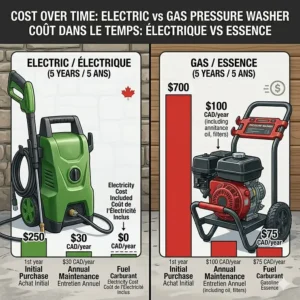
Let’s run an honest 5-year total cost of ownership calculation in CAD for a mid-range electric vs a mid-range gas unit.
| Cost Category | Electric (Sun Joe SPX3000) | Gas (Westinghouse WPX2700) |
|---|---|---|
| Purchase Price | ~$250 CAD | ~$520 CAD |
| Annual Oil Changes | $0 | ~$18 CAD/yr × 5 = $90 |
| Spark Plugs | $0 | ~$10 CAD / 2 yrs = $25 |
| Air Filter | $0 | ~$12 CAD / 2 yrs = $30 |
| Fuel Stabiliser | $0 | ~$12 CAD/yr × 5 = $60 |
| Nozzle/Accessory Replacement | ~$30 over 5 yrs | ~$30 over 5 yrs |
| Pump Saver (annual) | ~$10 CAD/yr × 5 = $50 | ~$10 CAD/yr × 5 = $50 |
| 5-Year Total | ~$330 CAD | ~$775 CAD |
The numbers show that a mid-range gas unit costs approximately 2.3× more over five years than a comparable mid-range electric model in Canada. That cost gap closes significantly if you own the gas unit for 10–15 years (as the purchase price amortises), which is one argument for investing in the quality of the Simpson MegaShot’s Honda engine and AAA pump upfront — it’s designed to last two to three times longer than budget gas units.
The comparison above uses real CAD pricing and maintenance cost estimates based on current Canadian Tire pricing at the time of research. Prices may vary by region — notably, maintenance parts can cost 10–20% more in remote or northern communities due to shipping.
✨ Don’t Miss These Exclusive Deals!
🔍 These carefully selected pressure washers are available right now on Amazon.ca. Click any highlighted product name to check current pricing, confirm Prime eligibility, and see the latest Canadian buyer reviews. Act before prices change!
Canadian Regulations and Safety Standards for Pressure Washers
This is the section that most blogs skip — and it’s the one that can cost you real money if you ignore it.
CSA Certification for Electric Models In Canada, the Canadian Standards Association (CSA) is the primary certification body for electrical appliances. For a pressure washer to be legally sold and used in Canada, it must carry CSA, ULC (Underwriters Laboratories of Canada), or an equivalent approved certification mark. When buying from Amazon.ca, most major brands (Kärcher, Sun Joe, Greenworks, Westinghouse) include this certification. Buyer beware: some very low-cost units from lesser-known brands sold on Amazon.ca’s marketplace may not include Canadian-market certification — always check the product listing for “CSA certified” or “cUL listed.”
Gas Pressure Washer Emissions Canada follows Environment and Climate Change Canada’s Off-Road Engine Emission Regulations, which set emission standards for small engines including those used in gas pressure washers. Most major brands (Honda, Briggs & Stratton, Westinghouse) comply with these standards. British Columbia has its own stricter standards under the BC Motor Vehicle Act — confirm compliance before purchasing if you’re in BC.
Safe Use: No Indoor Operation for Gas Models Health Canada is explicit: gasoline engines produce carbon monoxide, which is colourless, odourless, and lethal in enclosed spaces. Never operate a gas pressure washer in an attached garage, basement, or any space with limited ventilation, even with the door open. This applies year-round, but is especially important in Canadian spring when people are tempted to fire up equipment in a half-open garage during shoulder-season cold snaps.
Bilingual Product Labelling Under the Consumer Packaging and Labelling Act, products sold in Canada must have bilingual (English and French) labels. Major brands selling on Amazon.ca generally comply — but if you’re purchasing a product as a gift or for a Quebec recipient, confirm bilingual labelling is included, particularly for user manuals.
FAQ: Electric vs Gas Pressure Washer Canadian Climate
❓ Is an electric pressure washer powerful enough for a Canadian driveway?
❓ Can I use a gas pressure washer in my Canadian garage in winter?
❓ Do pressure washers ship to remote Canadian addresses on Amazon.ca?
❓ How do I winterize a pressure washer in Canada before long storage?
❓ Are gas pressure washers allowed in Canadian urban areas?
Conclusion: Making the Right Choice for Your Canadian Home
The electric vs gas pressure washer Canadian climate debate doesn’t have a universal winner — it has a right answer for your specific property, budget, and lifestyle.
If you’re in a Canadian city or suburb with a standard residential property, an electric pressure washer delivers exceptional value, lower maintenance costs, zero emissions, quieter operation, and genuine cleaning performance for 90% of household tasks. The Sun Joe SPX3000 remains the best entry point, the Kärcher K5 Premium is the upgrade for those who want durability and finesse, and the Greenworks Pro 2700 PSI bridges the gap for buyers who want near-gas-level performance in an electric package.
If you have a large property, need to clean far from electrical outlets, or tackle heavy-duty concrete work regularly, the Westinghouse WPX2700 offers the best value entry into gas territory. For buyers who see this as a 15-year investment — particularly in rural Canada — the Simpson MegaShot MSH3125 with its Honda engine is worth every extra dollar in CAD.
Regardless of which type you choose: winterize it properly, store it above freezing, and it will serve you faithfully through many Canadian spring cleanups to come.
✨ Don’t Miss These Exclusive Deals!
🔍 Take your cleaning routine to the next level with these carefully selected pressure washers on Amazon.ca. Click any highlighted product to check current pricing and confirm Prime eligibility. Your neighbours are going to wonder what happened to your driveway. 😄
Recommended for You
- Dyson vs Shark Cordless Vacuum: 7 Best for Canada 2026
- 7 Best Pressure Washers for Fence & Siding Canada 2026
- 7 Best Pressure Washers for Patio Furniture in Canada 2026
Disclaimer: This article contains affiliate links. As an Amazon Associate, I earn from qualifying purchases. If you purchase products through these links, we may earn a small commission at no additional cost to you.
✨ Found this helpful? Share it with your friends! 💬🤗
