
In This Article
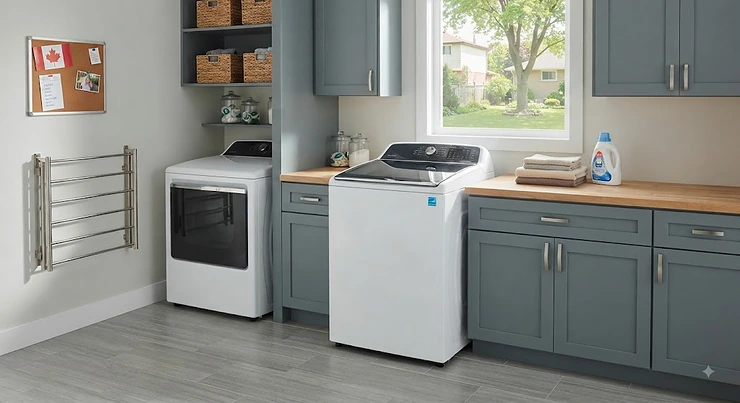
Somewhere between your parents’ clunky agitator machine and the sleek, stackable front-loader you keep eyeing at the appliance store sits the high-efficiency top load washer — and for a huge number of Canadian households, it’s the smarter compromise nobody talks about enough. You get the no-bending, drop-and-go convenience of a top loader, but under the lid is a machine engineered to sip water instead of gulping it. A high-efficiency top load washer uses an impeller or paddle system instead of a central agitator post, spins faster to pull more water out before the dryer even starts, and is typically certified to use roughly a third less water and around a quarter less energy than a conventional top loader. That’s not a marketing footnote — it’s the entire reason this appliance category exists.
If you’ve been scrolling through HE top load washer reviews trying to figure out whether the extra $150 for a “smart” model is worth it, or whether an energy efficient top loader can actually rinse out mud from a hockey bag as well as your old machine did, you’re in the right spot. We dug into real specs, real aggregated review sentiment, and Canadian regulatory data — not recycled Amazon listings — to build this guide. Current federal regulations are pushing the entire washing machine category further in this direction, with Natural Resources Canada working to cut the energy use of household clothes washers sold here by roughly 25% compared to minimum-compliant models, while also trimming water use by about a third — proof this isn’t a niche category, it’s where the whole market is headed.
We’ll walk through seven real, currently sold high-efficiency top load washer models across budget, mid-range, and premium tiers, then dig into low water consumption, concentrated detergent compatibility, and what an Energy Star badge actually guarantees versus what it doesn’t.
Quick Comparison Table
| Washer | Capacity | Type | Best For | Price Range (CAD) |
|---|---|---|---|---|
| Insignia HE Top Load Washer | 4.1 cu. ft. | Impeller | Tightest budgets, apartments | Under C$650 |
| Whirlpool WTW5057LW | 4.5 cu. ft. | Impeller | Everyday value, small families | C$700-C$900 |
| Amana NTW4519JW | 4.5 cu. ft. | Agitator-lite HE | No-frills reliability | C$650-C$800 |
| Samsung WA50R5400AV | 5.0 cu. ft. | Impeller | Speed and stain-fighting | C$900-C$1,150 |
| GE Profile Smart Top Load Washer | 5.0 cu. ft. | Impeller | Smart features, larger loads | C$1,200-C$1,500 |
| Maytag MVW7232HW | 5.3 cu. ft. | Impeller | Heavy-duty households | C$1,000-C$1,300 |
| LG WT7900HBA | 5.5 cu. ft. | Impeller | Big families, mega capacity | C$1,300-C$1,800 |
A quick scan of this table already tells a story: capacity climbs steadily as price climbs, but efficiency features — auto sensing, HE detergent dispensing, faster spin speeds — show up even on the cheapest Insignia model. That matters, because it means you’re not paying a premium just to get an energy efficient top loader; you’re paying a premium for capacity, smart connectivity, and stain-fighting cycles layered on top of the efficiency baseline. Budget-conscious buyers shouldn’t assume they’re sacrificing water savings by going cheap here — they’re mostly sacrificing bells and whistles.
💬 Just one click — help others make better buying decisions too!😊
Top 7 High-Efficiency Top Load Washers: Expert Analysis
1. Insignia HE Top Load Washer — best true budget entry point
The standout here isn’t a headline feature — it’s the price-to-efficiency ratio, which is unusually good for an entry-level machine. At 4.1 cu. ft., this is a compact-capacity washer built for apartments, condos, or a couple doing two or three loads a week rather than a family plowing through hockey gear daily. It skips the agitator post entirely in favour of a low-profile impeller, which is the actual mechanical reason it qualifies as high-efficiency rather than just being labelled that way for marketing purposes. Auto-sensing fill and a handful of preset cycles cover the basics — normal, delicates, bulky items, quick wash — without drowning you in options you’ll never touch.
Based on the spec comparison across this list, this is the model to buy if your priority is simply “wash clothes, use less water, spend less money,” full stop. It’s not going to out-clean a Samsung on a mud-caked pair of soccer socks, and reviewers consistently note that cycle times run long on the deeper settings, which is a common trade-off on budget impeller washers. Aggregated feedback across major Canadian retailers points to solid reliability in year one, with the usual caveat that entry-level machines carry shorter parts warranties than their pricier siblings.
Pros:
- ✅ Lowest entry price in this roundup, ideal for renters
- ✅ Compact footprint fits small laundry closets
- ✅ Genuine impeller-based HE design, not just a badge
Cons:
- ❌ Smaller 4.1 cu. ft. drum limits bulky-item loads
- ❌ Fewer specialty cycles than mid-range competitors
At under C$650, this is the price-anchor for the entire category — check current price and availability, as promotional pricing on entry-level Insignia models shifts frequently.
2. Whirlpool WTW5057LW — best everyday value pick
What makes this one worth a second look is Deep Water Wash, an option that overrides the water-saving auto-sensing when you genuinely need a full tub — think comforters or a load that’s more mud than fabric. That flexibility is the standout feature: most HE top loaders lock you into water-stingy sensing with no manual override, and Whirlpool’s decision to let you choose is a small thing that ends up mattering a lot in practice. The 4.5 cu. ft. stainless steel basket handles a realistic family-of-three’s laundry rotation without feeling cramped, and the Adaptive Wash Technology with Sensors adjusts water temperature and agitation intensity based on fabric type sensed mid-cycle.
What most buyers overlook about this model is that it’s essentially the workhorse trim of a much larger Whirlpool lineup — the mechanicals are shared with pricier siblings, so you’re getting proven internals without the smart-home premium. Reviewers consistently flag the exterior as a bit more plasticky than the metal-heavy Maytag above it in this same lineup, but note that wash performance on everyday loads is comparable. If you’re not chasing WiFi connectivity, this is arguably the smarter dollar-for-dollar buy than stepping up to a smart model.
Pros:
- ✅ Deep Water Wash option overrides default water-saving mode
- ✅ Adaptive sensor-based wash cycles adjust automatically
- ✅ Proven Whirlpool direct-drive motor platform
Cons:
- ❌ No WiFi or app connectivity at this tier
- ❌ Plastic-heavy exterior feels less premium than steel-clad rivals
In the C$700-C$900 range, this is the sweet spot for households that want real capability without smart-home extras — always confirm current pricing, since Whirlpool runs frequent seasonal promotions.
3. Amana NTW4519JW — best for pure no-nonsense reliability
Amana, a Whirlpool-owned brand, built its entire reputation on stripping things down to what actually matters, and this washer is the embodiment of that philosophy — the standout feature is genuinely how few things there are to break. There’s no touchscreen, no app, no sensor array guessing at fabric type; you get dial-and-button controls, a 4.5 cu. ft. stainless steel wash basket, and an eight-cycle lineup that covers the essentials without padding the spec sheet for the sake of it.
Here’s what to weigh: the trade-off for that simplicity is a less nuanced water-sensing algorithm than you’ll find on the Samsung or GE Profile further down this list, meaning it occasionally fills a touch more generously than strictly necessary on partial loads. On paper this means slightly less optimized water use per load, but in exchange you get a mechanically simpler machine that’s historically been cheaper and easier to repair when something eventually does go wrong — a real consideration once you’re outside the standard one-year warranty window. Aggregated review sentiment across major retailers describes it as “boring in the best way,” a phrase that shows up often enough to be a genuine pattern rather than a coincidence.
Pros:
- ✅ Simple mechanical controls reduce points of failure
- ✅ Stainless steel basket resists rust and staining
- ✅ Historically inexpensive parts and service calls
Cons:
- ❌ Less refined water-sensing than pricier impeller rivals
- ❌ No smart features or remote start whatsoever
Typically priced in the C$650-C$800 range, the Amana is the pick for buyers who’ve been burned by “smart” appliances before and just want something that works.
4. Samsung WA50R5400AV — best for speed and stain-fighting
Active WaterJet is the party trick here — a small, integrated faucet built into the top of the lid lets you pre-treat stains with a targeted water jet without hauling the load to a sink first, and it’s the kind of feature that sounds gimmicky until you’ve actually used it on a coffee-stained work shirt. The 5.0 cu. ft. capacity puts it solidly in mid-size territory, and Super Speed cycle technology can knock a full wash-and-spin down to around 28 minutes on lighter loads, which is genuinely useful on a weekday morning.
Based on the spec comparison, Samsung’s Vibration Reduction Technology+ (VRT+) is what separates this from cheaper impeller machines at high spin speeds — imbalanced loads with heavy items like towels are far less likely to send the whole unit walking across your laundry room floor. Reviewers consistently note strong stain removal on the Super Speed and Active WaterJet combination, though some flag that the touch controls can be less intuitive at first than Samsung’s dial-based competitors. Families juggling sports gear, work uniforms, or anyone who does laundry in short weekday windows will get the most value from this model specifically.
Pros:
- ✅ Active WaterJet built-in faucet for stain pre-treatment
- ✅ Super Speed cycle finishes light loads in under 30 minutes
- ✅ VRT+ vibration reduction stabilizes high-speed spin
Cons:
- ❌ Touch controls have a steeper learning curve
- ❌ Mid-pack water efficiency versus the GE Profile and LG above it
Expect to pay in the C$900-C$1,150 range depending on finish and retailer promotions — prices fluctuate often enough that checking current listings is worth the extra thirty seconds.
5. GE Profile Smart Top Load Washer — best for smart features on a mid-range budget
Smarter Wash Technology is the headline act — the machine automatically adjusts water level, wash time, and spin speed based on load size and soil level detected during the fill cycle, which takes the guesswork (and the tendency to over-fill “just in case”) out of daily use entirely. At 5.0 cu. ft., it splits the difference between the compact budget models and the mega-capacity LG at the top of this list, and the Easier Reach basket design tilts the drum slightly forward to reduce the awkward over-the-lip reach that plagues deeper top loaders.
What the spec sheet won’t tell you, but user reports suggest, is that the Microban antimicrobial treatment on the dispenser drawers meaningfully cuts down on the musty smell that develops in humid laundry rooms over time — a small quality-of-life detail that doesn’t show up in a spec comparison but shows up constantly in longer-term ownership reviews. This is the model we’d point tech-comfortable households toward if they want genuine automation (not just a WiFi badge) without stepping up to LG’s premium pricing tier.
Pros:
- ✅ Smarter Wash Technology auto-adjusts water and spin per load
- ✅ Easier Reach basket design reduces bending and reaching
- ✅ Microban-treated dispensers resist odour buildup
Cons:
- ❌ Interface has a learning curve for cycle customization
- ❌ Sits at a price premium versus similarly-sized Whirlpool and Samsung units
Priced roughly C$1,200-C$1,500, this one rewards buyers who’ll actually use the smart features rather than defaulting to “Normal” every time.
6. Maytag MVW7232HW — best for heavy-duty households
The Extra Power button is the standout, and it’s a genuinely clever piece of engineering: instead of just running hotter water, it runs a dual-temperature wash within a single cycle, tackling stains that respond to hot water and stains that respond to cold water in the same load. Maytag’s Power impeller uses a reverse wash motion with triple-action spray to keep clothes saturated throughout the cycle, and the 5.3 cu. ft. stainless drum with a built-in water faucet is squarely aimed at families who generate serious laundry volume — think teenagers in contact sports, work uniforms, or a household running multiple loads daily.
Reviewers consistently note that cycle times run longer than nimbler competitors like LG’s 30-minute Normal cycle, and that WiFi connectivity nudges the price up further than the mechanical upgrades alone would justify — a fair critique, since the core cleaning performance doesn’t require the smart layer to be excellent. On the other hand, the Advanced Vibration Control system genuinely earns its name; aggregated feedback describes noticeably quieter operation on unbalanced loads than typical impeller machines in this price bracket. If you’re replacing a tired old agitator washer and durability plus raw cleaning power matter more than speed, this is the strongest all-rounder on this list.
Pros:
- ✅ Extra Power button tackles hot- and cold-soluble stains together
- ✅ 10-year limited motor warranty backs long-term ownership
- ✅ Advanced Vibration Control keeps operation quiet
Cons:
- ❌ Cycle times run longer than speed-focused rivals
- ❌ WiFi connectivity adds cost without a proportional cleaning upgrade
Typical pricing lands around C$1,000-C$1,300, though it’s frequently discounted from list price during appliance sale events — worth watching if you’re not in a rush.
7. LG WT7900HBA — best for large families needing mega capacity
At 5.5 cu. ft., the standout is simply room — this tub swallows a king-size comforter without the awkward re-balancing dance smaller drums require, making it the pick for genuinely large households or anyone who’s tired of hauling bedding to the laundromat. TurboWash3D technology uses multiple spray jets to saturate the load from several angles simultaneously, and it’s a meaningfully different approach than a single-jet system, translating to shorter cycle times without a corresponding hit to cleaning performance on common stains.
Based on the spec comparison, the SmartThinQ app is the most fully-featured smart layer of any washer on this list, letting you start, pause, or monitor cycles remotely and download additional wash cycles as they’re released. What most buyers overlook about a machine at this capacity is that bigger doesn’t always mean better for smaller households — running a half-empty 5.5 cu. ft. drum regularly works against the water and energy savings that drew you to an HE machine in the first place, so this is genuinely a “match the machine to your household size” situation rather than a “bigger is always better” one. Aggregated review sentiment is broadly positive on cleaning performance, with the most common complaint centered on the app interface feeling more complex than it needs to be for basic remote-start functionality.
Pros:
- ✅ 5.5 cu. ft. capacity handles bulky bedding easily
- ✅ TurboWash3D shortens cycle times without sacrificing cleaning
- ✅ SmartThinQ app enables remote monitoring and cycle downloads
Cons:
- ❌ Premium pricing puts it at the top of this list
- ❌ Oversized for smaller households, working against water savings
Prices typically run C$1,300-C$1,800, though this model has shown up in deeper promotional discounts at various retailers — as always, check current price rather than relying on a list price.
Top 7 Products: Specs and Value Comparison
| Washer | Standout Feature | Cycle Options | Warranty | Best For |
|---|---|---|---|---|
| Insignia HE Top Load Washer | Rock-bottom entry price | 6-8 cycles | 1-year limited | Renters, singles |
| Whirlpool WTW5057LW | Deep Water Wash override | 8-10 cycles | 1-year limited | Everyday families |
| Amana NTW4519JW | Mechanical simplicity | 8 cycles | 1-year limited | Reliability-first buyers |
| Samsung WA50R5400AV | Active WaterJet + Super Speed | 10 cycles | 1-year limited | Stain-heavy laundry |
| GE Profile Smart Top Load Washer | Smarter Wash automation | 11 cycles | 1-year limited | Tech-comfortable households |
| Maytag MVW7232HW | Extra Power dual-temp wash | 13 cycles | 10-year motor | Heavy-duty, large families |
| LG WT7900HBA | 5.5 cu. ft. mega capacity | 12+ cycles | 1-year limited | Large households, bedding |
Looking at the table above, warranty length is the quiet differentiator most shoppers skip past — Maytag’s 10-year motor warranty stands well apart from the industry-standard one-year coverage everyone else on this list offers. Cycle count climbs with price, but more cycles doesn’t automatically mean better cleaning; it usually means more marketing-friendly presets layered over the same handful of underlying wash motions. If you’re weighing two similarly priced machines, warranty terms and real-world reliability data are a better tiebreaker than cycle count on the box.
Benefits vs. Traditional Agitator Washers
| Factor | HE Top Load Washer | Traditional Agitator Washer |
|---|---|---|
| Water use per load | Roughly 33% less | Baseline (higher) |
| Energy use | Roughly 25% less | Baseline (higher) |
| Load capacity | Larger (no agitator post taking up space) | Smaller effective capacity |
| Fabric wear | Gentler, less abrasion | Rougher, more friction-based |
| Cycle time | Often longer | Often shorter |
| Detergent needed | Concentrated HE detergent only | Regular detergent works fine |
The efficiency gains aren’t marketing spin — Natural Resources Canada states that Energy Star qualified washing machines use about 25% less energy and 33% less water on average than conventional machines, and because they spin clothes faster, laundry comes out of the machine drier, which shortens dryer time too. The trade-off nobody advertises is cycle length: removing the agitator’s brute-force scrubbing action means these machines lean on time and smarter water distribution instead, so a Normal cycle that used to take 35 minutes might now take 55-70 minutes on some models.
✨ Don’t Miss These Exclusive Deals!
🔍 Take your laundry routine to the next level with these carefully selected high-efficiency top load washers. Click on any highlighted model to check current pricing and availability. These machines will help you cut water and energy costs without sacrificing the clean your family actually needs!
Practical Usage Guide: Getting the Most From Your New Washer
The first thirty days with a new HE top load washer are where most people either fall in love with it or quietly start resenting it, and the difference usually comes down to habits carried over from an old agitator machine. First, resist the urge to overfill — unlike agitator washers where a stuffed tub was just inefficient, an overloaded HE drum genuinely struggles to redistribute weight during the high-speed spin, which is the single most common cause of the “walking washer” complaint. Second, run the tub-clean cycle monthly, not “when it starts to smell” — HE machines use so little water that detergent residue and biofilm build up faster in the door seals and dispenser trays than on older, water-heavy models.
Third, level the machine properly during install using the adjustable feet and a torpedo level; even a slight tilt gets amplified dramatically at HE spin speeds, which routinely exceed 800 RPM on mid-range models and can approach 1,000+ RPM on premium units. Fourth, always use concentrated detergent compatible with HE machines — this isn’t optional, it’s mechanical necessity, since regular detergent oversudses in low-water conditions and can trigger extended rinse cycles or leave residue on dark fabrics. Finally, leave the lid propped open between loads for the first few hours after each wash; it sounds trivial, but it’s the cheapest possible insurance against the mildew smell that gives HE machines an undeserved bad reputation.

Real-World Scenarios: Which Washer Fits Your Life
The downtown condo renter. Sarah does two loads a week for herself and doesn’t own a car, so anything she buys has to be delivered and fit through a narrow hallway. Budget is tight, capacity needs are minimal, and she’s not chasing smart features. The Insignia HE Top Load Washer or Amana NTW4519JW both fit this profile — compact, inexpensive, and simple enough that a landlord-approved repair technician can service either without specialty parts.
The suburban family of five. The Okonkwo household runs three to four loads daily between sports uniforms, bedding, and work clothes, and water/energy bills are a real line item in their monthly budget. Capacity and durability matter more than speed here — the Maytag MVW7232HW or LG WT7900HBA both handle high-volume laundry without constant babysitting, and Maytag’s longer motor warranty is a meaningful hedge against the wear a busy household puts on a machine.
The dual-income couple with a tight morning schedule. No kids yet, both work full-time, and laundry happens in 30-minute windows before or after work. Cycle speed and stain removal on gym clothes and work shirts matter more than raw capacity. The Samsung WA50R5400AV, with its Super Speed cycle and Active WaterJet pre-treatment, is built almost exactly for this use case.
Problem → Solution Guide
Problem: Clothes come out with detergent residue. This is almost always a detergent issue, not a machine defect — regular (non-HE) detergent oversudses in low-water HE cycles. Solution: switch to a concentrated detergent compatible with HE machines, and cut your dose to the HE-specific line on the cap, not the regular-detergent line.
Problem: The washer vibrates or “walks” during spin. Usually an unbalanced load or an unlevel machine. Solution: redistribute large single items like a comforter with a couple of towels to balance the drum, and re-check the leveling feet — this single fix resolves the majority of vibration complaints in aggregated review data.
Problem: A musty smell develops after a few months. HE machines use so little water that mildew can build up in the gasket and dispenser tray. Solution: run a monthly tub-clean cycle with an affresh or oxygen-bleach tablet, wipe the door gasket dry after heavy-use weeks, and leave the lid cracked between loads.
Problem: Cycles feel painfully slow compared to your old machine. This is often a setting issue, not a machine problem — many buyers unknowingly default to the longest Normal or Heavy Duty cycle. Solution: use the Quick Wash or Speed cycle for lightly soiled everyday loads; reserve the longer cycles for genuinely dirty laundry.
Problem: Small items get missed or clumped. Impeller washers move clothes differently than agitator machines, and small items like socks can occasionally clump together unwashed inside larger items. Solution: use a mesh laundry bag for small items and avoid mixing a single large item (like a hoodie) with a load of tiny things.
How to Choose a High-Efficiency Top Load Washer
- Match capacity to actual household size, not aspirational size — a 5.5 cu. ft. drum run half-empty defeats the water-saving purpose you bought it for.
- Check the spin speed — higher RPM (800-1,000+) extracts more water before drying, cutting dryer time and energy costs downstream.
- Confirm concentrated detergent compatible dispensing — auto-dispensing trays that hold multiple loads’ worth of HE detergent save real time over months of ownership.
- Compare warranty terms beyond year one — motor and drum warranties vary wildly, and this is where long-term value is actually decided.
- Weigh smart features honestly — WiFi connectivity is genuinely useful for some households and dead weight for others; don’t pay for automation you won’t use.
- Look for Energy Star certification specifically, not just a general “efficient” label — it’s the only third-party-verified efficiency benchmark in this category.
- Read the noise/vibration data if you have shared walls or an open-concept layout — this is rarely on the spec sheet but shows up constantly in aggregated review sentiment.
Common Mistakes When Buying a High-Efficiency Top Load Washer
The single most common mistake is buying based on capacity alone, treating “bigger drum” as synonymous with “better washer.” Reviewers consistently note that oversized machines running small loads waste more water proportionally than a correctly-sized machine would, because auto-sensing systems have efficiency floors below which they don’t scale down further. A second frequent misstep is skipping HE detergent entirely, assuming “any detergent will do” — this isn’t a minor preference, it’s a mechanical mismatch that can trigger extended rinse cycles, leave residue, and in persistent cases contribute to service issues down the line. A third mistake is ignoring installation requirements: HE top loaders at high spin speeds are far less forgiving of an unlevel floor or a poorly bolted set of feet than the agitator machine they’re replacing, and skipping proper leveling is the single biggest predictor of the “why is my new washer so loud” complaint.
High-Efficiency Top Load Washer vs. Front Load Washer
The honest answer is that front-load washers generally edge out even the best high-efficiency top load washer on raw water and energy efficiency, largely because gravity does more of the work in a horizontal drum than any impeller design can replicate in a vertical one. But that efficiency edge comes with real trade-offs: front loaders typically cost more upfront, require more careful gasket maintenance to avoid mildew, and force you to bend down to load and unload — a genuine accessibility issue for anyone with back or knee limitations. Top loaders, HE or otherwise, also tend to finish cycles somewhat faster in a straight comparison and don’t require the same drainage and door-seal vigilance.
For most Canadian households without a specific mobility need or an extreme efficiency mandate, an energy efficient top loader delivers roughly 80-90% of a front loader’s water and energy savings at a lower price point and with meaningfully easier day-to-day ergonomics. If you’re chasing the absolute lowest utility bill and don’t mind bending, a front loader wins on paper. If you want most of the savings without the compromises, the HE top load category — the entire subject of this guide — is the more realistic choice for the average household.
Energy Efficient Top Loader: What Low Water Consumption Actually Means
“Low water consumption” isn’t a vague marketing phrase — it’s measurable, and it’s the whole engineering premise behind the energy efficient top loader category. Instead of fully submerging a load the way a traditional agitator machine does, HE machines tumble and rotate clothes through a much shallower water pool, relying on gravity and drum rotation to move water through the fabric rather than sheer volume. An Energy Star certified washing machine uses roughly 25% less energy on average than a standard model and about 45% less water in the commercial pay-per-use context, and while residential figures differ slightly, the underlying mechanism — less water in, faster and more thorough extraction out — is the same across both categories.
What this means in practice is a genuinely smaller water and energy bill line item over a machine’s typical 10-14 year lifespan, but it also means the machine is more sensitive to being used correctly. Underfilling detergent bays, ignoring auto-sensing overrides, or running Deep Water Wash out of habit rather than necessity all erode the water savings you’re paying a premium to get. For readers researching low water consumption specifically as a purchase driver — say, a household on well water or facing municipal water restrictions — this is the category where that concern is genuinely, mechanically addressed rather than just marketed.
Concentrated Detergent Compatible: Getting HE Detergent Right
Every washer on this list is concentrated detergent compatible — in fact, they require it. Regular detergent is formulated to suds heavily in the large water volumes of a traditional agitator machine; put that same detergent into a low-water HE cycle and you get oversudsing, which the machine’s sensors interpret as “still dirty,” triggering extra rinse cycles that quietly cancel out the water savings you bought the machine for in the first place. Concentrated HE detergent is a different formulation entirely — low-sudsing, engineered to work in a shallow water pool, and typically dosed at a fraction of the volume of regular detergent per load.
The practical upshot: check the bottle for the “HE” symbol before you buy detergent, not after you notice a problem, and resist the instinct to “add a little extra for a really dirty load” — that instinct is a holdover from agitator-washer habits and works directly against how these machines are engineered to clean. Auto-dispensing models like the GE Profile Smart Top Load Washer and Maytag MVW7232HW hold multiple loads’ worth of concentrated detergent at once, which is convenient, but it’s still worth periodically confirming the correct dose per load rather than assuming the dispenser calibration matches every detergent brand identically.
Energy Star Top Load Washers: Certification, Rebates, and What the Badge Actually Means
An Energy Star badge on a top load washer isn’t a self-declared marketing claim — it’s independently third-party tested and certified, and Energy Star products are built to perform the same as or better than standard products without compromising performance. In Canada specifically, this program is administered by Natural Resources Canada, and it’s worth understanding that the certification bar has tightened over time rather than staying static. Every model featured in this guide carries Energy Star certification, which is a meaningful floor to shop above — treat any HE top load washer without it as a red flag worth investigating further before you buy.
Provincial and utility-level rebate programs for Energy Star appliances come and go depending on region and current energy policy, so it’s worth a quick check with your local utility provider before purchase — some Canadian municipalities and provinces have historically offered modest rebates or recycling incentives when you retire an older, inefficient machine. Beyond rebates, the certification matters for a more practical reason day to day: it’s the only standardized, apples-to-apples efficiency comparison point across brands, since manufacturer-reported efficiency claims otherwise use inconsistent testing methodologies.
Long-Term Cost & Maintenance
The purchase price is only the opening chapter of what an HE top load washer actually costs you over its lifespan. Utility savings compound quietly: average annual energy consumption for electric clothes washers dropped by roughly 84% between 2000 and 2019, driven substantially by the shift toward HE technology and tightening minimum performance standards — a figure that puts real numbers behind the “it pays for itself” claim you’ll hear from every appliance salesperson. Maintenance costs, meanwhile, run lower than most buyers expect if you follow basic habits: monthly tub-clean cycles, prompt attention to unusual vibration (almost always a leveling or load-balance issue, not a mechanical failure), and HE-compatible detergent use are collectively responsible for preventing the majority of service calls these machines generate in their first five years.
Where costs diverge sharply between models is warranty coverage and parts availability. Maytag’s 10-year motor warranty is a genuine long-term cost hedge that the one-year-warranty machines on this list simply don’t offer, and it’s worth pricing that difference against the sticker-price gap when comparing models. Speed Queen-style commercial-grade machines (outside this list’s scope, since this guide focuses specifically on true HE models) trade some efficiency for repairability, which is a legitimate alternative philosophy for buyers who prioritize a 20-plus-year lifespan over maximum water savings.
Features That Actually Matter (And Those That Don’t)
Features that matter: auto-sensing fill (genuinely saves water every single load, not just on paper), a documented spin speed above 800 RPM (meaningfully shortens dryer time and therefore total energy use per laundry cycle), and a stainless steel — not painted — wash basket (resists staining and rust over a decade-plus lifespan). Features that don’t matter nearly as much as marketing suggests: an excessive number of specialty cycles (most households use three or four cycles regularly and never touch the rest), and app-based remote start on a machine that lives ten feet from where you already are most of the day.
The one feature that’s genuinely divisive rather than universally good or bad is cycle count and smart connectivity — for a household that travels often or juggles unpredictable schedules, remote start and cycle notifications on models like the LG WT7900HBA or GE Profile Smart Top Load Washer are legitimately useful. For a household with a predictable routine, that same feature is paid-for complexity that adds nothing to the actual wash quality.
Safety, Regulations, and Compliance in Canada
Every washer sold in Canada must comply with Canada’s Energy Efficiency Regulations, which set minimum performance standards manufacturers are legally required to meet before a model can be sold here at all — this isn’t optional or voluntary the way some efficiency marketing implies. Beyond baseline compliance, Energy Star certification specifically requires independent third-party testing against stricter efficiency specifications, which is why we’ve focused this guide exclusively on certified models rather than anything merely labelled “efficient” by its manufacturer.
On the installation side, Canadian building codes generally require a dedicated grounded electrical outlet and proper drainage standpipe height for any washing machine install; if you’re moving into a new build or older home without existing laundry hookups, it’s worth confirming code compliance with a licensed electrician or plumber rather than assuming a DIY install meets local requirements. For Energy Star top load shoppers specifically comparing certified models, Natural Resources Canada maintains a searchable product database that’s worth cross-referencing against retailer listings before you commit to a purchase.
Frequently Asked Questions
❓ What is a high-efficiency top load washer?
❓ Is a high-efficiency top loader better than a regular top loader?
❓ Can I use regular detergent in an HE top load washer?
❓ How much water does a high-efficiency top load washer actually save?
❓ Are Energy Star top load washers worth the extra cost?
Conclusion
A high-efficiency top load washer isn’t a compromise appliance — it’s the category that quietly does the most work in a modern Canadian laundry room, blending genuine water and energy savings with the ergonomic convenience a front loader can’t match. Whether you land on the budget-friendly Insignia HE Top Load Washer, the do-it-all Maytag MVW7232HW, or the mega-capacity LG WT7900HBA, the underlying technology — impeller-based washing, auto-sensing fill, Energy Star certification — delivers real, measurable savings rather than marketing-only efficiency claims. The right pick ultimately comes down to matching capacity and features to your actual household size and habits, not the biggest drum or the longest feature list on the shelf tag.
Whatever model you land on, pair it with concentrated HE detergent, level it properly on install day, and run that monthly tub-clean cycle you’ll be tempted to skip — those three habits do more for long-term performance than any single spec on the box. The category has matured well past “compromise appliance” status, and 2026’s lineup proves it.
Recommended for You
- Agitator vs Impeller Washer: 7 Real Top Load Picks (2026)
- Top Load Impeller Washer: 7 Best Picks for Canadian Homes (2026)
- Best Steam Washer 2026: 7 Top Picks for Canadian Homes
Disclaimer: This article contains affiliate links. As an Amazon Associate, I earn from qualifying purchases. If you purchase products through these links, we may earn a small commission at no additional cost to you.
✨ Found this helpful? Share it with your friends! 💬🤗
