
In This Article
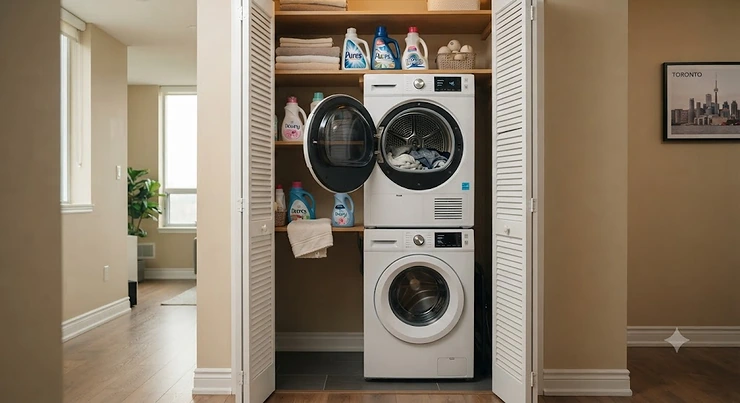
If you’ve ever stood in a laundromat basement in a Toronto highrise, feeding loonies into a machine while wondering why your unit doesn’t have its own dryer, you already understand the appeal here. A ventless dryer draws no air in from outside and pushes none back out through a wall duct. Instead, it condenses moisture from damp clothes into a drain hose or a removable tank, or pulls the water out using a small internal heat pump — the same basic mechanical principle Wikipedia’s overview of clothes dryers touches on when it distinguishes venting from condensing designs. That single design choice is why the best ventless dryer picks on the market right now keep showing up in condo laundry closets, basement suites with no exterior wall in reach, and tiny homes from Halifax to Victoria.
I spent the past few weeks pulling spec sheets, cross-referencing owner feedback on retailer sites and appliance forums, and checking what Canadian retailers actually stock — not just what shows up on a U.S. spec sheet with a Canadian flag pasted on the listing. What follows is my best ventless dryer shortlist for 2026: seven real machines, ranging from a roughly C$150 folding rack to a nearly C$2,900 heat-pump flagship, all genuinely purchasable by Canadian shoppers right now. Some of these no vent dryer solutions plug into a standard wall outlet; others need the same 240V circuit your current machine already uses. I’ll flag which is which throughout, because that one detail can decide whether a model fits your space at all.
One honest caveat before we dive in: ventless technology trades speed for flexibility. Every model below takes longer per load than a comparable vented dryer, and that’s not a flaw in any single unit — it’s physics. A dryer that isn’t allowed to exhaust hot, humid air outside has to do more work internally to get the same result. Keep that trade-off in mind as you read, because it shapes almost everything else on this list.
Quick Comparison Table
Before the deep dive, here’s how the seven models on this best ventless dryer shortlist stack up at a glance. I’ve grouped them roughly budget to premium, and every price below is a range rather than a snapshot figure, since Amazon.ca pricing shifts week to week.
| Product | Type | Capacity | Voltage | Price Range (CAD) | Best For |
|---|---|---|---|---|---|
| Miele T1 TXD160WP | Heat pump | 4.02 cu. ft. (114 L) | 120V or 220V | C$2,400–C$2,900 | Most efficient, gentlest drying |
| Bosch 800 Series WTG865H3UC | Condensation | 4.0 cu. ft. (113 L) | 240V | C$1,700–C$2,000 | Wi-Fi control, smart homes |
| LG DLHC1455W | Heat pump | 4.2 cu. ft. (119 L) | 240V/208V | C$1,500–C$1,800 | Balance of speed and capacity |
| Whirlpool WHD862CHC | Hybrid heat pump | 7.4 cu. ft. (210 L) | 240V | C$1,700–C$2,100 | Larger households, full-size loads |
| GE GFT14JSIMWW | Condensation | 4.1 cu. ft. (116 L) | 240V | C$1,300–C$1,600 | Best value built-in ventless |
| Equator EZ 4700 C | Condensation combo | 1.62 cu. ft. (46 L) | 110V | C$1,100–C$1,400 | Zero-hookup all-in-one for condos |
| Panda PAN82PD | Heated drying rack | 22 lb (10 kg) load | 110–120V | C$150–C$220 | No installation, tightest budget |
A pattern jumps out immediately: capacity and price climb together, but voltage doesn’t follow the same curve. The Miele T1 and the Equator combo both run happily on a regular 110–120V household outlet — the kind already behind your fridge — while the Bosch, LG, Whirlpool, and GE units all need the same heavier 240V circuit a conventional vented dryer uses. If your condo or rental doesn’t have a dedicated laundry circuit, that distinction matters more than any spec on this table.
💬 Already spot a model that fits your outlet situation? Check today’s price on Amazon.ca before it changes — one click helps you compare without digging through five browser tabs.
Top 7 Ventless Dryers: Expert Analysis
I picked these seven for my best ventless dryer roundup to cover every real scenario a Canadian shopper is likely to hit: a fully built-in unit for a renovated condo laundry closet, a compact all-in-one for a studio with zero hookups, and a genuinely budget option for someone who just needs damp jeans dry by tomorrow. Every product name below stays bolded on every mention so you can scan for the one you’re weighing.
1. Miele T1 TXD160WP — most efficient, gentlest heat pump drying
The standout here is that the Miele T1 TXD160WP can run on a standard 120V, 15A household outlet — the same one your microwave uses — instead of the heavier 240V circuit almost every other built-in dryer demands.
Under the hood, a heat pump recirculates and dehumidifies the same batch of air instead of heating fresh air and expelling it, which is why Miele rates this unit’s typical cycle temperature dramatically cooler than a conventional element-based dryer. In practice, that means the honeycomb-textured drum and DirectSensor moisture control are doing real fabric-protection work, not just marketing copy — cooler air means less thermal stress on elastic, synthetics, and anything you’d normally hang-dry out of caution. The 4.02 cu. ft. (114 L) drum handles an 18 lb (8 kg) load, which is on the larger end for a compact ventless unit.
Based on owner discussions on appliance forums like Houzz, two things come up repeatedly: the 120V flexibility is treated as a genuine selling point for exactly the condo-and-basement-suite crowd this article is written for, and dryer sheets are a real problem — the wax coating can gum up the heat exchanger’s sensors and trigger error codes, so Miele explicitly recommends wool dryer balls or a fabric softener alternative instead. Cycle times run noticeably faster when paired with a matching Miele washer’s high-speed spin; on its own, expect a longer cycle than the specs alone would suggest.
Pros:
- ✅ Runs on a standard 120V outlet, not a dedicated 240V line
- ✅ Cooler heat pump drying is measurably gentler on fabrics
- ✅ Honeycomb drum plus DirectSensor reduces over-drying damage
Cons:
- ❌ Highest price on this list by a wide margin
- ❌ No dryer sheets — wax buildup can trigger sensor errors
At the time of research, the Miele T1 TXD160WP sits in the C$2,400–C$2,900 range depending on retailer promotions, and for a household that does laundry several times a week, the fabric-care and energy savings can offset that premium over the machine’s lifespan — check current price before assuming it’s out of reach.
2. Bosch 800 Series WTG865H3UC — smartest Wi-Fi controlled compact dryer
The Bosch 800 Series WTG865H3UC leans hardest into smart-home integration, with Home Connect app control that lets you start, monitor, and get a “cycle finished” push notification from your phone.
Bosch’s spec sheet lists 14 dry cycles on a 4.0 cu. ft. (113 L) stainless-adjacent drum, a moisture sensor that auto-adjusts run time, and a dedicated Sanitize cycle that’s genuinely useful for anyone drying reusable cloth items, gym gear, or anything else you’d rather not just air out. What the spec sheet doesn’t tell you, but lab testing from independent reviewers does, is that this is a condensation dryer in the traditional sense — no heat pump — which means it runs hotter and slower than the heat-pump models on this list. That’s the real-world trade for its lower price point relative to the Miele.
Reviewed’s lab testing found the Cotton cycle ran past 90 minutes and reached temperatures above 176°F (80°C), high enough to raise fabric-wear concerns over repeated cycles, while the “Quick 40” setting frequently left loads noticeably damp rather than fully dry. That’s useful context: if fast turnaround matters more to you than smart features, this isn’t the pick, but if you mostly run overnight loads and want remote monitoring, the trade-off is reasonable.
Pros:
- ✅ Home Connect app control and cycle-complete notifications
- ✅ Dedicated Sanitize cycle for gear, cloth masks, and gym wear
- ✅ Reversible door simplifies tight laundry-closet installs
Cons:
- ❌ Runs notably hotter than heat-pump alternatives
- ❌ Quick cycles can leave loads underdried
The Bosch 800 Series WTG865H3UC typically lists in the C$1,700–C$2,000 range in Canada, though availability shifts between retailers as Bosch refreshes its compact lineup — always confirm current stock and price before ordering.
3. LG DLHC1455W — best balance of speed and capacity
What makes the LG DLHC1455W stand out on this list is its Dual Inverter HeatPump™ system, which LG pairs with a self-cleaning condenser that’s supposed to cut down on the manual lint-and-moisture-trap maintenance ventless dryers are known for.
The 4.2 cu. ft. (119 L) capacity is the largest among the compact heat-pump models here, and the 14 dry programs plus Sensor Dry give you granular control over how aggressively the machine dries a given load. It’s Wi-Fi enabled through LG’s ThinQ app, with Alexa and Google Home compatibility, and it’s stackable with LG’s matching compact washer for a true closet-column install. One spec worth flagging clearly: this unit needs a 240V/208V, 30A circuit — the same as a conventional dryer — so it is not a drop-in-anywhere plug like the Miele or Equator on this list.
Based on the independent expert reviews I cross-referenced, the Auto Cleaning Condenser earns consistent praise for reducing the maintenance grind, and Sensor Dry is credited with preventing the over-drying that shrinks cotton and stresses synthetics. The flip side, echoed across multiple reviews, is the same one you’ll see repeated throughout this article: heat-pump drying takes longer than a vented cycle, and the compact drum means oversized items like a queen duvet need to go elsewhere.
Pros:
- ✅ Largest capacity among the compact heat-pump models tested
- ✅ Auto Cleaning Condenser reduces manual maintenance
- ✅ ThinQ app plus Alexa/Google Home compatibility
Cons:
- ❌ Requires a dedicated 240V/208V, 30A circuit
- ❌ Cycle times run longer than a comparable vented dryer
Expect the LG DLHC1455W to run in the C$1,500–C$1,800 range at the time of research, with LG’s periodic laundry-pair bundle promotions sometimes bringing the effective per-unit cost down further.
4. Whirlpool WHD862CHC — largest capacity in a ventless design
If the compact 4-cubic-foot drums on this list feel too small for a family’s laundry pile, the Whirlpool WHD862CHC is the answer: a 7.4 cu. ft. (210 L) hybrid heat-pump dryer that’s genuinely full-size, not shrunk down to fit a closet.
That capacity is the headline feature, paired with 36 dry cycles, a three-sensor Advanced Moisture Sensing system, and a Wrinkle Shield™ Plus option with steam that can hold garments wrinkle-free for up to 150 minutes after a cycle ends — handy if you’re the type who starts a load and then gets pulled into a work call. The “hybrid” branding means it blends heat-pump efficiency with a supplemental heating element, which Whirlpool positions as a way to close some of the speed gap that pure heat-pump dryers struggle with.
Here’s where honesty matters more than filling space: detailed, verifiable owner-review data specifically for this model was harder to pin down than for the smaller compact units, since Whirlpool’s ventless hybrid line is a newer, lower-volume category than its standard vented dryers. What is verifiable from the spec sheet is the 240V, 30A electrical requirement and the closet-depth 27-inch footprint, both of which matter enormously for anyone trying to fit a full-size ventless machine into a condo laundry room built around 24-inch compact appliances. If floor space allows a 27-inch unit, this is the pick for larger households that don’t want to compromise on load size just because they can’t run a vent.
Pros:
- ✅ Largest capacity of any model on this list, 7.4 cu. ft.
- ✅ Three-sensor moisture detection reduces over- and under-drying
- ✅ Steam-assisted Wrinkle Shield™ Plus option for delayed unloading
Cons:
- ❌ 27-inch closet-depth footprint won’t fit every 24-inch laundry nook
- ❌ Hybrid heating still draws more power than a pure heat-pump design
The Whirlpool WHD862CHC generally lists in the C$1,700–C$2,100 range in Canada; because it’s a hybrid heat-pump model rather than entry-level, pricing tends to track closer to the premium end of that band during non-promotional periods.
5. GE GFT14JSIMWW — best value built-in ventless dryer
Sold in Canada under the model code GFT14JSIMWW (a near-identical variant of the U.S.-market GFT14ESSMWW), the GE GFT14JSIMWW is the value pick among the built-in, 240V ventless dryers on this list.
It’s a straightforward condenser design rather than a heat pump, which keeps the price down but means, like the Bosch above, it runs hotter and on the slower side. GE’s HE Sensor Dry with dual thermistors continuously tracks moisture levels across 13 programs, and a Damp Alert notification flags the ideal moment to pull items out for ironing — a small but genuinely useful touch. The 4.1 cu. ft. (116 L) stainless-drum unit is rated for closet, under-counter, or corner-stack installation with no external venting required.
Independent lab testing from Reviewed found this model achieved 95–100% dry results across most cycles with a 4.3-out-of-5 customer satisfaction rating — genuinely strong drying performance. The trade-offs are real, though: the Mixed Loads cycle ran 2 hours and 17 minutes in testing, Heavy Duty took 1 hour 42 minutes, and internal temperatures on tested cycles ranged from 162°F to nearly 174°F, all well above the 150°F threshold generally considered safer for delicate synthetics. A smaller number of owners have also reported condensate drainage backups and humidity buildup around the unit, which is worth checking for on the model of drain hose or tank your specific installation uses.
Pros:
- ✅ Strong 95–100% drying performance across tested cycles
- ✅ Damp Alert notification simplifies timing for ironing
- ✅ Lowest price among the built-in 240V ventless models here
Cons:
- ❌ Long cycle times, over two hours on Mixed Loads
- ❌ Runs hot enough to raise fabric-wear concerns on synthetics
The GE GFT14JSIMWW tends to land in the C$1,300–C$1,600 range, making it the most accessible entry point into a genuine built-in, closet-installed ventless dryer — check current price, as GE runs frequent seasonal appliance promotions.
6. Equator EZ 4700 C — best for zero-hookup condo living
The Equator EZ 4700 C solves a different problem than the five units above it: it’s a fully built-in, all-in-one washer-dryer combo that runs on a standard 110V outlet, meaning it needs no dedicated dryer circuit and no separate washer hookup beyond a standard water line.
At 1.62 cu. ft. (46 L) and a 15 lb (6.8 kg) load capacity, it’s noticeably smaller than the stand-alone dryers on this list, because it’s washing and condensation-drying the same load in one drum, one cycle after another. Equator built in a Sanitize cycle, an Allergen setting, and a Pet Cycle specifically aimed at pulling embedded pet hair out of bedding and clothing — a detail that matters more than it sounds if you share a small space with a shedding dog or cat. Installation genuinely is close to zero-clearance, which is the entire appeal for a studio or one-bedroom condo with no laundry room at all.
Based on independent reviews I checked, the washing performance is consistently rated as solid and effective, and the Pet Cycle in particular draws specific praise. The honest limitation is capacity: a queen duvet or a week’s worth of towels for two people will strain this drum, and reviewers consistently note that combined wash-and-dry cycles run considerably longer than running a separate washer and dryer in sequence, simply because the machine is doing both jobs with one motor and one condensing system.
Pros:
- ✅ Runs on a standard 110V outlet — no dedicated circuit needed
- ✅ Dedicated Pet Cycle for allergen and hair removal
- ✅ True zero-clearance, all-in-one footprint for studios
Cons:
- ❌ Small drum limits loads to roughly one person’s laundry at a time
- ❌ Combined wash-and-dry cycles run notably long
At the time of research, the Equator EZ 4700 C falls in the C$1,100–C$1,400 range, positioning it as a genuinely affordable path to in-suite laundry for a condo that was never plumbed or wired for a full washer-dryer pair.
7. Panda PAN82PD — most affordable no-install option
Full transparency up front: the Panda PAN82PD is not a tumble dryer. It’s a heated, foldable drying rack — a warm-air blower pushes gently heated air through an insulated tube into a fabric-covered folding frame you hang or lay clothes across, and it plugs straight into a regular 110–120V outlet.
I’m including it deliberately, because for a huge number of renters — students, people between apartments, anyone in a unit where even a compact dryer isn’t an option — this is the actual realistic no vent dryer solution, not a full-size machine they can’t install anyway. At 900W and 8.5 lb (3.9 kg), it folds down small enough to store in a closet, handles up to 22 lb (10 kg) of laundry laid across its racks, and Panda rates maximum drying time at up to 180 minutes depending on fabric and load size.
Because this is a fundamentally different product category from the six machines above it, direct owner-review data specific to this exact folding-rack model was limited in my research; broader feedback on Panda’s compact laundry appliances as a brand tends to emphasize long-term reliability and straightforward, easy-to-understand controls, which is a reasonable signal even if it isn’t reviews of this precise SKU. What is verifiable and worth weighing honestly: a heated rack dries by convection across a flat or draped surface rather than tumbling, so it won’t fluff towels or bedding the way a drum dryer does, and heavier fabrics like jeans will take meaningfully longer than the rated maximum suggests.
Pros:
- ✅ Requires zero installation — plugs into any standard outlet
- ✅ Folds flat for storage in a closet or under a bed
- ✅ Lowest price by a wide margin on this list
Cons:
- ❌ Not a tumble dryer — no fluffing action for towels or bedding
- ❌ Heavier items and full loads can exceed the rated drying time
At the time of research, the Panda PAN82PD generally sells for under C$220, making it less an alternative to the other six machines and more a genuine emergency-laundry-day or first-apartment safety net — check current price, since it’s frequently discounted.
Top 7 Ventless Dryers at a Glance
| Product | Cycle Time (typical) | Reported Rating/Sentiment | Ideal Buyer |
|---|---|---|---|
| Miele T1 TXD160WP | 60–90+ min (longer solo) | Strongly positive on efficiency and gentleness | Efficiency-focused, has 120V outlet |
| Bosch 800 Series WTG865H3UC | 90+ min, up to 2+ hrs bulky | Positive on features, mixed on heat/speed | Smart-home households, overnight loads |
| LG DLHC1455W | Longer than vented, faster than most heat pumps | Positive on maintenance and sensor accuracy | Households wanting app control |
| Whirlpool WHD862CHC | Verifiable data limited; specs suggest 90+ min | Insufficient public data to rate confidently | Larger households needing full-size capacity |
| GE GFT14JSIMWW | 1h42m–2h17m in lab testing | 4.3/5 customer rating (Reviewed testing) | Budget-conscious, built-in installs |
| Equator EZ 4700 C | Notably long combined wash+dry cycles | Positive on washing, mixed on drying speed | Condos with zero laundry hookups |
| Panda PAN82PD | Up to 180 min rated maximum | Limited SKU-specific data; brand reliability positive | Renters needing zero installation |
Looking at this table alongside the earlier comparison, a clear pattern emerges: every genuinely ventless option on the market trades cycle speed for installation flexibility, and the honest reviews back that up consistently rather than contradicting each other. If speed is your single biggest priority, none of these seven will outrun a vented dryer, but if venting simply isn’t possible in your unit, the Miele T1 TXD160WP and LG DLHC1455W post the most favourable balance of performance to install-flexibility in this batch.
No Vent Dryer Solutions: Installation & Setup for Any Space
Getting a ventless dryer running well comes down to three things: matching the electrical requirement to what’s actually in your wall, managing condensation properly, and keeping the moisture-recovery system clean. Get those right and flexible installation becomes a genuine advantage rather than a compromise.
Start with the outlet. As the comparison table above shows, the Miele T1 TXD160WP and Equator EZ 4700 C are the two units here built to run on a standard 110–120V household circuit, which means no electrician visit for most condo installs. The Bosch 800 Series WTG865H3UC, LG DLHC1455W, Whirlpool WHD862CHC, and GE GFT14JSIMWW all need a 240V (or 208V) 30A circuit — the same one a conventional vented dryer already uses, so if you’re replacing an existing vented unit, that wiring is likely already in place.
Condensation handling is the second decision point. Most built-in models here let you choose between an internal removable tank you empty manually every one to three loads, or a permanent drain line routed to a nearby sink or floor drain for hands-off operation. If your laundry closet is anywhere near existing plumbing, wiring the permanent drain during install is worth the extra hour of work — emptying a tank gets old fast once the novelty wears off. Finally, budget five minutes after every few loads to wipe down the condenser or lint-and-moisture filter; skipping this is the single most common cause of the “dryer suddenly takes forever” complaint that shows up across nearly every review I read.
Real-World Scenarios: Matching a Ventless Dryer to Your Space
Concrete situations tend to clarify a buying decision faster than specs alone, so here are three common Canadian living situations and how they map onto this list.
If you’re a young professional in a downtown Toronto or Vancouver condo with a stacked washer-dryer closet that’s currently wired for 240V and you do laundry two or three times a week, the LG DLHC1455W or Bosch 800 Series WTG865H3UC make sense — you already have the electrical infrastructure, and the extra capacity over the smallest units here matters when you’re not doing daily small loads.
If you’re renting a basement or garden-level suite in an older house with no exterior wall accessible for venting and only standard outlets to work with, the Miele T1 TXD160WP is the standout, precisely because it sidesteps the 240V requirement entirely while still delivering genuine heat-pump performance rather than a compromise.
And if you’re in a studio or one-bedroom that was never built with a laundry room — a growing share of new Canadian condo construction, unfortunately — the choice comes down to the Equator EZ 4700 C for a real, if modest, in-suite laundry setup, or the Panda PAN82PD as a stopgap while you’re saving up or waiting to see whether the building allows a proper installation at all.

Common Ventless Dryer Problems (And How to Fix Them)
Even honest, well-reviewed machines run into predictable snags. Here’s what shows up most often across the reviews and forum threads I read, and the fix that actually works.
Musty or damp smell after a cycle almost always traces back to a full condensation tank or a clogged drain line that’s letting moisture sit rather than clear the system — empty the tank every load rather than waiting, and if you’ve got a drain-line install, check it for kinks. Cycles that seem to be getting slower over time are usually a dirty condenser or lint filter; every model on this list, including the GE GFT14JSIMWW and Bosch 800 Series WTG865H3UC, needs that surface wiped down regularly, not just the lint trap most people already remember. If clothes come out warm and only 80–90% dry, the machine is very likely fine — this is a known characteristic of condensation drying rather than a defect, and running a slightly longer cycle setting or a second short “fluff” cycle resolves it in most cases.
One less obvious issue: hard water in some Canadian regions can leave mineral scale inside a condenser over months of use, gradually reducing efficiency. A monthly wipe-down with a mild descaling solution, checked against your specific model’s manual, keeps that from compounding into the “why is this suddenly so slow” complaint that shows up in long-term owner reviews.
How to Choose a Ventless Dryer for Your Canadian Home
Working through these seven models surfaced a fairly clear decision process. Here’s how to apply it to your own space.
- Check your electrical panel and outlet type first. A 240V, 30A outlet opens up the Bosch, LG, Whirlpool, and GE options; a standard 110–120V outlet limits you to the Miele, Equator, or Panda, but that’s not a downgrade — it’s a genuine constraint that rules out an electrician visit.
- Measure your actual laundry space in centimetres, not just “it’ll probably fit.” Compact units run roughly 60 cm (24 in) wide; the Whirlpool WHD862CHC at closet-depth is closer to 69 cm (27 in) and needs that extra clearance confirmed before you order.
- Decide between a heat pump and a straight condenser. Heat pump models like the Miele, LG, and Whirlpool run cooler and use less electricity per cycle; condenser models like the Bosch and GE cost less upfront but run hotter and typically use more power per load.
- Match capacity to your actual household size, not an aspirational one — a couple doing towels and bedsheets weekly needs more than the 1.62 cu. ft. Equator combo can comfortably manage in one go.
- Plan for condensation before delivery day, deciding tank-emptying versus a permanent drain line so installation doesn’t stall on decision-making with the delivery crew standing in your hallway.
- Read the fine print on venting versus fully ventless. Some “convertible” dryers can be vented or ventless; confirm you’re buying the ventless configuration if that’s the entire point of your search.
- Set cycle-time expectations honestly before you buy, because every model above runs longer than a comparable vented dryer, and that’s the trade you’re making for flexible installation, not a fault in any single unit.
Condensation Dryer vs Heat Pump Dryer vs Vented Dryer
These three terms get used loosely, and mixing them up is the most common mistake I saw in comment sections and forum threads while researching this piece.
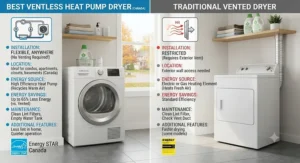
A vented dryer, the kind most Canadian homes have had for decades, heats air with an electric element or gas burner, blows it through wet clothes, and exhausts the resulting hot, humid air outside through a duct — fast, but entirely dependent on having somewhere to vent it. A condensation dryer, like the Bosch 800 Series WTG865H3UC and GE GFT14JSIMWW on this list, still heats air with an element, but instead of exhausting it outside, runs the humid air over a cool metal surface where moisture condenses into water that drains or collects in a tank — no duct required, but the internal air needs to cycle repeatedly to fully dry a load, which takes longer. A heat pump dryer, like the Miele T1 TXD160WP, LG DLHC1455W, and Whirlpool WHD862CHC, goes a step further: instead of an electric heating element, a refrigerant-based heat pump extracts moisture and recycles the heat back into the airflow, which is why these units typically run at lower temperatures and use meaningfully less electricity per cycle.
| Feature | Vented | Condensation | Heat Pump |
|---|---|---|---|
| External venting needed | Yes | No | No |
| Typical cycle time | Fastest | Slowest | Moderate |
| Typical energy use per load | Highest | High | Lowest |
| Heat exposure to fabrics | High | Highest | Lowest |
| Best For | Homes with existing venting | Budget-conscious, no vent access | Efficiency and fabric care priority |
The practical takeaway from this table is that condensation and heat pump dryers solve the exact same installation problem — no external venting — but arrive at it through different trade-offs. If your priority is the lowest upfront cost and venting simply isn’t available, a condensation model like the GE GFT14JSIMWW gets the job done. If your priority is lower running costs and gentler fabric treatment over the machine’s lifespan, the heat pump premium on something like the LG DLHC1455W tends to pay for itself gradually through electricity savings — a claim Natural Resources Canada’s own efficiency regulations back up, since ventless electric dryers sold in Canada must meet a Combined Energy Factor standard specifically because the category’s efficiency gains are measurable and regulator-verified, not just marketing language.
Ventless Dryer for Condo & Apartment Living in Canada
Condo and apartment living is really the whole reason this category exists, so it’s worth being specific about what changes when you’re shopping for a ventless dryer for condo apartment living rather than a detached house.
Building codes and condo corporation bylaws are the first hurdle, often before spec sheets even matter. Many multi-unit residential buildings restrict or outright prohibit cutting new exterior venting, which is precisely the gap ventless models fill — CMHC’s own guide to ventilation systems in multi-unit residential buildings explains why shared mechanical systems in these buildings are engineered as a whole, and why an individual unit adding its own new exterior vent penetration is often a non-starter both structurally and administratively. Before ordering anything on this list, it’s worth confirming with your property manager or condo board whether even a ventless model needs a notification or approval, since some buildings still have restrictions tied to electrical load or plumbing modifications for a drain line.
Space is the second constraint, and it’s why every compact model here runs in the 24-inch-wide range rather than the 27-to-29-inch width of a standard house dryer. If your unit was built with a stacked laundry closet, measure the actual opening before assuming “compact” automatically means “fits” — door swing and vent-free clearance requirements still apply even without a vent duct to route around. For anyone without a laundry closet at all, the Equator EZ 4700 C and Panda PAN82PD remain the two realistic paths forward, one as genuine in-suite laundry, the other as a functional stopgap.

Common Mistakes When Buying a Ventless Dryer
The clearest mistake I kept seeing across reviews and forum posts is assuming a ventless dryer will match a vented dryer’s cycle time — it won’t, on any model in this category, and buyers who don’t set that expectation upfront tend to leave the most frustrated reviews regardless of how well the machine actually performs on its own terms.
A second common mistake is ignoring the voltage requirement until delivery day. Ordering a 240V unit like the Bosch 800 Series WTG865H3UC or LG DLHC1455W for a space that only has a standard outlet means either an electrician bill you didn’t budget for or a returned appliance — confirm this before you order, not after the delivery crew is standing in your hallway. A third mistake is underestimating capacity needs to save money upfront; the Equator EZ 4700 C‘s 1.62 cu. ft. drum is genuinely well-suited to one or two people doing frequent small loads, but buyers expecting to wash a week’s worth of laundry for a family of four in one cycle consistently report frustration that has nothing to do with the machine’s actual quality.
Finally, skipping condenser and filter maintenance is the fastest way to turn a well-reviewed machine into a slow, unreliable one. Every ventless dryer on this list depends on a clean internal heat exchanger to perform anywhere near its rated cycle time, and that upkeep isn’t optional the way some vented-dryer lint-trap cleaning can feel like.
Features That Actually Matter (And Those That Don’t)
After going through spec sheets for all seven of these machines, a few features consistently separated the genuinely useful from the marketing filler.
Moisture sensing that actually works — meaning multiple sensors like Whirlpool’s three-point system, rather than a single contact sensor — matters enormously, because it’s the difference between a cycle that stops the moment clothes are dry and one that either overshoots into fabric-damaging heat or stops too early and leaves items damp. A self-cleaning or auto-cleaning condenser, like LG’s Auto Cleaning Condenser, matters because manual condenser maintenance is genuinely tedious, and a design that reduces that burden pays for itself in convenience over years of ownership. Wi-Fi connectivity, on the other hand, is pleasant but not essential — the Bosch and LG units both offer it, and reviewers who mention it tend to call it “nice to have” rather than a deciding factor, which tracks with my own read of the feature.
Sanitize cycles are worth having if you regularly dry reusable items like cloth masks, gym gear, or pet bedding, but they’re not a reason to pay a premium if your laundry habits don’t call for them. And steam-assisted wrinkle options, like the one on the Whirlpool WHD862CHC, are a genuine convenience for anyone who leaves loads sitting after the cycle ends, but they’re not solving a problem most people who empty the dryer promptly will ever notice.
Long-Term Cost & Maintenance: Is It Worth It?
Sticker price is only half the financial picture with these machines, so it’s worth running the numbers on ongoing costs before committing.
Heat pump models like the Miele T1 TXD160WP, LG DLHC1455W, and Whirlpool WHD862CHC cost meaningfully more upfront but use less electricity per cycle than the condensation models, a difference that’s real enough to be baked directly into Canada’s federal efficiency regulations rather than being a marketing claim — Natural Resources Canada’s regulatory framework sets a stricter Combined Energy Factor ceiling specifically for ventless standard electric dryers, which is the regulatory way of saying the efficiency gap between categories is measured, not assumed.
| Model | Approx. Upfront Price (CAD) | Relative Energy Use per Cycle | Maintenance Burden |
|---|---|---|---|
| Miele T1 TXD160WP | C$2,400–C$2,900 | Lowest | Moderate (avoid dryer sheets) |
| LG DLHC1455W | C$1,500–C$1,800 | Lowest | Low (auto-cleaning condenser) |
| Whirlpool WHD862CHC | C$1,700–C$2,100 | Low-moderate | Moderate |
| Bosch WTG865H3UC | C$1,700–C$2,000 | Moderate-high | Moderate |
| GE GFT14JSIMWW | C$1,300–C$1,600 | Moderate-high | Moderate |
| Equator EZ 4700 C | C$1,100–C$1,400 | Moderate | Low-moderate |
| Panda PAN82PD | Under C$220 | Lowest (900W, short use) | Minimal |
Reading this table alongside the earlier price comparison shows the real long-term calculation: a heat pump dryer’s higher purchase price is partly offset over several years by lower per-cycle electricity draw, while a condensation dryer’s lower purchase price is offset by higher ongoing energy costs and, in some cases, a shorter practical lifespan if the condenser isn’t maintained. For a household doing several loads a week over a five-to-eight-year ownership window, the Miele T1 TXD160WP or LG DLHC1455W generally work out closer in total cost of ownership to the cheaper condensation units than the upfront price gap suggests — though your actual electricity rate, which varies significantly by province, ultimately decides how much that gap closes.
✨ Comparing total cost, not just sticker price? Click through to check today’s Amazon.ca listing and see the current price before you decide.
Safety, Certification & Regulations: What Canadian Buyers Need to Know
Every dryer legally sold in Canada, ventless or otherwise, has to meet electrical safety certification requirements, and it’s worth understanding what that actually covers before you buy.
Electric clothes dryers sold in Canada are subject to CSA Group safety and performance standards, overseen through the Standards Council of Canada’s accreditation process, which governs everything from electrical safety to drum performance testing before a model can legally reach Canadian retail shelves. Look for a CSA or cULus mark on the rating plate of any unit you’re considering — every model on this list carries one, but it’s worth checking directly on the listing before you buy from a smaller or third-party seller. Separately, Natural Resources Canada’s energy efficiency regulations set the Combined Energy Factor ceilings referenced earlier in this article, meaning the “ventless dryers use less energy” claim isn’t just a manufacturer talking point — it’s a regulated, tested threshold specific to this appliance category.
One safety note specific to ventless models: because there’s no external duct pulling lint and moisture away from the unit, regular condenser and filter cleaning isn’t just a performance issue, it’s a fire-safety one too, since accumulated lint inside any clothes dryer, vented or not, is a recognized fire risk. Building your cleaning routine around the maintenance guidance in each product’s manual, rather than treating it as optional, is the single easiest way to keep any of these seven machines both safe and running at their rated performance over the long term.
FAQ
❓ What is the best ventless dryer for a Canadian apartment?
❓ Do ventless dryers need special electrical wiring?
❓ How long does a ventless dryer take to dry a full load?
❓ Is a condensation dryer better than a heat pump dryer?
❓ Can I use dryer sheets in a ventless dryer?
Conclusion
Seven very different machines, one shared engineering problem: how do you dry a load of laundry without a hole in the wall. If there’s a single takeaway from putting these side by side, it’s that the best ventless dryer for you depends far more on what’s already in your walls and your budget ceiling than on any single spec sheet number. The Miele T1 TXD160WP earns its premium price through genuine 120V flexibility and the gentlest drying on this list, the LG DLHC1455W and Bosch 800 Series WTG865H3UC make sense if you’ve already got a 240V laundry closet wired and ready, the Whirlpool WHD862CHC is the pick if capacity matters more than closet depth, the GE GFT14JSIMWW gets you into a built-in ventless setup for the least money, and the Equator EZ 4700 C and Panda PAN82PD cover the two ends of the zero-hookup, small-space spectrum.
Whichever one fits your outlet, your closet, and your laundry habits, the honest advice holds across all seven: set your cycle-time expectations before delivery day, stay on top of condenser maintenance from week one, and check the current listed price on Amazon.ca before you buy, since appliance pricing shifts more often than the spec sheets do.
✨ Don’t miss the current pricing on these picks!
🔍 Click through to any of the seven ventless dryers above to check today’s availability and price on Amazon.ca — a few minutes of comparison now can save you from a laundry-day headache for years to come.
Recommended for You
- Heat Pump Dryer Worth It? 7 Top Picks; Real Savings (2026)
- Heat Pump Dryer Canada: 7 Best Ventless Picks for 2026
- Gas Dryer Installation Cost in Canada 2026: 7 Top Picks; Fees
Disclaimer: This article contains affiliate links. As an Amazon Associate, I earn from qualifying purchases. If you purchase products through these links, we may earn a small commission at no additional cost to you.
✨ Found this helpful? Share it with your friends! 💬🤗
