
In This Article
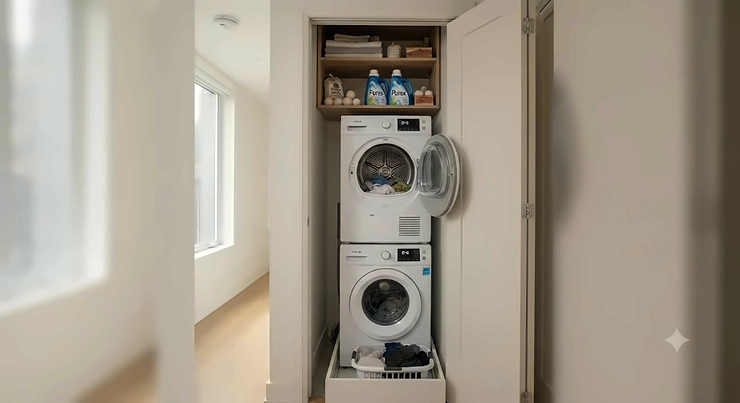
A compact ventless dryer is a 24-inch (about 61 cm) dryer that dries laundry using a condenser or heat pump instead of a hose to the outdoors, which is why it can slide into a closet, a corner of the kitchen, or a bathroom that was never built with laundry in mind. If you’ve ever stood in a rental unit staring at a stackable hookup with zero vent access, you already know why this category exists — it’s the appliance equivalent of a workaround that actually works. Choosing the right compact ventless dryer for a Canadian apartment or condo means weighing capacity against footprint, energy draw against drying time, and price against how often you’re realistically willing to babysit a lint filter.
This guide breaks down seven real, currently available models, spanning budget wall-mount units to premium steam-equipped machines, based on manufacturer specifications and aggregated owner feedback gathered from retailer review pages. We’ll also dig into how these machines actually perform day to day, not just what the spec sheet promises. According to Natural Resources Canada, heat pump dryers can cut energy consumption by 20 to 60 percent compared with standard models, which matters a lot when you’re paying Canadian electricity rates for a machine that runs longer cycles than a full-size unit. Whether you’re renting a downtown Toronto studio or setting up a laundry nook in a Calgary basement suite, there’s a compact ventless dryer on this list built for your situation.
Quick Comparison Table
| Category | Pick | Capacity | Price Range (CAD) | Best For |
|---|---|---|---|---|
| Best Overall | LG DLEC888W | 4.2 cu. ft. | C$950–C$1,200 | All-around apartment use |
| Best Budget | Magic Chef MCSDRY15W | 1.5 cu. ft. | C$280–C$380 | Micro-apartments, dorms |
| Quietest / Companion Set | Bosch 300 Series WTG86400UC | 4.0 cu. ft. | C$1,050–C$1,250 | Shared walls, condos |
| Shallowest Footprint | Asko T208CW | 4.0 cu. ft. | C$1,900–C$2,300 | Ultra-tight closets |
| Premium Pick | Miele TXR860WP Eco & Steam | 4.0 cu. ft. | C$2,300–C$2,800 | Fabric care, allergy households |
Looking at the spread above, the price gap between the cheapest and priciest option here isn’t really about drying power — it’s about extra cycles, fabric-care technology, and build quality that Canadian renters may or may not need. Budget-conscious buyers doing small, frequent loads will get most of the practical benefit from the Magic Chef MCSDRY15W, while anyone drying delicates or dealing with allergies will find the Miele TXR860WP Eco & Steam‘s sanitize cycle earns its higher price. For most one- or two-person households, the LG DLEC888W hits the sweet spot between capacity and cost.
Just one click — help others make better buying decisions too! 😊
Top 7 Compact Ventless Dryers: Expert Analysis
Below is a detailed look at seven real compact ventless dryer models sold through major Canadian appliance retailers and, where available, on amazon.ca. Prices are shown as ranges only, since retail pricing shifts constantly — always check current pricing before buying. Coverage spans budget, mid-range, and premium tiers, plus a couple of notably different form factors for tight spaces.
1. LG DLEC888W — best all-around apartment performer
The LG DLEC888W built its reputation on doing the unglamorous stuff well: consistent drying, sturdy hardware, and controls that don’t require a manual.
At 4.2 cu. ft., the LG DLEC888W offers one of the larger drums in the compact ventless dryer category, and it uses LG’s Sensor Dry technology paired with a NeverRust stainless steel drum that resists the corrosion cheaper plastic or painted-steel drums eventually show. In practical terms, that combination means fewer half-damp loads and a machine that should still look presentable after five years of humid condenser cycles. Based on the spec comparison, this is the model that best balances capacity with a genuinely 24-inch-wide footprint, which matters when you’re trying to squeeze a stacked pair into a coat closet.
Reviewers consistently report that the LG DLEC888W‘s NFC Tag-On feature — which lets you download specialty cycles like Wool or Sports Wear from a phone — is more useful than it sounds, especially for households juggling technical outdoor gear. A common theme in aggregated owner feedback is appreciation for the interior drum light, a small feature that solves the age-old problem of a lost sock hiding in a dark drum.
Pros:
- ✅ NeverRust stainless drum resists long-term corrosion
- ✅ NFC Tag-On unlocks downloadable specialty cycles
- ✅ Largest usable capacity in this compact-dryer roundup
Cons:
- ❌ No built-in Wi-Fi for remote app monitoring
- ❌ Sits toward the higher end of the mid-range price bracket
Expect the LG DLEC888W to land somewhere in the C$950–C$1,200 range at the time of research. For a primary dryer in a one- or two-bedroom apartment, it’s a strong value given the capacity you’re getting.

2. Bosch 300 Series WTG86400UC — best for shared walls and condos
If your unit shares a wall with a neighbour who works night shifts, the Bosch 300 Series WTG86400UC is the compact ventless dryer built for that exact anxiety.
This 24-inch model packs a 4.0 cu. ft. drum and Bosch’s Sensitive Condensation Drying System, which uses a rounded drum chamber specifically engineered to dampen vibration and noise — what most buyers overlook here is that this isn’t just marketing language, since Bosch designs the 300 Series washer and dryer to physically pair together for a matched, balanced installation. The dryer plugs directly into a companion Bosch washer for simplified setup, which is a genuine convenience if you’re outfitting a laundry closet from scratch rather than replacing a single unit. On paper, this means less cross-brand guesswork about stacking kits and venting adapters, because there isn’t any venting to plan for at all.
Aggregated review sentiment across appliance retailers frequently praises the Bosch 300 Series WTG86400UC‘s quiet operation and fabric-gentle cycles, though some owners note the 25-inch depth requires more clearance than expected once the door is factored in.
Pros:
- ✅ Noticeably quieter operation than most condenser rivals
- ✅ Matches directly with Bosch’s 300 Series washer for a unified setup
- ✅ Sensitive Condensation system is gentle on delicate fabrics
Cons:
- ❌ 25-inch depth needs extra clearance for the door swing
- ❌ Condenser-only design (no heat pump) uses more energy per cycle
Current pricing for the Bosch 300 Series WTG86400UC typically falls in the C$1,050–C$1,250 range. It’s a strong pick for condo owners prioritizing quiet operation over the absolute lowest energy bill.
3. Magic Chef MCSDRY15W — best budget pick for micro-apartments
When floor space is measured in square feet rather than square metres, the Magic Chef MCSDRY15W is the compact ventless dryer that asks the least of your apartment.
At just 1.5 cu. ft., this non-vented, front-load dryer holds up to 2.5 kg (about 5.5 lbs) of laundry, runs on a standard 110V outlet, and can be wall-mounted or set up as a countertop unit — a flexibility almost no other model on this list offers. Here’s what to weigh: that tiny drum means you’re doing more frequent, smaller loads rather than one big weekly wash, but for a single person in a studio or dorm room, that trade-off is often a feature rather than a bug. The see-through window and simple high/low heat dial keep the learning curve close to zero.
A common complaint in user reviews is that full loads take noticeably longer to dry than the cycle-time estimates suggest, which tracks with how compact condenser dryers generally behave once you push past their comfortable capacity.
Pros:
- ✅ Wall-mount or countertop installation flexibility
- ✅ Genuinely tiny footprint fits closets other dryers can’t
- ✅ Lowest price point of any model in this roundup
Cons:
- ❌ 2.5 kg (5.5 lb) capacity limits load size significantly
- ❌ Reviewers report slow cycles when the drum is loaded near capacity
At the time of research, the Magic Chef MCSDRY15W sits in the C$280–C$380 range, making it the clear entry point for anyone testing whether a compact ventless dryer even fits their routine before spending more.
4. Electrolux ELFE422CAW — best for wrinkle control between washes
The Electrolux ELFE422CAW is the compact ventless dryer for people who own exactly one iron and would prefer to never use it.
Despite its 24-inch width, this model offers a 4.0 cu. ft. capacity and pairs Gentle Dry Advanced Technology — which runs lower heat cycles to reduce fabric and environmental strain — with an Instant Refresh Cycle that dewrinkles and freshens clothing without a full wash-and-dry loop. What most buyers overlook about this feature is how often it gets used in practice: for anyone who works from a closet full of button-downs, being able to de-wrinkle a shirt in a short cycle instead of ironing it is a genuine time-saver, not just a spec-sheet bullet point. Reviewers note that the lower-heat approach also seems to extend the life of elastic and synthetic fabrics compared with high-heat vented cycles.
Based on aggregated owner sentiment, the trade-off is a condenser reservoir that needs regular emptying and cycle times that stretch out noticeably on bulky items like towels and bedding.
Pros:
- ✅ Instant Refresh Cycle dewrinkles clothing without a full dry
- ✅ Gentle Dry Advanced Technology reduces heat-related fabric wear
- ✅ 4.0 cu. ft. capacity in a genuinely 24-inch-wide unit
Cons:
- ❌ Condenser water reservoir requires frequent manual emptying
- ❌ Bulky items like towels and bedding take considerably longer to dry
Expect a price range around C$1,100–C$1,400 for the Electrolux ELFE422CAW. It’s a strong mid-range choice for anyone who cares more about fabric care than raw drying speed.
5. GE GFT14ESSMWW — most straightforward controls
Not every buyer wants smart features and steam settings — some just want a compact ventless dryer that dries clothes and gets out of the way, and that’s the GE GFT14ESSMWW‘s whole pitch.
This model reliably brings laundry to 95–100% dryness, according to independent lab testing, though it typically takes 15 to 30 minutes longer than rival ventless models to get there — a known trade-off in a category where smaller drums and closed-loop moisture recovery both work against speed. What the spec sheet won’t tell you, but testers note, is that the unit also runs hotter than some competitors during longer cycles, so it’s worth giving it a bit of breathing room rather than tucking it into a fully sealed cabinet. In practice, this is a dependable second dryer or starter unit rather than a flagship, and its intuitive dial-based control layout means there’s essentially no setup learning curve.
Owner feedback aggregated from retailer reviews frequently cites the GE GFT14ESSMWW‘s simple interface as a selling point for older household members or anyone who just wants “dry” and “damp” as the only two settings that matter.
Pros:
- ✅ Reaches 95–100% dryness reliably in independent testing
- ✅ Simple, intuitive dial controls with no learning curve
- ✅ Compact 24-inch profile fits tight laundry nooks
Cons:
- ❌ Runs 15–30 minutes longer per cycle than several ventless rivals
- ❌ Can reach noticeably high temperatures during longer cycles
Pricing for the GE GFT14ESSMWW generally lands in the C$900–C$1,100 range, positioning it as a solid, no-frills mid-range option.

6. Asko T208CW — shallowest depth for ultra-tight closets
Depth, not width, is usually what kills a laundry-closet renovation, and the Asko T208CW was built specifically to solve that problem.
At just 22.5 inches deep — noticeably shallower than most 24- to 25-inch-deep rivals — this Scandinavian-built condenser dryer fits into closets that would reject almost everything else on this list. On paper, this means the difference between fitting a stacked pair behind a standard closet door and needing to remove the door entirely. The T208CW pairs that shallow footprint with a 4.0 cu. ft. drum, so buyers aren’t sacrificing much capacity for the space savings, and its quieter, rounded-drum design echoes the vibration-dampening approach used by other premium European brands.
Reviewers who’ve owned Asko appliances for years frequently cite long-term build quality and reliability as the brand’s defining trait, though Canadian buyers should factor in that service networks for Asko are smaller than for mainstream North American brands.
Pros:
- ✅ Unusually shallow 22.5-inch depth for space-constrained closets
- ✅ Reviewers consistently praise long-term build quality
- ✅ Quiet, rounded-drum operation reduces vibration noise
Cons:
- ❌ Premium pricing relative to its capacity class
- ❌ Fewer Canadian service centres than mainstream competitors
The Asko T208CW typically runs in the C$1,900–C$2,300 range at the time of research — a real premium, but one that solves a specific space problem few other models address.
7. Miele TXR860WP Eco & Steam — premium pick for fabric care
For buyers who treat laundry as a fabric-preservation project rather than a chore, the Miele TXR860WP Eco & Steam is the compact ventless dryer that competes with full-size machines on features, not just footprint.
This model’s steam and sanitize cycles genuinely stand out in the category: steam helps release wrinkles without added heat exposure, while the sanitize setting is aimed at households managing allergies or simply wanting a higher bar for hygiene on towels and bedding. Reviewers note that its maximum operating temperature runs lower than most rivals, which — combined with its specialized cycle settings — appears to reduce wear and tear on delicate fabrics over repeated cycles. Based on the spec comparison, this is easily the most fully-featured unit in this roundup, closing much of the performance gap that typically separates compact ventless dryers from full-size vented models.
Aggregated owner and reviewer sentiment consistently frames the Miele TXR860WP Eco & Steam as a “buy once” appliance — expensive upfront, but built and specced to justify staying in service far longer than budget alternatives.
Pros:
- ✅ Steam and sanitize cycles rival full-size dryer performance
- ✅ Low maximum temperature reduces fabric wear over time
- ✅ Simple to install and reposition despite its premium feature set
Cons:
- ❌ Among the most expensive compact ventless dryers on the market
- ❌ Feature set is overkill for renters who just want basic drying
Expect the Miele TXR860WP Eco & Steam to sit around C$2,300–C$2,800. It’s a genuine investment piece rather than an entry-level buy, best suited to households planning to stay put for years.
Small Ventless Dryer Reviews: What Real Owners Are Saying
Reading through small ventless dryer reviews across multiple retailers reveals a consistent pattern that doesn’t always show up on spec sheets: capacity claims and real-world load size rarely match up perfectly. Reviewers of models like the Magic Chef MCSDRY15W frequently mention needing to split what would be a single vented-dryer load into two or three smaller runs, while owners of larger-drum options like the LG DLEC888W and Bosch 300 Series WTG86400UC report closer-to-advertised performance.
A second theme that shows up again and again in aggregated feedback is drying time. Compact condenser and heat-pump dryers recirculate air through a closed loop rather than venting it outside, so cycles routinely run 1.5 to 2 times longer than a standard vented dryer — this isn’t a defect, it’s simply how the technology works, and it’s echoed consistently across owner reviews for the GE GFT14ESSMWW and Electrolux ELFE422CAW alike. Reviewers consistently note that once they adjusted their laundry routine around longer cycles — running a load before bed instead of waiting on it, for instance — satisfaction scores climbed noticeably. The takeaway from small ventless dryer reviews as a category: judge these machines by consistency and fabric care rather than speed, and set load-size expectations lower than the vented dryer you might be replacing.
Apartment Size Ventless Dryer: Fitting One Into Your Floor Plan
Finding the right apartment size ventless dryer starts with a tape measure, not a spec sheet. Most models in this category are 24 inches (61 cm) wide, but depth varies meaningfully — anywhere from the Asko T208CW‘s 22.5-inch depth to the Bosch 300 Series WTG86400UC‘s 25-inch depth — and that difference can decide whether a unit fits behind a standard closet door or forces you to remove it.
Before buying, measure three things: the width and depth of the intended space, the swing radius of the dryer door (many open to 105 degrees or more), and the clearance behind the unit, since condenser dryers need airflow to avoid overheating in an enclosed space. Also confirm your outlet — nearly every model here runs on a standard 120V, 15-amp household circuit, unlike full-size vented dryers that often require a dedicated 240V line. That’s genuinely good news for renters, since it usually means no electrical work is required, just a nearby outlet and, ideally, a floor drain or sink access for the condensate line if the model doesn’t use an internal reservoir. If you’re stacking an apartment size ventless dryer above a compact washer, double-check the manufacturer’s stacking kit compatibility before purchase — not every washer and dryer pairing is rated for it, even within the same brand.
Space-Saving Drying: Real-World Scenarios for Tight Homes
Seeing how space-saving drying actually plays out for different households makes the buying decision a lot more concrete than a spec sheet alone.
The downtown studio renter. A single person in a 450-square-foot studio with no vent access and one nearby outlet is the textbook case for the Magic Chef MCSDRY15W. Small loads a few times a week, wall-mounted to free up floor space entirely, and a price point that doesn’t sting if the lease ends in a year.
The condo-owning couple. Two adults sharing a condo with thin walls and a laundry closet behind a bedroom need quiet operation as much as capacity. The Bosch 300 Series WTG86400UC, matched with its companion washer, handles regular loads without disturbing sleep schedules or angering the neighbours.
The family in a basement suite. A family of four doing frequent laundry — including bulky bedding and towels — needs more drum capacity and durability than a single-person unit offers. The LG DLEC888W‘s 4.2 cu. ft. drum and corrosion-resistant build make it the more realistic long-term fit, even though it costs more upfront than the Magic Chef.
Across all three, the constant is that space-saving drying isn’t just about the appliance’s footprint — it’s about matching capacity and noise level to how the household actually lives, not just how much floor space is available.
✨ Don’t miss these exclusive deals!
🔍 Take your laundry setup to the next level with these carefully selected compact ventless dryers. Click on any highlighted model to check current pricing and availability — small upgrades like these can make apartment living genuinely more comfortable.
Portable Dryer Option vs Compact Ventless Dryer: Which Wins?
Before settling on a compact ventless dryer, it’s worth understanding how it actually differs from a portable dryer option like a mini spin dryer or a fully portable washer-dryer combo, since the terms get used loosely online.
A true portable dryer option — like a countertop spin dryer — doesn’t heat air at all. It rapidly spins wet laundry to extract water mechanically, which is fast and cheap to run but doesn’t fully dry clothes on its own; you’re still hang-drying afterward. A ventless washer-dryer combo unit, such as those sold under the Equator and EdgeStar brands, takes a different approach: it washes and dries in the same drum using condenser technology, similar to the standalone dryers reviewed above, but in a single all-in-one machine that’s easier to move between rentals.
| Factor | Compact Ventless Dryer | Portable Spin Dryer | Ventless Washer-Dryer Combo |
|---|---|---|---|
| Fully dries clothes | Yes | No — needs air-drying after | Yes |
| Typical cycle time | 1.5–3 hours | 5–10 minutes | 3–5 hours (combined wash + dry) |
| Needs a water/drain hookup | Sometimes (drain hose) | No | Yes |
| Best For | Households doing regular full loads | Supplementing hang-drying | Renters needing both wash and dry in one machine |
The analysis here is fairly clear-cut: if you already own a washer and just need drying, a standalone compact ventless dryer like the LG DLEC888W or Magic Chef MCSDRY15W is the more capable long-term choice. If you have zero laundry hookups at all — a common reality in older Canadian apartment buildings — a ventless washer-dryer combo is the more realistic portable dryer option, since it solves both problems in one footprint. A pure spin dryer is really a supplement to a clothesline, not a full replacement for either.
Small Laundry Room Setup: Installation and Maintenance Tips
Getting a small laundry room set up around a compact ventless dryer is mostly about airflow, drainage, and a maintenance habit you’ll actually keep.
Setup basics: Leave at least 5 cm (2 inches) of clearance around the unit for ventilation, even though it’s “ventless” — the condenser still needs to exhaust heat into the room, and condenser dryers can noticeably warm a small space during a cycle. Decide upfront whether you’re using an internal water reservoir (empty it after every load or two) or a drain hose routed into a nearby sink or floor drain, since forgetting this step is the single most common first-week mistake new owners report.
Ongoing maintenance: Clean the primary lint filter after every load — this is non-negotiable for both efficiency and safety. Most compact ventless dryers also have a secondary condenser filter that needs cleaning every one to three months; skipping this step is the second-most-cited cause of the “why is my dryer suddenly taking forever” complaints in owner reviews. A quick monthly wipe-down of the door seal also prevents the musty smell that can develop in a sealed, humid drum.
Common first-month mistakes: Overloading the drum to save time (it backfires, extending cycle length disproportionately), ignoring the condensate reservoir until it overflows, and placing the unit in a fully enclosed cabinet with no airflow at all, which can trigger overheat protection mid-cycle.
How to Choose a Compact Ventless Dryer
Choosing the right model comes down to seven practical checks, in roughly this order of importance:
- Measure your space first. Confirm width, depth, and door swing clearance before comparing features — a dryer that doesn’t physically fit isn’t a bargain at any price.
- Decide between condenser and heat pump technology. Heat pump models use less energy and run cooler, per Natural Resources Canada, while condenser models are typically cheaper upfront.
- Match capacity to household size. A single person can usually manage with 1.5–2.5 cu. ft.; a couple or small family should look at 4.0 cu. ft. or larger.
- Check the drainage method. An internal reservoir needs manual emptying; a drain hose needs a nearby sink or floor drain — pick whichever fits your plumbing reality.
- Confirm the outlet type. Nearly all compact ventless dryers run on standard 120V household power, which avoids costly electrical upgrades.
- Weigh noise level if you share walls. Condo and apartment dwellers should prioritize models specifically marketed for quiet operation.
- Factor in resale or portability. Renters who move often should favour lighter, simpler units over heavier premium machines that are harder to relocate.
Common Mistakes When Buying a Compact Ventless Dryer
Even careful shoppers tend to trip over the same handful of pitfalls in this category.
The biggest one is assuming capacity translates directly from a vented dryer — it doesn’t. A 4.0 cu. ft. compact ventless dryer will not comfortably handle the same load size as a 7 cu. ft. standard dryer, and expecting otherwise leads straight to disappointment and returned appliances. A second common mistake is ignoring drainage requirements until move-in day, only to discover the unit needs either a sink connection or daily reservoir emptying that wasn’t factored into the laundry room’s layout. Buyers also frequently underestimate cycle time, assuming a 45-minute vented-dryer habit will carry over, when 90 minutes to 3 hours is closer to the compact ventless dryer norm. Finally, skipping the depth measurement in favour of just checking width is a recurring theme in negative reviews — several models on this list differ by 2 to 3 inches of depth, which is often the exact margin that determines whether a closet door can close.
Compact Ventless Dryer vs Standard Vented Dryer
The comparison that matters most for most Canadian buyers isn’t between ventless brands — it’s between going ventless at all versus installing a standard vented dryer where possible.
| Factor | Compact Ventless Dryer | Standard Vented Dryer |
|---|---|---|
| Installation | No outdoor venting needed | Requires exterior vent duct |
| Typical footprint | 24″ wide, fits closets/nooks | Wider, needs dedicated laundry space |
| Cycle time | 1.5–3 hours | 40–60 minutes |
| Energy use per cycle | Lower (especially heat pump models) | Higher |
| Upfront cost | Often higher for comparable features | Generally lower for entry models |
| Ideal setting | Apartments, condos, no vent access | Houses with existing vent infrastructure |
The analysis here favours different buyers for different reasons: a standard vented dryer wins decisively on speed and upfront cost when venting is already available, but a compact ventless dryer wins on flexibility and long-term energy use in any space where installing a vent simply isn’t an option — which describes a large share of Canadian rental housing. For renters specifically, the “no ducting required” advantage isn’t just convenient, it’s often the only path to having in-unit laundry at all.

Long-Term Cost & Maintenance
Sticker price only tells part of the story with a compact ventless dryer — energy use over years of ownership matters just as much, especially with Canadian electricity rates varying widely by province.
| Tier | Typical Upfront Price (CAD) | Relative Energy Use | 5-Year Outlook |
|---|---|---|---|
| Budget (e.g., Magic Chef MCSDRY15W) | C$280–C$380 | Higher per load due to smaller, less efficient cycles | Lowest upfront cost, may need earlier replacement |
| Mid-range (e.g., LG DLEC888W, Bosch 300 Series WTG86400UC) | C$950–C$1,400 | Moderate, condenser-based | Balanced cost-per-use over time |
| Premium (e.g., Asko T208CW, Miele TXR860WP Eco & Steam) | C$1,900–C$2,800 | Lower on efficient cycles, built for longevity | Higher upfront, potentially lower lifetime cost if it lasts longer |
Reading the table above alongside the Efficiency Canada report on appliance standards, it’s clear that heat pump technology — increasingly common even in compact and combo units — is where the real long-term savings live, since it can cut energy use by 20 to 60 percent versus a standard condenser model. For renters who might move within a couple of years, the budget tier often makes more financial sense despite higher energy use per load, simply because the total number of loads run before moving out is limited. For homeowners planning to stay put, paying more upfront for an efficient, durable mid-range or premium model tends to pencil out over a five-year horizon.
Safety, Regulations, and Compliance Guide
Every compact ventless dryer sold in Canada needs to meet electrical safety requirements before it can legally reach a store shelf or your apartment. Look for CSA certification markings on the unit — the CSA Group tests household appliances, including laundry equipment, against Canadian electrical safety and energy-efficiency standards, and compliance with the Canadian Electrical Code is mandatory in every province and territory, not optional.
Beyond certification, a few practical safety habits matter specifically for ventless models: never block the front or side vents that release heat into the room, since restricted airflow is the most common cause of overheat shutdowns; empty condensate reservoirs promptly rather than letting water sit, which can encourage mould growth in a sealed unit; and if your building has specific rules about water drainage lines for laundry appliances (common in older Canadian apartment buildings), confirm your chosen drainage method — reservoir versus hose — is actually permitted before installation day. Landlords in some provinces also require written permission before installing any appliance that connects to a drain, so it’s worth a quick email to property management before your compact ventless dryer arrives.
Buyer’s Decision Framework
If you’re still weighing options, use this simple framework to cut through the noise:
- If you live alone in under 500 square feet with no drain access, choose a wall-mountable budget model like the Magic Chef MCSDRY15W, because low capacity and simple reservoir emptying match a single-person routine.
- If you share walls with neighbours and want a matched, easy-install laundry pair, choose the Bosch 300 Series WTG86400UC, because its Sensitive Condensation system and companion washer minimize both noise and setup guesswork.
- If your closet depth is under 24 inches, choose the Asko T208CW, because it’s one of the few models genuinely built for shallow spaces.
- If you’re drying for a couple or small family and want the best all-around balance, choose the LG DLEC888W, because its larger drum and durable drum coating handle frequent use well.
- If fabric care and allergy control matter more than budget, choose the Miele TXR860WP Eco & Steam, because its steam and sanitize cycles genuinely outperform the rest of this list on that specific priority.

Frequently Asked Questions
❓ How long does a compact ventless dryer take to dry a load?
❓ Do compact ventless dryers need to be vented at all?
❓ Can I install a compact ventless dryer myself?
❓ Are compact ventless dryers more expensive to run than regular dryers?
❓ What size compact ventless dryer do I need for an apartment?
Conclusion
Picking the right compact ventless dryer really comes down to being honest about your space, your laundry habits, and how much you’re willing to pay for convenience versus features. The LG DLEC888W remains the most broadly sensible pick for apartment dwellers who want solid capacity without premium pricing, while the Magic Chef MCSDRY15W solves the problem for anyone working with genuinely minimal square footage and an even more minimal budget. Buyers dealing with shared walls should lean toward the Bosch 300 Series WTG86400UC for its quieter operation, and anyone fighting an unusually shallow closet has a real answer in the Asko T208CW. At the top end, the Miele TXR860WP Eco & Steam proves that “compact” and “genuinely full-featured” aren’t mutually exclusive, provided the budget allows for it.
Whichever model you land on, remember that a compact ventless dryer plays by different rules than the vented dryer you might be used to — longer cycles, smaller loads, and a bit more hands-on maintenance in exchange for fitting into a space that otherwise couldn’t have laundry at all. For most Canadian renters and condo owners, that trade-off is a genuinely good one.
Recommended for You
- Ventless Dryer for Basement: 7 Best Picks Ranked for 2026
- Best Ventless Dryer: 7 Top Picks for Canadian Condos (2026)
- Heat Pump Dryer Worth It? 7 Top Picks; Real Savings (2026)
Disclaimer: This article contains affiliate links. As an Amazon Associate, I earn from qualifying purchases. If you purchase products through these links, we may earn a small commission at no additional cost to you.
✨ Found this helpful? Share it with your friends! 💬🤗
