
In This Article
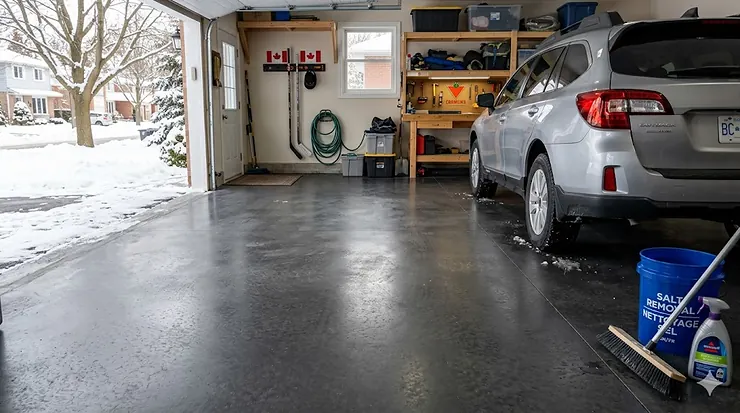
Every spring, Canadian homeowners face the same frustrating sight: white, crusty salt stains covering their garage floors after months of winter driving. If you’ve tried hosing down your concrete only to watch those stains reappear days later, you’re not alone. The road salt used by Canadian municipalities — primarily calcium and magnesium chloride — doesn’t just sit on your garage floor; it penetrates deep into concrete’s porous surface where simple water rinsing can’t reach it.
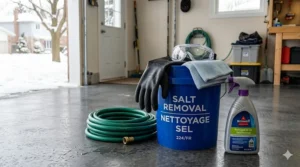
Here’s what most homeowners don’t realize: that salt isn’t merely unsightly. Left untreated, road salt creates a destructive cycle. It pulls moisture from the air, keeping your concrete perpetually damp, which leads to surface scaling, spalling, and eventual structural deterioration. In provinces like Ontario and Quebec where winter road maintenance crews use up to 5 million tonnes of salt annually, garage floors take an extraordinary beating. The good news? With the right approach and products available on Amazon.ca, you can effectively remove road salt from garage floor surfaces and protect your investment for years to come.
This guide walks you through proven methods used by Canadian contractors, compares the most effective cleaners available to Canadian buyers, and shares maintenance strategies that account for our harsh winters and spring thaw cycles.
Quick Comparison: Top Salt Removal Methods
| Method | Speed | Effectiveness | Cost Range (CAD) | Best For |
|---|---|---|---|---|
| Commercial Degreaser | Fast (30 mins) | Excellent | $25-$45 | Heavy buildup |
| Salt Neutralizer | Medium (1 hour) | Excellent | $20-$35 | Prevention & cleaning |
| Vinegar Solution | Slow (2+ hours) | Good | $5-$10 | Light stains, budget |
| Pressure Washing | Fast (45 mins) | Moderate | $150-$400 (equipment) | Large areas |
| Oxy-Based Cleaner | Medium (1 hour) | Very Good | $30-$50 | Eco-conscious buyers |
Looking at this comparison, commercial degreasers like Zep and Simple Green deliver the fastest results for severe Canadian winter buildup, while DIY vinegar solutions work well for homeowners who tackle cleaning bi-weekly rather than waiting until spring. Budget buyers should note that investing the extra $15-$25 in a dedicated salt neutralizer prevents the salt from recrystallizing after cleaning — a frustration that hits harder during Canadian winters when cold temperatures already reduce your garage’s battery range by 10-20%.
💬 Just one click — help others make better buying decisions too! 😊
Top 7 Products to Remove Road Salt From Garage Floor: Expert Analysis
1. Zep Driveway and Concrete Cleaner and Degreaser (ZUCON128)
Zep Driveway and Concrete Cleaner stands out as the contractor-grade solution Canadian professionals reach for when standard cleaners fail. This concentrated formula makes up to 20 gallons of cleaner, which translates to exceptional value for homeowners with double or triple-car garages — common in Canadian suburbs where vehicle storage matters during harsh winters.
The real advantage here isn’t just cleaning power; it’s the alkaline formulation specifically designed to break down road salt’s chemical bonds with concrete. While you’re scrubbing, the surfactants lift salt crystals from within the concrete’s pores rather than just washing surface residue. For Canadian garages that see daily exposure from November through April, this deep-cleaning action prevents the cumulative damage that leads to expensive resurfacing down the road.
Mix 340-680 ml (12-24 oz) per gallon of water depending on salt buildup severity. The concentrated format means you’re not paying for water weight in shipping — a consideration when ordering to remote areas of Alberta or northern Ontario where delivery costs add up. Canadian contractors report success using this at full strength on stubborn white streaks that appear after spring melt.
✅ Pros:
- Makes 20 gallons of cleaner from one bottle
- Construction-grade formula trusted by Canadian pros
- Works on oil stains and deicing fluid residue simultaneously
❌ Cons:
- Requires proper ventilation (strong alkaline odour)
- Can be harsh on unsealed or damaged concrete
Price: Around $35-$50 CAD for 3.78L |
Best for: Homeowners with severe winter salt buildup who want professional results
2. Simple Green Oxy Solve Concrete and Driveway Cleaner
Simple Green Oxy Solve uses peroxide-powered cleaning technology that appeals to environmentally conscious Canadian buyers. This formula meets U.S. EPA Safer Choice standards and won’t harm the grass, shrubs, or pets that inevitably come into contact with garage runoff — important for families in suburban developments where drainage flows to shared green spaces.
What distinguishes this from basic Simple Green is the oxygen-based activation. When you apply it to salt-stained concrete, the peroxide molecules break apart salt deposits through oxidation rather than harsh chemicals. Canadian users in BC and Atlantic provinces appreciate that this biodegradable formula won’t contribute to the watershed issues already strained by municipal road salt runoff.
The 1-gallon concentrate covers up to 185 square metres (2,000 sq ft), adequate for most two-car Canadian garages with space to spare. It connects directly to garden hoses via the included nozzle, though you’ll get better results applying with a pump sprayer and letting it dwell for 5-10 minutes before scrubbing. Works effectively even in temperatures down to 4°C (40°F), which matters during those unpredictable Canadian spring days when you’re eager to clean but temperatures haven’t fully warmed.
✅ Pros:
- Pet and plant-safe biodegradable formula
- Pressure washer and manual application compatible
- Removes algae and mildew stains alongside salt
❌ Cons:
- Requires scrubbing for heavy buildup (not spray-and-rinse)
- Less aggressive than industrial alkaline cleaners
Price: Around $40-$55 CAD |
Best for: Eco-conscious families who want effective cleaning without harsh chemicals
3. emzone Salt & Stain Remover (425g Aerosol)
emzone Salt & Stain Remover represents a uniquely Canadian product designed specifically for our winter conditions. This Ontario-based company understands what Montreal, Toronto, and Ottawa drivers face: repeated exposure to calcium chloride brine solutions that leave behind stubborn white residue traditional cleaners struggle with.
The aerosol delivery system provides targeted application ideal for spot-treating high-traffic paths where you park daily or areas near the garage door threshold where salt accumulation concentrates. Canadian reviewers consistently praise its effectiveness on fresh-to-moderate salt stains, noting it works faster than DIY vinegar solutions and requires less scrubbing effort.
For older or thick salt buildup, emzone recommends pre-soaking with hot water to soften deposits before applying the spray. This two-step approach mirrors what professional detailers use when treating vehicle interiors after Canadian winters. The 425g canister handles approximately 3-4 square metres (32-43 sq ft) of moderate staining, making it most practical for maintaining high-traffic zones rather than treating an entire 400 sq ft garage floor in one session.
✅ Pros:
- Canadian-designed for our specific road salt formulations
- Aerosol format allows precise targeting of problem areas
- Effective on both fresh and set-in salt stains
❌ Cons:
- Coverage limited compared to bulk liquid cleaners
- Higher cost per square metre for large area treatment
Price: Around $12-$18 CAD per can |
Best for: Spot treatment and maintenance between deep cleans
4. Professional Salt Neutralizer Floor and Carpet Cleaner (Home Hardware)
Professional Salt Neutralizer from Home Hardware takes a different chemical approach than standard cleaners. Rather than just dissolving salt, neutralizers alter the salt’s molecular structure so it stops attracting atmospheric moisture — the root cause of those recurring white stains that frustrate Canadian homeowners every spring.
This Canadian-formulated product works on both hard floors and carpets, addressing a reality most garage owners face: those rubber floor mats you use to protect your concrete also trap salt-laden slush that eventually migrates to the concrete beneath. The 4-litre format provides enough solution to treat a typical double-car garage floor plus entry mats.
What makes neutralizers particularly valuable for Canadian applications is their preventive quality. After cleaning and neutralizing salt deposits, treated concrete resists new salt adhesion for 2-3 weeks — meaningful protection during February and March when your vehicle tracks in fresh salt daily. Mix according to instructions (typically 1 part neutralizer to 4 parts water) and apply with a mop or pump sprayer. Professional cleaning services across Canada use similar neutralizing chemistry as a final step after pressure washing.
✅ Pros:
- Prevents salt from recrystallizing after cleaning
- Dual-purpose for floors and automotive carpets
- Canadian retailer availability (Home Hardware nationwide)
❌ Cons:
- Requires initial cleaning before neutralization works best
- May need reapplication during heavy salt exposure periods
Price: Around $22-$32 CAD for 4L |
Best for: Homeowners wanting long-term protection against recurring salt stains
5. White Vinegar Solution (DIY Budget Option)
White Vinegar represents the most accessible solution for Canadian homeowners on tight budgets or those preferring to avoid commercial chemicals. The acetic acid in vinegar (typically 5% concentration) creates a mildly acidic environment that helps dissolve calcium and magnesium chloride deposits — the primary components of Canadian road salt.
Mix equal parts white vinegar and warm water in a pump sprayer or bucket. The warm water component matters more than most realize; cold temperatures slow the chemical reaction, while water above 40°C (104°F) significantly accelerates salt dissolution. Pour or spray liberally on affected areas, let dwell 5-10 minutes, then scrub with a stiff-bristled brush.
The limitation with vinegar solutions becomes apparent with heavy buildup — those thick, crusty deposits that form by garage door thresholds after 4-5 months of Canadian winter. You’ll need multiple applications and considerable scrubbing effort where commercial cleaners would work faster. However, for homeowners who clean bi-weekly rather than waiting until spring, vinegar provides adequate performance at around $6 CAD for 4 litres. It’s also the safest option for older concrete or surfaces with existing sealant that might be sensitive to harsh alkaline cleaners.
✅ Pros:
- Extremely budget-friendly ($5-$8 CAD per treatment)
- No special storage or ventilation requirements
- Safe for all concrete types including sealed surfaces
❌ Cons:
- Requires more physical scrubbing than commercial cleaners
- Multiple applications needed for severe buildup
- Vinegar odour (dissipates after drying)
Price: Around $5-$10 CAD per full garage treatment |
Best for: Budget-conscious homeowners who maintain regular cleaning schedules
6. Heavy-Duty Deck Scrub Brush with Long Handle
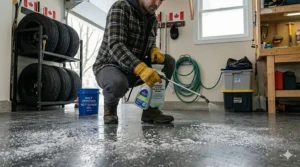
You can’t effectively remove road salt from garage floor surfaces without proper mechanical agitation, which is where stiff-bristled deck brushes become essential. The models popular on Amazon.ca feature 1.5-inch bristles that penetrate into concrete’s porous surface where salt crystals hide, with 1.2-1.5 metre (48-60 inch) handles that eliminate the back strain from hunching over while scrubbing a 400 sq ft garage.
Look for brushes with polypropylene bristles rather than natural fibres — synthetic materials maintain their stiffness even when soaked with cleaning solutions and withstand the aggressive scrubbing required for Canadian winter salt buildup. The YONILL and Superio brands frequently appearing in Canadian search results offer dual-sided designs with scrapers on one edge, useful for lifting thick salt crust before applying liquid cleaners.
Canadian buyers should specifically note handle material. Aluminum or fibreglass handles tolerate cold garage temperatures without becoming brittle, unlike some plastic handles that crack if you’re cleaning during a late-season cold snap. The investment in a quality brush ($25-$40 CAD) pays dividends over years of spring cleaning sessions and works for other concrete cleaning tasks — driveways, patios, basement floors — making it a versatile tool for Canadian homeowners.
✅ Pros:
- Long handle prevents back strain during extended scrubbing
- Stiff synthetic bristles won’t soften in cleaning solutions
- Multi-purpose use beyond garage floor cleaning
❌ Cons:
- Requires physical effort (not a chemical-only solution)
- Quality brushes start around $25-$30 CAD
Price: Around $25-$45 CAD |
Best for: Anyone serious about DIY concrete maintenance
7. Drill-Powered Scrub Brush Attachment Kit
Drill-powered brush attachments transform your cordless drill into a powered scrubbing tool that dramatically reduces the time and effort required to remove road salt from garage floor surfaces. The Drillbrush brand kits popular on Amazon.ca include multiple brush heads with varying stiffness levels, allowing you to match aggression to your concrete’s condition.
For Canadian applications, this tool shines when tackling the heavy salt deposits that accumulate over 5-6 month winters. What would take 45-60 minutes of manual scrubbing with a push brush reduces to 15-20 minutes with powered agitation. The circular scrubbing motion works cleaning solution into concrete pores more effectively than linear push-brush strokes, which explains why professional detailers use similar powered tools.
Choose a kit with at least one red-bristle (stiff) brush for concrete work. The drill must be 18V or higher for adequate torque — those old 12V drills most Canadians have in the garage lack the power to maintain speed under load when scrubbing textured concrete. Extension attachments prove invaluable for reaching the back corners of garages without kneeling. At around $35-$60 CAD for a quality kit on Amazon.ca, this represents a modest investment that transforms an unpleasant spring chore into a manageable 20-minute task.
✅ Pros:
- Reduces scrubbing time by 60-70% versus manual methods
- Consistent circular action improves cleaning effectiveness
- Multiple brush heads handle various surface types
❌ Cons:
- Requires cordless drill (18V+ recommended)
- Some learning curve to avoid splash
Price: Around $35-$65 CAD for complete kit |
Best for: Homeowners wanting to minimize physical effort and time investment
How to Remove Road Salt From Garage Floor: Step-by-Step Canadian Method
Canadian winters demand a systematic approach because our road crews use salt formulations more aggressive than most U.S. regions, and our freeze-thaw cycles drive salt deeper into concrete. Here’s the method professional cleaning services use across Ontario, Quebec, and the Prairies.
Step 1: Choose Your Timing Strategically
Don’t clean too early. Wait until nighttime temperatures consistently stay above 0°C (32°F) for at least three consecutive days. Cleaning when freezing temperatures return causes standing water to expand in concrete pores, worsening spalling damage. For most of Canada, late March through April provides the ideal window.
Step 2: Clear and Pre-Rinse
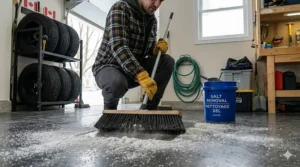
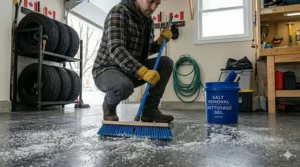
Remove vehicles, storage, and floor mats. Sweep up loose salt, sand, and debris with a push broom — you’d be surprised how much accumulates. Pre-rinse the entire floor with plain water from a garden hose or buckets. This removes surface grit that would otherwise scratch concrete during scrubbing and begins softening salt deposits.
Step 3: Apply Your Chosen Cleaner
Whether using Zep, Simple Green, or DIY vinegar solution, apply generously to salt-stained areas. For commercial cleaners, follow dilution ratios on the label — heavier stains justify stronger concentrations. Let the solution dwell for 7-15 minutes. You’ll see foaming action with peroxide-based cleaners or notice salt crystals beginning to break down.
Step 4: Aggressive Scrubbing
This is where many Canadians go wrong — they don’t scrub hard enough. Salt penetrates concrete; surface wiping won’t remove it. Use a stiff-bristled brush or drill-powered attachment and scrub in overlapping circular patterns. Pay special attention to the apron area near the garage door where salt concentrations peak. You should see dirty grey water forming as salt and grime lift from the concrete.
Step 5: Rinse Thoroughly and Repeat
Rinse away all cleaning solution and suspended salt with fresh water. For best results, use a wet-dry vacuum to extract dirty water from concrete rather than squeegeeing it toward the drain — this prevents salt from redepositing. Inspect for remaining white stains. Stubborn areas need a second treatment, which is normal for Canadian garage floors after harsh winters.
Step 6: Optional Neutralizer Application
For ultimate protection, apply a salt neutralizer as your final step. This prevents the frustrating reappearance of white stains that occurs when residual salt in deep concrete pores migrates back to the surface as the floor dries.
Step 7: Consider Sealing
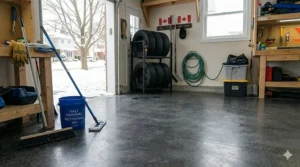
Once your garage floor is completely dry (wait 48-72 hours), applying a concrete sealer provides a protective barrier that makes future salt removal dramatically easier. Epoxy coatings are popular among Canadian homeowners, though they require temperatures above 10°C (50°F) for proper curing — another reason spring cleaning makes sense.
Why Road Salt Damages Concrete (And Why It’s Worse in Canada)
Understanding the chemistry helps explain why simple hosing doesn’t work. Calcium chloride and magnesium chloride — the primary deicing compounds used across Canadian provinces — are hygroscopic, meaning they actively pull moisture from the air. Even after you’ve rinsed your garage floor, residual salt in concrete pores continues attracting atmospheric moisture, keeping the concrete damp.
This creates two destructive processes. First, when moisture freezes and expands within concrete pores, it causes internal pressure cracks. Second, the salt itself reacts with calcium hydroxide in concrete, forming calcium oxychloride crystals that physically expand and spall the surface. Canadian research shows that concrete exposure to road salt can reduce service life by 30-40% compared to unsealed concrete in non-winter climates.
The freeze-thaw cycle intensity explains why Canadian garage floors suffer more than American counterparts in warmer states. From November through March, temperatures frequently oscillate above and below freezing — sometimes multiple times weekly. Each freeze-thaw event drives salt-laden moisture deeper into concrete, compounding damage over winter. By spring, what appears as simple white staining actually represents salt distributed throughout the top 5-10mm of your concrete, which is why surface cleaning alone proves ineffective.
Common Mistakes When Removing Salt Stains
Mistake 1: Using Pressure Washers Incorrectly
Many Canadian homeowners assume that 2000+ PSI pressure washers blast salt away. In reality, high pressure without proper cleaning solution simply drives salt deeper into concrete pores. If using a pressure washer, always apply cleaner first, let it dwell, then use moderate pressure (800-1200 PSI) with a wide fan tip to rinse.
Mistake 2: Cleaning Too Infrequently
Waiting until spring to address six months of salt accumulation creates unnecessarily difficult work. Professionals recommend quick rinses after every major snowfall if garage temperatures permit. This prevents thick crusty deposits that require aggressive chemicals and scrubbing.
Mistake 3: Ignoring Winter Storage Products
Garage floor mats designed for Canadian winters — the kind with raised channels that contain slush — dramatically reduce the salt that reaches your concrete. Yet many homeowners skip this $50-$80 CAD investment, then spend hours each spring dealing with preventable staining. Quality mats from Canadian Tire or Home Hardware pay for themselves in reduced cleaning effort and delayed concrete deterioration.
Mistake 4: Using Hot Water on Frozen Concrete
Pouring boiling water onto frozen garage floors creates thermal shock that can crack concrete. If cleaning during cold periods, use lukewarm water (around 20-30°C) that’s warm enough to activate cleaning chemistry without creating dangerous temperature differentials.
Concrete Floor Maintenance for Canadian Winters
Prevention always beats cleanup. Here’s how Canadian homeowners can minimize salt damage before it becomes a spring restoration project.
Monthly Winter Maintenance:
- Quick sweep or leaf blower to remove loose salt and sand
- Spot-treat high-traffic areas with diluted vinegar solution
- Check and maintain garage door seals to minimize exterior infiltration
Seasonal Protection:
- Apply concrete sealer in fall before first snowfall (wait for temperatures above 10°C)
- Install quality winter floor mats with high containment walls
- Keep a squeegee handy to push standing slush outdoors immediately
Long-Term Strategies:
- Consider epoxy floor coatings for ultimate protection (popular upgrade among Canadian homeowners)
- Establish a no-shoes-beyond-mat zone if garage connects to home interior
- Annual spring deep-clean using methods outlined in this guide
Canadian garage floors endure conditions few other regions experience. The combination of aggressive road salt formulations, extreme temperature swings, and months-long exposure creates maintenance challenges that demand proactive approaches. Homeowners who invest 30 minutes monthly during winter save themselves hours of spring remediation work and extend their concrete’s lifespan by years.
Sealing Options After Salt Removal
Once you’ve thoroughly removed road salt from garage floor surfaces, sealing becomes the logical next step for Canadian homeowners serious about long-term protection. Different sealing options suit different budgets and usage patterns.
Acrylic Sealers ($40-$80 CAD): Penetrating sealers offer basic moisture protection and are easy to apply with a paint roller. They last 1-2 years and work well for homeowners planning to reapply annually. The downside: they don’t significantly improve chemical resistance against road salt.
Epoxy Coatings ($300-$800 CAD for DIY): Two-part epoxy systems create a thick, impermeable barrier that road salt simply can’t penetrate. Popular brands like Rust-Oleum RockSolid and Behr Premium dominate Canadian hardware stores. The catch: epoxy requires meticulous surface preparation (acid etching or grinding) and must be applied when temperatures stay above 10°C for 48+ hours — challenging timing in Canadian spring weather.
Polyaspartic Coatings ($600-$1,200 CAD professionally applied): The newest technology allows application in temperatures as low as -18°C, making them ideal for Canadian conditions. They cure rapidly (often in 24 hours) and provide superior chemical resistance. Most homeowners hire professionals for polyaspartic application, but the durability justifies the investment for severe-winter regions.
FAQ: Remove Road Salt From Garage Floor
❓ How often should I clean salt from my garage floor during winter?
❓ Will vinegar damage my concrete garage floor?
❓ Can I use Simple Green on epoxy-coated garage floors?
❓ Why do salt stains keep coming back after I clean?
❓ Is it safe to pressure wash my garage floor in winter?
Conclusion: Protecting Your Concrete Investment
Learning how to effectively remove road salt from garage floor surfaces represents essential knowledge for Canadian homeowners. The combination of prolonged winter exposure, aggressive municipal deicing programs, and our dramatic freeze-thaw cycles creates conditions that accelerate concrete deterioration faster than almost anywhere else in North America.
The good news: with products readily available on Amazon.ca — from industrial-strength Zep cleaners to eco-friendly Simple Green formulas — Canadian homeowners have access to the same professional-grade solutions contractors use. Whether you opt for budget-friendly vinegar solutions or invest in dedicated salt neutralizers, consistent spring cleaning prevents the cumulative damage that leads to expensive concrete replacement.
Remember that prevention beats remediation. Those $60 winter floor mats, $80 concrete sealer, or 20 minutes spent on monthly maintenance will save you hours of spring restoration work and extend your garage floor’s lifespan by decades. For homeowners in high-salt regions like the Golden Horseshoe, Montreal corridor, or Calgary, proactive maintenance isn’t optional — it’s essential protection for a significant home investment.
Start with a thorough spring cleaning using the methods outlined here, then establish the maintenance routine that suits your schedule and budget. Your concrete will thank you for it every spring when salt stains lift easily instead of requiring the aggressive scrubbing and harsh chemicals that accumulated neglect demands.
Recommended for You
- Best Pressure Washer for Salt Removal Driveway Canada 2026
- 7 Best Spring Deck Restoration Pressure Washers Canada 2026
- 7 Best Pressure Washers for Composite Deck Safe Canada 2026
Disclaimer: This article contains affiliate links. As an Amazon Associate, I earn from qualifying purchases. If you purchase products through these links, we may earn a small commission at no additional cost to you.
✨ Found this helpful? Share it with your friends! 💬🤗
