
In This Article
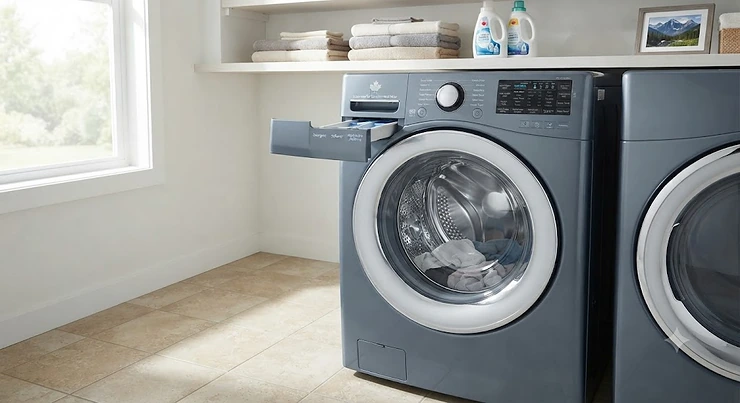
A washer for hard water is a laundry machine built or optioned to handle mineral-heavy municipal or well supplies — think extra rinse cycles, deep-fill or deep water wash options, self-cleaning tub cycles, and sanitize settings that push back against calcium and magnesium scale before it ever touches your clothes. If that sentence made you nod because your towels have gone crunchy and your dark jeans have that faint grey film, you are not imagining things. You are living downstream of geology.
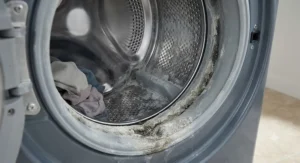
Here in Canada, water hardness swings wildly by postal code. Winnipeg, Regina, and Calgary residents deal with some of the harder municipal supplies in the country, while folks in Vancouver or parts of the Maritimes often enjoy naturally soft water straight from the tap. Add a private well into the mix — common across rural Ontario, the Prairies, and Atlantic Canada — and hardness levels can spike even further, sometimes north of 180 mg/L as calcium carbonate, which puts you solidly in “very hard” territory. Every one of those minerals eventually finds its way into your washing machine’s pump, heating element, and hoses.
This guide walks through seven real washers currently sold to Canadian shoppers, each chosen because of how they specifically handle mineral-loaded water — not just because they’re popular. We’ll break down what actually matters on a spec sheet, what reviewers genuinely report after months of ownership, and how to keep any washer running smoothly when your water supply is working against you. We’ll also dig into the washing machine hard water compatible features worth paying for, honest detergent recommendations, and region-specific hard water laundry tips Canada shoppers can actually use.
One quick housekeeping note before we dive in: prices shift constantly on Amazon.ca, so every figure below is a range based on research at the time of writing — always check current pricing before you buy.
Quick Comparison Table
| Washer | Type | Hard Water Feature | Price Range (CAD) |
|---|---|---|---|
| Speed Queen TR7003WN | Top Load (Agitator) | Extra Rinse Option, simple mechanical controls | C$1,100–C$1,300 |
| Maytag MVW5435PW | Top Load (Agitator) | Deep Fill + built-in faucet for pretreating | C$800–C$1,000 |
| Whirlpool WTW5020SW | Top Load (Agitator) | Deep Water Wash + built-in faucet | Under C$800 |
| LG WT1701CV | Top Load (HE Impeller) | Oxi-Sanitize, TurboWash speed | C$900–C$1,100 |
| LG WM3070HWA | Front Load | Steam wash, low water use | C$1,100–C$1,400 |
| Samsung WF45T6000AW | Front Load | Sanitize (65°C), Self Clean+ | C$1,000–C$1,300 |
| Panda PAN50SWF2 | Portable/Compact | Frequent-cleaning friendly, faucet adapter | Under C$400 |
Looking at the table, the split between top-load agitator machines and front-load HE units matters more than it seems at a glance: agitator washers generally fill with more water per cycle, which dilutes minerals faster and rinses more thoroughly, while front loaders sip water but lean harder on their sanitize or steam settings to compensate. If your priority is raw mechanical simplicity that a local appliance tech can service for decades, the Speed Queen TR7003WN anchors that end of the table. If you’re renting or living in a condo where a full-size hookup isn’t an option, the Panda PAN50SWF2 is really the only realistic pick here.
💬 Just one click — help others make better buying decisions too!😊
Top 7 Washers for Hard Water: Expert Analysis
1. Speed Queen TR7003WN — commercial-grade durability under mineral-heavy water
The Speed Queen TR7003WN is built on the same bones as the coin-operated machines you’ll find in Canadian laundromats, and that lineage matters a lot when your water is aggressively scaling. Its 3.2 cu. ft. (roughly 91 L) stainless steel wash tub pairs with a Solid Mount Suspension System and a fully mechanical dial interface — no touchscreen, no circuit board sensors that mineral-laden water and humidity can slowly corrode over time. The Extra Rinse option is a standard preset rather than a buried menu setting, and the Full Tub Wash & Rinse fills the entire basket for every cycle, which means detergent and dissolved minerals get diluted far more aggressively than in a water-sipping HE machine.
Based on the spec comparison, this is the washer for someone who has already been burned by a “smart” appliance dying young in a hard-water household. What most buyers overlook about this model is that its simplicity is the feature: fewer electronic parts means fewer things for scale deposits to interfere with, and Speed Queen backs the transmission with one of the longest warranties in the category. Independent appliance-repair surveys and owner review aggregates consistently rank Speed Queen among the most reliable brands on the market, though buyers should go in with realistic expectations — this is not a steam-cycle, app-connected machine, and reviewers who expected smart features report disappointment on that front specifically.
Pros:
- ✅ Fully mechanical controls resist hard-water corrosion better than touch panels
- ✅ Full-tub fill dilutes minerals and detergent thoroughly every cycle
- ✅ Industry-leading warranty coverage backed by decades of reliability data
Cons:
- ❌ No steam, sanitize, or smart connectivity features
- ❌ Higher upfront price than comparable agitator washers
At around C$1,100–C$1,300, the Speed Queen TR7003WN isn’t the cheapest top-loader here, but if your water heater and kettle are already crusted with limescale, the long-term value case for a machine engineered to outlast that mineral load is hard to argue with.
2. Maytag MVW5435PW — built-in faucet for pretreating scale stains
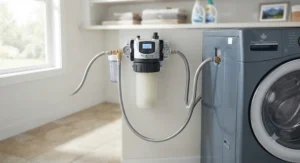
The Maytag MVW5435PW puts a genuinely clever feature front and centre: a built-in water faucet mounted right in the wash basket. For hard-water households dealing with the grey-white mineral rings that form on collar lines and cuffs, being able to spot-rinse a stain directly under running water before the cycle even starts is a real, practical advantage that most competitors don’t offer. Its 4.7 cu. ft. capacity comes with the Power agitator and a 360-degree wash motion, plus a Deep Fill option that — like Speed Queen’s approach — adds more water to the basket specifically to help dissolve and flush out stubborn mineral and detergent residue.
Here’s what the spec sheet won’t tell you outright: Deep Fill matters more in hard water than in soft water, because minerals reduce detergent’s ability to fully dissolve and rinse clean at standard water levels. Reviewers aggregated across major Canadian retailers frequently mention the Extra Power cycle as genuinely effective on set-in stains, while a recurring theme in the complaint column is that the agitator design (versus an impeller) can be a bit rougher on delicate fabrics over hundreds of hard-water wash cycles, since mineral deposits can make fabric fibres slightly more brittle.
Pros:
- ✅ Built-in faucet lets you pretreat mineral stains without a separate sink trip
- ✅ Deep Fill option boosts water volume to dissolve stubborn residue
- ✅ 10-year limited parts warranty on the motor and stainless basket
Cons:
- ❌ Agitator post takes up basket space versus impeller designs
- ❌ Some reviewers note it runs louder on spin than premium front loaders
Expect the Maytag MVW5435PW to land in the C$800–C$1,000 range, which puts genuinely useful hard-water functionality within reach of a mid-range laundry budget.
3. Whirlpool WTW5020SW — best value deep water wash pick
If your budget is the deciding factor, the Whirlpool WTW5020SW covers the fundamentals without much fuss. Its 5.3 cu. ft. Smooth Spiral Stainless Steel Wash Basket is paired with the Deep Water Wash Option, which — same principle as its Maytag cousin — automatically boosts the fill level so heavier mineral and detergent loads get properly rinsed rather than redeposited on fabric. A built-in faucet handles prewash spot treatment, and a 30-minute Presoak Option lets tough scale-and-grime combinations loosen before the main wash even begins.
On paper this means a household in, say, a hard-water Prairie city can run a routine load with Presoak plus Deep Water Wash active and get noticeably better rinse performance than a standard economy cycle would deliver. What reviewers consistently note across budget top-loaders in this tier is a trade-off: you get real hard-water-relevant functionality, but you’re working with a more basic 850 RPM spin speed and no internal water heater, so very hot sanitizing washes aren’t part of the package.
Pros:
- ✅ Deep Water Wash and Presoak directly target mineral and soil buildup
- ✅ Built-in faucet doubles as a convenient prewash station
- ✅ Most affordable full-size washer on this list
Cons:
- ❌ Lower max spin speed (850 RPM) than premium competitors
- ❌ No internal water heater limits true high-temperature sanitizing
At under C$800, the Whirlpool WTW5020SW is the pragmatic entry point for renters and first-time homeowners who need real hard-water performance without a premium price tag.
4. LG WT1701CV — Oxi-Sanitize top-load with TurboWash speed
The LG WT1701CV takes a different route to fighting mineral buildup: rather than leaning purely on extra water volume, it layers in Oxi-Sanitize technology alongside TurboWash and WaveForce wash motion. TurboWash’s high-pressure nozzles are designed to cut cycle time roughly in half compared to a standard cycle, which — in a hard-water context — also means less total dwell time for minerals to interact with detergent residue and clothing fibres. The 4.9 cu. ft. capacity and Direct Drive Motor come with a notably long warranty tail: LG backs the motor for ten years.
What most buyers overlook about a TurboWash-equipped machine is that the multiple wash and rinse temperature options (Extra Hot down through Tap Cold) actually give you meaningful control over mineral behaviour, since hot water dissolves calcium and magnesium deposits faster than cold — a point echoed by general appliance-industry guidance on hard-water laundering. Aggregated owner feedback for LG’s top-load HE line tends to split along predictable lines: strong marks for wash performance and noise levels, with a recurring maintenance note that the Tub Clean cycle genuinely needs to be run on schedule in hard-water homes, or scale can accumulate around the pulsator over time.
Pros:
- ✅ Oxi-Sanitize and TurboWash combine speed with mineral-fighting sanitation
- ✅ Five wash/rinse temperature options for real hard-water flexibility
- ✅ 10-year Direct Drive Motor warranty backs long-term reliability
Cons:
- ❌ Requires disciplined monthly Tub Clean cycles to prevent scale buildup
- ❌ WiFi/SmartDiagnosis features add complexity some buyers don’t want
Priced around C$900–C$1,100, the LG WT1701CV suits a household that wants HE efficiency without fully committing to a front-load layout.
5. LG WM3070HWA — steam-powered front-load for low-water-use homes
Front-load washers use less water per cycle by design, which sounds counterintuitive for hard water — less water means a higher relative mineral concentration touching your clothes. The LG WM3070HWA compensates with genuine Steam Technology, which penetrates fabric to help lift mineral film and detergent residue that cooler water simply can’t dissolve as effectively. Its 3.7 cu. ft. extra-large drum, ColdWash technology, and 6Motion wash action are backed by a direct drive motor carrying a 10-year warranty, and LG states the platform uses about 30% less energy and roughly half the water of a conventional washer.
Based on the spec comparison, this machine is a strong fit for anyone who has already invested in — or is planning to install — a whole-home water softener, since front loaders generally reward softer water with noticeably better long-term gasket and pump longevity. Without a softener, reviewers who’ve run front-load machines for several years in hard-water regions commonly flag one specific maintenance point: the rubber door gasket is where mineral and detergent film builds up fastest, and it needs regular wiping to avoid odour and eventual seal degradation.
Pros:
- ✅ Steam technology helps lift mineral film that cold cycles leave behind
- ✅ Roughly half the water use of a standard washer, lowering total mineral exposure
- ✅ Extra-large 3.7 cu. ft. capacity reduces the number of loads needed weekly
Cons:
- ❌ Door gasket requires frequent wiping to prevent mineral and mould buildup
- ❌ Best long-term results really do assume pairing with a home softener
Look for the LG WM3070HWA in the C$1,100–C$1,400 range, positioning it as a mid-premium pick for households that can commit to the gasket maintenance routine.
6. Samsung WF45T6000AW — Self Clean+ front-load for scale control
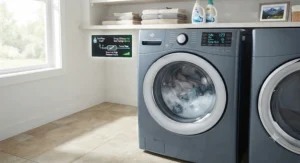
Samsung’s approach to hard-water durability centres on two features working together: a genuine Sanitize cycle that heats water to roughly 65°C to break down bacteria and residue, and Self Clean+, a dedicated tub-cleaning cycle that Samsung recommends running every 40 washes and that actively notifies you when it’s due. That notification matters more than it sounds — the single biggest reason front-load washers develop odour and scale problems in hard-water homes is simply that owners forget to run maintenance cycles, and Samsung builds the reminder directly into the control panel.
The Swirl+ drum pattern is engineered to extract more water during rinse, which shortens the time detergent-and-mineral-laden water sits in contact with fabric, while VRT Plus technology keeps vibration down even as the tub spins at higher speeds. Reviewers consistently report satisfaction with capacity and everyday wash performance on Samsung’s steam-equipped front-load line, though a meaningful minority flag reliability concerns — loud noises, vibration, and occasional leaks — that tend to surface after the standard warranty period ends, which is worth factoring into a hard-water household’s long-term cost math.
Pros:
- ✅ True heated Sanitize cycle (≈65°C) tackles mineral and bacterial buildup
- ✅ Self Clean+ actively reminds you every 40 washes, reducing owner error
- ✅ Swirl+ drum pattern speeds water extraction during rinse
Cons:
- ❌ Some owner reviews report vibration or leak issues after the warranty window
- ❌ Requires diligent maintenance participation to avoid long-term buildup
Expect to pay roughly C$1,000–C$1,300 for the Samsung WF45T6000AW, a fair mid-premium price for a genuinely hard-water-aware feature set.
7. Panda PAN50SWF2 — most compact portable pick for condos
Not everyone dealing with hard water owns a house with a dedicated laundry hookup. The Panda PAN50SWF2 is a 1.6 cu. ft. (11 lb) portable washer with a stainless steel tub that connects directly to any standard kitchen or bathroom faucet using an included adapter — a genuinely useful option for condo and apartment dwellers who have no control over a building’s water treatment and often don’t even know the hardness level of what’s coming out of the tap. Its six wash programs include an upgraded rinse function, and the compact size means running a self-clean or vinegar-rinse maintenance cycle is fast and cheap compared to descaling a full-size drum.
What the spec sheet won’t tell you is that portable washers like this actually have a practical hard-water advantage: because you manually connect the inlet hose before every use, you’re far more likely to notice early warning signs of scale (reduced water flow, white crust at the adapter threads) than you would with a permanently plumbed machine tucked in a closet. Reviewers of compact portable washers in this class consistently flag the smaller capacity as the main trade-off — this is a machine for singles or couples doing frequent small loads, not a family’s primary washer.
Pros:
- ✅ Faucet-adapter design makes hard-water maintenance easy to spot and address
- ✅ Compact stainless tub is quick and cheap to descale regularly
- ✅ No installation or dedicated laundry hookup required
Cons:
- ❌ Small 11 lb capacity isn’t practical for family-sized loads
- ❌ Manual hose connection adds a few minutes to every wash session
At under C$400, the Panda PAN50SWF2 is the clear pick for renters who need hard-water-friendly laundry without a permanent installation.
Hard-Water-Ready Washers vs Standard Washers: What’s the Difference
| Feature | Hard-Water-Ready Washer | Standard Washer |
|---|---|---|
| Rinse options | Multiple/Extra Rinse as standard preset | Often a single fixed rinse |
| Water fill | Deep Fill/Deep Water Wash available | Fixed HE-optimized fill only |
| Self-cleaning | Dedicated Tub Clean/Self Clean+ cycle with reminders | May lack a dedicated cycle or reminder |
| Temperature control | Multiple hot/warm options for mineral dissolving | Limited or single default temperature |
| Best For | Speed Queen TR7003WN, Samsung WF45T6000AW | Households on confirmed soft municipal water |
The core distinction here isn’t marketing fluff — it comes down to how much control you have over water volume, temperature, and rinse repetition, since those three variables are exactly what determine whether minerals get flushed out or left behind on fabric. A standard economy washer optimized purely for water and energy savings often strips out the very features — deep fill, extra rinse, high heat — that hard water needs most, which is a genuine tension between eco-efficiency and hard-water performance that Canadian shoppers in mineral-heavy regions need to weigh deliberately.
Setting Up and Maintaining Your Washer in a Hard Water Home
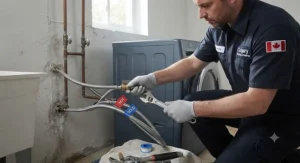
Getting a new washer running well in a hard-water household starts before the first load. During installation, use braided stainless steel inlet hoses rather than basic rubber ones — mineral deposits accelerate rubber degradation from the inside, and stainless resists that buildup considerably longer. Once it’s running, the single highest-impact habit is sticking to a self-clean or tub-clean schedule: most manufacturers recommend running it every 30 to 40 washes, and skipping this in a hard-water home lets scale accumulate on heating elements and around the drum in a way that’s far harder to reverse later.
In the first 30 days, resist the urge to skip the manufacturer’s suggested detergent dose “because the water feels fine” — hard water actually requires slightly more detergent than soft water to achieve the same lather and cleaning action, since minerals bind with some of the active cleaning agents before they ever reach your clothes. A common mistake is under-dosing to save money, which paradoxically leaves more mineral-detergent residue on fabric, not less. For ongoing upkeep, wipe down door gaskets on front-load machines weekly, and run a monthly cycle with a washing-machine-specific descaling tablet or a cup of white vinegar in an empty drum to keep pumps and heating elements clear.
Which Washer Fits Your Household? Real-World Scenarios
The rural well-water family of four — Running a private well with hardness readings above 180 mg/L and doing six to eight loads a week calls for volume and mechanical resilience over gimmicks. The Speed Queen TR7003WN or Maytag MVW5435PW both fit here: full-tub fills dilute the heavy mineral load, and simpler mechanical systems are easier and cheaper for a local technician to service when scale eventually causes a part to need replacing.
The condo renter in a hard-water city like Calgary or Regina — No dedicated laundry hookup, no control over building water treatment, and probably no interest in a five-year appliance commitment. The Panda PAN50SWF2 solves the access problem directly, and its manual connection process means you’ll notice early scale warning signs before they become expensive.
The budget-conscious young couple upgrading their first apartment washer — Moderate hardness, moderate laundry volume, and a real need to stretch every dollar. The Whirlpool WTW5020SW delivers genuinely useful Deep Water Wash and Presoak functionality without the premium price tag of steam-equipped competitors, making it the practical middle ground.
How to Choose a Washer for Hard Water
- Check your local water hardness first. Municipal water reports or an inexpensive home test strip will tell you whether you’re dealing with moderately hard or very hard water, which determines how aggressively you need to shop for mineral-fighting features.
- Prioritize deep fill or extra rinse options. More water volume per cycle directly dilutes dissolved minerals and rinses detergent residue more completely.
- Look for a dedicated self-clean or tub-clean cycle with reminders. Scale accumulates inside the machine itself, not just on your clothes, so this feature protects your investment.
- Consider mechanical simplicity if your water is very hard. Fewer electronic sensors mean fewer components vulnerable to mineral-related corrosion over a decade of use.
- Match temperature flexibility to your needs. Hot water dissolves minerals faster, so multiple temperature settings give you real control.
- Factor in whether you already have — or plan to install — a water softener. A softener changes the calculus considerably, making front-load and HE options far more viable long-term.
- Weigh warranty length against your water’s severity. Very hard water accelerates component wear, so a longer motor or parts warranty is genuinely more valuable here than in a soft-water home.
Washing Machine Hard Water Compatible: Features That Actually Matter
Not every feature marketed toward hard-water households delivers equal value, and this is where honest filtering pays off. Extra Rinse and Deep Fill/Deep Water Wash options matter enormously — they directly address the core problem of insufficient water volume to flush dissolved minerals. A genuine heated Sanitize cycle, like Samsung’s ~65°C setting, also earns its place, since heat measurably speeds mineral dissolution in a way cold-water “eco” cycles simply cannot replicate.
On the other hand, some heavily marketed features matter less than their branding suggests. Smart connectivity and app-based diagnostics are convenient, but they don’t change how minerals interact with water and fabric — and in very hard water environments, added electronics can actually introduce more failure points, not fewer, as several owners of touchscreen-heavy machines in hard-water regions have reported after a few years of use. Similarly, ultra-high spin speeds are nice for reducing dryer time but do nothing to address mineral buildup itself. If you’re shopping specifically for washing machine hard water compatible functionality, prioritize water volume control, temperature range, and self-cleaning cycles over flashier connectivity extras.
Mineral Buildup Prevention: Common Mistakes to Avoid
The single most common mistake in hard-water laundry rooms is skipping the manufacturer’s self-clean cycle because “the washer still smells fine.” Buildup is often invisible for months before it manifests as reduced water flow, a musty odour, or spotting on dark fabrics — by which point scale has already been accumulating on internal components. A second frequent error is overloading the machine, which restricts water flow around clothing and leaves mineral-laden water and detergent trapped in fabric rather than properly rinsed away.
Third, many households use standard rubber inlet hoses well past their recommended replacement window; hard water accelerates the internal breakdown of rubber compounds, raising leak risk. Fourth, some owners run every load on cold to save energy, unaware that cold water is measurably less effective at dissolving calcium and magnesium deposits — an occasional warm or hot cycle helps flush the system even if daily washing stays cold. Finally, ignoring visible white residue on the detergent drawer or dispenser tray is a mistake, since that same residue is coating internal pump components you can’t see.
Water Softener Compatibility Explained
A whole-home water softener changes almost every calculation in this guide. Softened water dramatically reduces the mineral load reaching your washer, which means front-load and HE machines — typically more sensitive to hard water than mechanical top-loaders — become considerably more viable long-term investments. Most standard washers, including every model featured above, connect to a softened water line without any special adapter; softening happens upstream at the home’s main water line, not inside the washer itself.
That said, a few practical notes matter. According to Health Canada’s guideline technical document on operational water parameters, ion-exchange softeners work by replacing calcium and magnesium with sodium, and the guidance specifically discusses sodium intake considerations for households using softened water for all domestic purposes — worth a glance if anyone in your home is on a sodium-restricted diet. If you’re on a softener, you can generally reduce detergent dosing slightly compared to hard-water recommendations, since soap and detergent lather more efficiently once minerals are removed. If you’re weighing whether a softener is worth installing before buying a new washer, our breakdown on Canadian drinking water hardness guidelines is a useful starting point for understanding where your local hardness level actually sits.
Detergent Recommendations for Hard Water Washing
Detergent choice matters just as much as machine choice when you’re dealing with mineral-heavy water. Look for detergents specifically formulated with water softening agents or chelating ingredients built in — these bind to calcium and magnesium ions before they can interfere with the detergent’s actual cleaning surfactants, which is a meaningfully different mechanism than a standard formula relies on. Liquid detergents generally dissolve more completely in hard water than powder formulas, reducing the risk of undissolved residue settling into fabric.
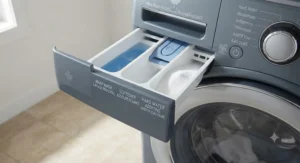
Dosing matters more than most people expect: hard water genuinely requires a slightly higher detergent dose than the “average water” line on most bottles assumes, since some of that detergent gets neutralized by mineral ions before it ever reaches your clothes. Adding a laundry booster containing sodium carbonate (washing soda) to particularly tough hard-water loads can noticeably improve rinse clarity and reduce the grey film that builds up on whites over time. Finally, skip fabric softener on top of already-stiff hard-water laundry when possible — the stiffness is usually a mineral residue problem, not a softness problem, and softener alone won’t fix it the way an extra rinse cycle will.
Hard Water Laundry Tips Canada Residents Should Know
Hard water severity varies enormously across this country, and knowing your region’s general profile helps you calibrate expectations. Ontario and the Prairies, including cities like Calgary, Regina, and Winnipeg, tend to sit on the harder end of the spectrum, while coastal British Columbia and much of the Maritimes generally see softer supplies. Even within a single territory, hardness can shift — a well-documented example comes from Whitehorse, where the city’s move from surface water to groundwater over a decade ago measurably increased local water hardness, a change local business owners noticed directly through equipment wear.
Practically speaking, Canadian hard-water households benefit from a few region-adjusted habits: running an occasional hot-water Sanitize cycle even in winter, when many households default to cold washes to save on heating costs, since cold water alone won’t touch dissolved mineral content. Rural well-water households should test hardness levels annually, since seasonal groundwater shifts (spring runoff, drought years) can meaningfully change mineral concentration. And regardless of province, keeping a small stock of washing-machine descaling tablets on hand year-round is one of the cheapest, most effective habits a hard-water household can adopt.
CSA Certification, Warranty and Safety Considerations
Every washer sold in Canada should carry CSA certification (or an equivalent recognized safety mark), confirming it meets Canadian electrical and safety standards — this is worth physically confirming on the rating plate rather than assuming, particularly with imported or lesser-known brands sold through third-party marketplace listings. Beyond basic certification, hard-water households should pay closer attention to warranty terms than soft-water households typically need to, since accelerated component wear from mineral buildup can push repairs into years three through five, right when many standard one-year manufacturer warranties have long since expired.
Look specifically for extended coverage on the motor, drum, and any internal heating element, since these are the components most affected by scale accumulation over time. It’s also worth checking whether your home insurance policy has any specific requirements around braided steel supply lines for major appliances — many Canadian insurers now recommend or require them specifically because standard rubber hoses, weakened faster by hard water, are a leading cause of in-home water damage claims.
✨ Don’t Miss These Exclusive Deals! 🔍
Take your laundry routine to the next level with these carefully selected washers. Click on any highlighted item to check current pricing and availability. These picks will help you keep mineral buildup under control and your clothes genuinely clean.
Long-Term Cost & Maintenance in Hard Water Homes
Total cost of ownership in a hard-water household includes more than the sticker price. Expect to budget for descaling tablets or vinegar treatments roughly monthly, occasional inlet hose replacement every few years even with stainless braiding, and a realistically shorter component lifespan on electronic parts compared to the same washer running on soft water. On the flip side, ENERGY STAR-certified washers meaningfully offset some of that added maintenance cost: according to Natural Resources Canada’s guidance on ENERGY STAR clothes washers, certified models use about 25% less energy and 33% less water on average than standard machines, which adds up over a decade of ownership regardless of your local water hardness.
Every washer featured in this guide carries meaningful warranty coverage on core components, which matters more in hard-water regions than the fine print might initially suggest. A machine like the Speed Queen TR7003WN, with its extended transmission warranty, or the LG WT1701CV and LG WM3070HWA, both backed by 10-year motor coverage, effectively shift some of that accelerated-wear risk back onto the manufacturer rather than your wallet — a genuinely valuable consideration when comparing otherwise similarly priced machines.
Frequently Asked Questions
❓ Does hard water damage washing machines?
❓ What washing machine settings are best for hard water?
❓ Do I need a water softener for my washing machine?
❓ How often should I clean a washer for hard water buildup?
❓ Is a top-load or front-load washer better for hard water?
Conclusion
Choosing a washer for hard water really comes down to matching your local mineral load to the right mix of water volume, temperature control, and self-cleaning discipline. If your water is aggressively hard and you want something a technician can service for fifteen years, the Speed Queen TR7003WN is the honest pick. If you want a genuine balance of hard-water-aware features and everyday convenience, the Maytag MVW5435PW, LG WT1701CV, and Samsung WF45T6000AW all deliver real value at their respective price points, while the Panda PAN50SWF2 solves a problem the other six machines simply can’t for renters without a dedicated hookup.
Whatever you land on, remember that the machine is only half the equation — pairing it with the right detergent, a consistent maintenance schedule, and an honest read on your regional water hardness will do more for your laundry’s long-term quality than any single feature on a spec sheet. Canadian water varies enormously from coast to coast, and a little research into your own tap’s mineral content, as outlined in the resources linked throughout this guide, pays off every single wash day.
Recommended for You
- 7 Best Washer Dryer Brand Canada Picks for 2026 (Ranked)
- Bosch vs KitchenAid Dishwasher: 7 Best Picks for 2026
- Portable vs Built-In Dishwasher: 7 Picks Ranked for 2026
Disclaimer: This article contains affiliate links. As an Amazon Associate, I earn from qualifying purchases. If you purchase products through these links, we may earn a small commission at no additional cost to you.
✨ Found this helpful? Share it with your friends! 💬🤗
