
In This Article
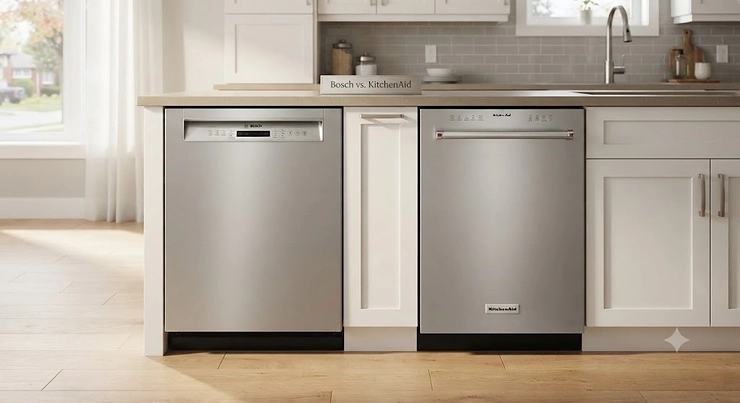
Your dishwasher just died mid-cycle — again — and now you’re standing in a warehouse aisle somewhere between Mississauga and Calgary, phone in hand, googling Bosch vs KitchenAid dishwasher while a floor associate hovers like they’re about to recite a script. Fair warning: they might actually be useful, because both these brands genuinely deserve the shortlist. This isn’t a case of picking between “good” and “bad” — it’s picking between two very different philosophies for washing a dinner plate, and getting that choice wrong means living with either a machine louder than your microwave or one that leaves every plastic container in your cupboard damp.
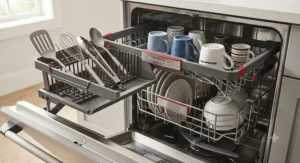
Bosch built its reputation as the quiet, tank-like European import — the brand your neighbour with the renovated kitchen won’t stop mentioning. KitchenAid built its reputation the North American way: bold styling, aggressive wash jets, and a stand-mixer pedigree that somehow makes a dishwasher feel like part of a matched kitchen suite. Both brands lean into efficiency by design; Natural Resources Canada notes that ENERGY STAR certified dishwashers use roughly 12% less energy and 30% less water than standard models, which matters whether you’re rinsing bottles for a family of six or running a single load every other night in a downtown condo.
Below, we dig into seven real, currently available models — four Bosch, three KitchenAid — spanning budget to genuinely luxurious, backed by manufacturer specs and aggregated review sentiment, plus the exact comparisons Canadian shoppers keep searching for: reliability ratings, feature comparison, and warranty coverage. By the end, you’ll know which badge belongs on your kitchen door, and why.
Quick Comparison Table
Before the deep dive into all seven machines, here’s the Bosch vs KitchenAid dishwasher breakdown in its simplest form — five factors, side by side.
| Factor | Bosch | KitchenAid |
|---|---|---|
| Noise level range | 38-50 dBA | 39-47 dBA |
| Signature drying tech | Condensation, AutoAir, CrystalDry (zeolite) | Heated, fan-assisted ProDry |
| Typical price range (CAD) | C$950-C$2,999 | C$1,050-C$2,200 |
| Standard warranty | 1 yr full, plus extended parts-only coverage on select components | 1 yr full parts & labour (varies by model) |
| Best for | Whisper-quiet operation, plastics-safe drying | Bold styling, aggressive cleaning jets |
Interpreting the numbers above, Bosch’s engineering focus clearly lands on noise reduction and drying technology that never exposes dishes to a hot element, while KitchenAid closes the price gap at the entry level and leans harder into rack flexibility and matched-suite styling. Warranty structure is the sleeper factor here — Bosch’s published coverage extends further past year one on specific components than KitchenAid’s model-dependent terms, something we’ll unpack properly later on.
💬 Just one click — help others make better buying decisions too!😊
Top 7 Bosch and KitchenAid Dishwashers: Expert Analysis
We dug into spec sheets, dBA ratings, and aggregated owner feedback across major Canadian retailers to shortlist seven dishwashers — four Bosch, three KitchenAid — spanning every budget from “just get the old one out of my kitchen” to “I want the quietest machine money can buy.”
1. Bosch 300 Series (SHE53C85N) — best budget entry into Bosch’s quiet lineup
The Bosch 300 Series (SHE53C85N) proves you don’t need to spend luxury money to get a Bosch badge and a fully stainless interior — a detail plenty of “budget” competitors still skip entirely.
Its all-stainless-steel tub and RackMatic third rack adjust across multiple height positions, so a stack of dinner plates and a tray of wine glasses can coexist without anyone getting crushed. Home Connect Wi-Fi lets you start a cycle from your phone or get a notification when it’s done, handy on mornings when you’re already out the door. At 46 dBA, it’s louder than Bosch’s flagship tiers but still quieter than most budget competitors from other brands, which often run 50-plus dBA and sound like they’re announcing themselves to the whole floor.
Based on the spec comparison, what most buyers overlook about this tier is that Bosch doesn’t cut corners on tub material the way rivals sometimes do at this price — a plastic tub, common on true entry-level machines, stains and retains odour far faster than stainless ever does.
Reviewers consistently note strong, quiet cleaning performance for the price, though a recurring complaint in user reviews is that the Home Connect app occasionally needs a manual restart to reconnect after a home Wi-Fi router reset.
Pros:
- ✅ Full stainless tub rare at this price point
- ✅ RackMatic third rack adjusts multiple ways
- ✅ Home Connect app adds remote monitoring
Cons:
- ❌ 46 dBA noticeably louder than pricier Bosch tiers
- ❌ Wi-Fi connection occasionally needs manual resetting
At the time of research, the Bosch 300 Series (SHE53C85N) typically runs in the C$950-C$1,150 range, making it one of the most sensible entry points into the Bosch ecosystem without stretching into 500 Series territory.

2. KitchenAid KDFM404KPS — best front-control budget pick with a third rack
The KitchenAid KDFM404KPS answers a specific complaint about budget dishwashers: why does the cheap one never come with a proper third rack? Here, it does, right out of the gate.
Its front-control panel keeps the buttons hidden below the door for a cleaner look, and the PrintShield finish resists the fingerprint smudging that shows up almost instantly on plain stainless. The included third rack adds real capacity for large serving spoons, spatulas, and lids that otherwise hog space in the main silverware basket, while a wash system delivering 50-plus total jets targets items from multiple angles rather than relying on water pressure alone. At 44 dBA, it edges out the pricier Bosch 300 Series above on paper, though real-world noise perception depends heavily on your flooring and cabinet construction, not just the spec sheet number.
What the spec sheet won’t tell you, but reviewers note, is that the ProWash sensor cycle genuinely adjusts wash time and temperature based on how dirty the water gets mid-cycle, rather than running a fixed timer regardless of soil level.
Aggregated owner feedback frequently praises the third rack’s usefulness for large utensils, while a common complaint centres on the finish still showing water spots under certain lighting despite the fingerprint-resistant claim.
Pros:
- ✅ Third rack included at a genuinely budget price
- ✅ PrintShield finish resists fingerprint smudging
- ✅ ProWash cycle adjusts to actual soil level
Cons:
- ❌ Water spots still visible on the finish sometimes
- ❌ Fewer wash cycle options than higher KitchenAid tiers
Expect the KitchenAid KDFM404KPS in roughly the C$1,050-C$1,250 range at the time of research, a fair ask for a third rack and sensor-based washing at this tier.
3. Bosch 500 Series (SHPM65Z55N) — best hands-free drying with AutoAir
The Bosch 500 Series (SHPM65Z55N) solves the classic dishwasher complaint of soggy plastic containers with a strangely simple trick: it just opens the door for you.
AutoAir triggers automatically once the wash cycle ends, cracking the door open a few centimetres so residual heat and humidity can escape rather than condensing back onto your dishes — exactly how condensation-drying machines dealt with the eternal “why is my Tupperware still wet” problem before this feature existed. Fully integrated hidden controls give it a seamless, panel-less look on the outside, and its capacity across three racks comfortably handles a family dinner plus serving dishes. At 44 dBA, it lands solidly in “background hum” territory rather than “everyone stop talking.”
Here’s what to weigh: AutoAir means the machine never uses an exposed heating element to force-dry dishes, which is genuinely better for delicate plastics — the trade-off is that drying takes a little longer than KitchenAid’s fan-assisted approach, since it relies on passive airflow rather than active heat.
Reviewers consistently report noticeably drier plastic items compared with older Bosch condensation-only models, while a recurring complaint in user reviews involves the door needing floor clearance to pop open, which can be awkward in a tight galley kitchen.
Pros:
- ✅ AutoAir dries plastics without a hot element
- ✅ Fully integrated design hides all controls
- ✅ Generous capacity across three flexible racks
Cons:
- ❌ Requires floor clearance for the door to open
- ❌ Drying takes longer than fan-assisted competitors
At the time of research, the Bosch 500 Series (SHPM65Z55N) generally sits in the C$1,150-C$1,400 range, a reasonable step up for households tired of hand-drying plastic lids every night.
4. KitchenAid KDTS424SPS — best FreeFlex third rack for oddly-shaped items
The KitchenAid KDTS424SPS is built around a genuinely clever rack system rather than a single headline gadget, which makes it the pick for anyone whose cupboard is full of mismatched mugs and oddly-shaped kitchen gadgets.
Its FreeFlex third rack holds long utensils, spatulas, and stemware without stealing space from the main racks below it, while SatinGlide+ telescoping rails let a fully loaded lower rack extend smoothly on ball bearings rather than sticking halfway out like cheaper slide mechanisms often do. A 360-degree multi-jet wash system delivers more than 50 total wash jets across every level, aiming water at plates from angles a single rotating arm simply can’t reach. Top-control styling keeps the touchpad visible on the door edge, a small design choice some buyers actually prefer over fully hidden controls since it’s easier to check cycle status without opening the door.
Based on the spec comparison against the entry-level KDFM404KPS above, the third rack here is the real upgrade — it’s engineered specifically for stemware and utensils rather than functioning as a flat afterthought shelf bolted on top.
Aggregated review sentiment consistently praises the smoothness of the SatinGlide+ rails under a full load, though a recurring theme in user feedback involves the top-control panel showing fingerprints more readily than fully integrated designs.
Pros:
- ✅ FreeFlex third rack purpose-built for stemware
- ✅ SatinGlide+ rails glide smoothly when fully loaded
- ✅ Multi-angle jets cover more of each load
Cons:
- ❌ Top control panel shows fingerprints easily
- ❌ Priced above comparable Bosch 500 Series specs
Expect the KitchenAid KDTS424SPS in the C$1,300-C$1,550 range at the time of research, positioned as KitchenAid’s answer to buyers who prioritize rack flexibility over hidden styling.
5. Bosch 800 Series (SHX78CM5N) — best drying technology with CrystalDry
The Bosch 800 Series (SHX78CM5N) is where Bosch’s engineering obsession really shows up, built around a drying method borrowed from a mineral rather than a heating coil.
CrystalDry uses zeolite granules that chemically bond with water molecules and release heat as they absorb moisture, then get “recharged” by the machine’s own residual heat between cycles — a genuinely different mechanism from the condensation drying found on the 300 and 500 Series above. Eight wash cycles and a generous place-setting capacity across three racks give it real flexibility for both a quick weeknight rinse and a proper post-dinner-party deep clean, while its targeted spray technology aims water based on each item’s position rather than a single fixed pattern. At 42 dBA, it’s quieter than every model above it on this list, without reaching Benchmark-tier silence.
What most buyers overlook about CrystalDry specifically is that it produces warm, immediately handleable dishes rather than the scalding-hot plates a traditional heating element leaves behind — a small but genuinely noticeable quality-of-life difference at 10 p.m. after guests leave.
Reviewers consistently report bone-dry plastic containers straight out of the cycle, a category where older Bosch models struggled, while a common complaint in aggregated feedback involves the zeolite drying taking a bit longer to shine on very short cycle settings.
Pros:
- ✅ CrystalDry leaves plastics genuinely dry, not damp
- ✅ Eight wash cycles cover light to heavy loads
- ✅ 42 dBA among the quietest in this lineup
Cons:
- ❌ Short cycles don’t fully benefit from CrystalDry
- ❌ Costs meaningfully more than the 500 Series
At the time of research, the Bosch 800 Series (SHX78CM5N) typically runs in the C$1,450-C$1,950 range depending on retailer promotions, reflecting its position as Bosch’s flagship drying technology below the Benchmark tier.

6. KitchenAid KDPM604KPS — best panel-ready option for custom cabinetry
The KitchenAid KDPM604KPS exists for one specific kind of buyer: someone mid-renovation who wants zero visible appliances breaking up a wall of custom cabinetry.
Its panel-ready design accepts a matching cabinet front panel supplied by your kitchen contractor or cabinet maker, so the dishwasher visually disappears into the kitchen rather than standing out as a stainless rectangle. Underneath that custom face, it still runs KitchenAid’s FreeFlex third rack and ProWash sensor cycle, so buyers aren’t sacrificing function for the built-in look. Quiet operation in the mid-40 dBA range keeps it in line with the brand’s other integrated models, a meaningful detail since panel-ready units often sit in open-concept kitchens where noise carries straight into the living space.
Here’s what to weigh: a panel-ready dishwasher only makes financial sense if you’re already installing custom cabinetry, since the cost of a matching panel — typically ordered separately from your cabinet supplier — adds a real expense most buyers don’t account for during initial budgeting.
Aggregated reviewer feedback frequently highlights how seamlessly the panel-ready front integrates once installed correctly, though a recurring complaint involves installation being noticeably fussier than a standard stainless model, often requiring a cabinet installer rather than just an appliance delivery crew.
Pros:
- ✅ Disappears seamlessly behind custom cabinet panels
- ✅ Retains FreeFlex rack and ProWash functionality
- ✅ Mid-40s dBA keeps noise low in open kitchens
Cons:
- ❌ Matching panel is a separate, added cost
- ❌ Installation more complex than standard models
The KitchenAid KDPM604KPS generally falls in the C$1,800-C$2,200 range at the time of research, before factoring in the custom panel itself — a genuine premium pick for a fully built-in kitchen look.
7. Bosch Benchmark (SHX9PCM5N) — quietest dishwasher in this lineup at 38 dBA
The Bosch Benchmark (SHX9PCM5N) sits at the very top of this list, and the spec that matters most is almost embarrassingly simple: at 38 dBA, you genuinely cannot hear it running from an adjoining room.
Bosch builds most Benchmark models largely in Germany rather than assembling them from parts sourced more broadly, a manufacturing detail the brand leans on heavily in its marketing, and one that aligns with the tighter tolerances needed to hit that noise floor. A countdown timer can project directly onto the kitchen floor from underneath the door, so you can check remaining cycle time without ever touching a control panel, while LED interior lighting lets you actually see inside when loading at night. A built-in water softener, available on select configurations, handles hard water automatically, protecting glassware from the cloudy etching that hard water causes over years of washing.
Based on the spec comparison against the 800 Series above, the noise difference between 42 dBA and 38 dBA might look small on paper, but decibels are logarithmic — that four-point gap represents a genuinely perceptible drop in loudness, not a rounding error.
Reviewers consistently single out the near-silent operation as the standout feature worth the upgrade, though a recurring theme in aggregated feedback is that the price premium over the 800 Series is hard to justify unless noise is a genuine priority in your household.
Pros:
- ✅ 38 dBA is close to genuinely silent operation
- ✅ Countdown timer projects onto the kitchen floor
- ✅ Built-in water softener protects glassware long-term
Cons:
- ❌ Steep price premium over the 800 Series
- ❌ Cleaning and drying performance nearly identical to 800
At the time of research, the Bosch Benchmark (SHX9PCM5N) typically ranges from C$2,200-C$2,999 depending on retailer and configuration, reflecting its position as the quietest, most premium dishwasher either brand currently sells in Canada.
What’s the Difference Between a Bosch and KitchenAid Dishwasher?
Bosch dishwashers are German-engineered machines built around whisper-quiet operation and condensation- or mineral-based drying that never uses an exposed hot element; KitchenAid dishwashers are North American-designed machines built around aggressive multi-jet wash systems and fan-assisted heat drying. The core difference is philosophy — quiet efficiency versus bold cleaning power — and it shapes almost every spec that follows.
Both companies have been building dishwashers since the mid-20th century, though their design priorities diverged sharply once each brand settled into its home market’s expectations: European kitchens historically prized quiet, energy-conscious appliances that could run overnight without waking anyone, while North American kitchens prized speed and raw cleaning force. That history still shows up today — a Bosch dishwasher generally hums along at 38-46 dBA depending on tier, while KitchenAid’s lineup runs closer to 39-47 dBA with a heavier emphasis on wash-jet count and coverage.
So which one actually gets your dishes cleaner? Neither wins outright. Bosch’s drying technology genuinely protects plastics better and its noise floor is lower across nearly every price tier, while KitchenAid’s rack systems and multi-jet wash arms tend to handle heavily soiled cookware a shade more aggressively. The honest answer, as with most brand-versus-brand debates, is that the “better” dishwasher is the one that matches your actual kitchen habits — something the seven models above, and the comparisons below, are built to help you figure out.
Bosch and KitchenAid Dishwasher Comparison: Top 7 Picks at a Glance
With the individual breakdowns behind us, here’s the full lineup in one scannable table — brand, noise, price range, and who each machine actually suits best.
| # | Model | Brand | Noise | Price Range (CAD) | Best For |
|---|---|---|---|---|---|
| 1 | Bosch 300 Series (SHE53C85N) | Bosch | 46 dBA | C$950-C$1,150 | Budget entry with Wi-Fi |
| 2 | KitchenAid KDFM404KPS | KitchenAid | 44 dBA | C$1,050-C$1,250 | Third rack on a budget |
| 3 | Bosch 500 Series (SHPM65Z55N) | Bosch | 44 dBA | C$1,150-C$1,400 | Hands-free plastic drying |
| 4 | KitchenAid KDTS424SPS | KitchenAid | 44 dBA | C$1,300-C$1,550 | Stemware and utensil racks |
| 5 | Bosch 800 Series (SHX78CM5N) | Bosch | 42 dBA | C$1,450-C$1,950 | CrystalDry drying performance |
| 6 | KitchenAid KDPM604KPS | KitchenAid | ~44 dBA | C$1,800-C$2,200 | Custom panel-ready kitchens |
| 7 | Bosch Benchmark (SHX9PCM5N) | Bosch | 38 dBA | C$2,200-C$2,999 | Near-silent, ultra-premium |
Laid out side by side, the noise-versus-price pattern is unmistakable: every few hundred dollars climbed up the Bosch ladder buys measurably fewer decibels, while KitchenAid’s price jumps buy more rack flexibility and styling options rather than dramatically quieter operation. Notice too that the two mid-tier picks — the Bosch 500 Series (SHPM65Z55N) and KitchenAid KDTS424SPS — sit within a couple hundred dollars of each other despite emphasizing completely different strengths, making them a genuinely useful head-to-head if you’re stuck deciding between the two brands at a similar budget.
✨ Don’t Miss These Exclusive Deals! ✨
🍽️ Compare live pricing on any of the seven dishwashers above — click through to check today’s availability on amazon.ca before your current machine gives out completely!
Best Dishwasher Brand Comparison: Bosch, KitchenAid, Miele, Samsung and LG
A genuine best dishwasher brand comparison has to look past Bosch and KitchenAid occasionally, if only to confirm they still earn their reputations against the rest of the field Canadian shoppers actually consider.
| Brand | Typical Noise Range | Price Positioning | Signature Strength |
|---|---|---|---|
| Bosch | 38-50 dBA | Mid to premium | Quiet operation, condensation/zeolite drying |
| KitchenAid | 39-47 dBA | Mid to premium | Aggressive multi-jet wash, rack flexibility |
| Miele | 38-44 dBA | Luxury | Engineered longevity, lab-tested lifespan |
| Samsung | 39-50 dBA | Budget to mid | Smart features, large capacity |
| LG | 40-52 dBA | Budget to mid | Value pricing, basic smart connectivity |
Miele genuinely competes with Bosch on quiet operation and arguably beats both brands on sheer engineered lifespan, but it starts roughly where Bosch’s Benchmark tier ends, pricing plenty of Canadian households out before they even compare features. Samsung and LG undercut both Bosch and KitchenAid dishwashers on price, but that gap generally reflects real differences in tub material, rack durability, and long-term reliability rather than pure markup — a pattern that shows up consistently across independent repair-rate data. For most mid-range Canadian kitchens, the real best dishwasher brand comparison narrows to Bosch versus KitchenAid specifically, which is exactly why the rest of this guide stays focused there.
Reliability Ratings Compared: Bosch vs KitchenAid Dishwasher
Reliability ratings are where the Bosch vs KitchenAid dishwasher debate gets genuinely messy, because depending on which dataset you check, either brand can claim the win.
J.D. Power’s 2025 residential appliance satisfaction survey actually crowned KitchenAid the most reliable dishwasher brand on the market, edging out Bosch and GE by a single point on reported problems per 100 units — a margin thin enough to call it a statistical tie rather than a decisive victory. Separately, Reviewed’s brand reliability analysis, built from industry repair data, technician feedback, and warranty claim patterns, ranks Bosch first overall, citing some of the lowest repair rates in the industry especially within the first five years, with KitchenAid landing third behind Miele. Yale Appliance, a large New England retailer that tracks its own first-year service call data across tens of thousands of installations, has published figures on both sides of this debate depending on the year and model mix sampled — sometimes putting KitchenAid’s service rate slightly below Bosch’s, sometimes the reverse.
What most buyers overlook is that these surveys measure genuinely different things: J.D. Power surveys owners about overall satisfaction and reported problems within a set window, while repair-rate data from retailers like Yale Appliance tracks actual technician visits, which skews toward whichever models a given retailer happens to sell most of. Based on the spec comparison and aggregated technician sentiment across multiple sources, both brands land in a similar reliability tier — meaningfully more dependable than budget alternatives, without either one holding a clear, consistent lead. If reliability alone is your deciding factor, the honest takeaway is to weigh it alongside noise, drying performance, and warranty coverage rather than treating any single ranking as gospel.

Feature Comparison: What Bosch and KitchenAid Dishwashers Get Right (And Wrong)
A proper feature comparison has to separate marketing language from features that change your actual dish-washing experience, and both brands are guilty of burying the genuinely useful stuff under flashier bullet points.
Drying technology is the feature that actually matters most day-to-day, and it’s where the two brands diverge hardest: Bosch’s condensation-based and CrystalDry systems, found on models like the Bosch 500 Series (SHPM65Z55N) and Bosch 800 Series (SHX78CM5N), never expose dishes to a hot heating element, which protects plastics but can leave a stray item slightly damp on shorter cycles. KitchenAid’s fan-assisted ProDry system, by contrast, dries faster and more consistently across a full load but runs hotter, which is exactly why plastic containers occasionally warp in fan-dry cycles regardless of brand. Third-rack design is the second feature worth real attention — the KitchenAid KDTS424SPS‘s FreeFlex rack and Bosch’s RackMatic system both solve the same problem of stemware and utensils competing for space, just with different adjustment mechanics.
What most buyers overlook entirely is Wi-Fi connectivity, a feature both brands now include on multiple tiers but which reviewers consistently rate as a “nice to have” rather than a genuine reason to upgrade — remote cycle notifications are convenient, not transformative. Noise reduction, on the other hand, is a feature that actually changes daily life in open-concept homes, and it’s the one area where Bosch’s engineering focus on decibel reduction consistently outpaces KitchenAid’s equivalent tiers, based on the spec sheets across this entire lineup.
Warranty Coverage: Bosch vs KitchenAid Dishwasher
Warranty coverage rarely gets discussed until something breaks, which is exactly when the fine print between these two brands starts to matter.
| Coverage Period | Bosch (Canada) | KitchenAid (Canada) |
|---|---|---|
| Year 1 | Full parts & labour | Full parts & labour |
| Years 2-5 | Parts only — circuit board/PCB and racks | Varies by model; check Owner’s Center |
| Lifetime | Parts only — rust-through on inner tub liner | Not standard on most models |
Bosch’s structure extends meaningfully past the standard first year: printed circuit boards and racks carry parts-only protection through year five, and the stainless inner tub is protected against rust-through for the appliance’s entire lifetime, though only the replacement part itself is covered, not labour. KitchenAid’s standard coverage runs a full year of parts and labour in the same way most major appliance brands structure their base warranty, but the company is explicit that exact terms — including any extended coverage on specific components — vary by model and should be confirmed through the Owner’s Center or the Use & Care guide packed with the unit, rather than assumed to match Bosch’s published multi-year structure.
Practically speaking, this means a Bosch dishwasher’s tub and control board carry a documented safety net well past year one, while a KitchenAid buyer should specifically ask a retailer or check the model’s manual for anything beyond the standard first-year coverage before assuming parity.
Premium Dishwasher Brands Review: Is the Upgrade Worth It?
Every premium dishwasher brands review eventually has to answer one blunt question: does the jump from a C$950 machine to a C$2,500 one actually change how your dishes come out, or are you mostly paying for badge and quiet?
Comparing the Bosch 300 Series (SHE53C85N) against the Bosch Benchmark (SHX9PCM5N) makes the honest answer clear — cleaning performance across both machines is genuinely close, since both use similar spray-arm engineering and modern detergent formulations do most of the heavy lifting regardless of price tier. As Reviewed’s Canadian breakdown of Bosch’s own series lineup explains, what actually changes at the premium end is noise, drying consistency, and small daily conveniences, not raw cleaning power. The same pattern holds on the KitchenAid side — the panel-ready KitchenAid KDPM604KPS doesn’t wash dishes meaningfully better than the KitchenAid KDFM404KPS, it just disappears into custom cabinetry and adds rack refinements.
Based on the spec comparison across this entire lineup, premium pricing buys three things specifically: a lower noise floor, more forgiving drying technology for plastics, and styling flexibility like panel-ready fronts or hidden controls — not dramatically cleaner dishes. If your kitchen is open-concept and noise genuinely bothers your household, or you’re mid-renovation with custom cabinetry already planned, the premium tier earns its price. If neither applies, the mid-range Bosch 500 Series (SHPM65Z55N) or KitchenAid KDTS424SPS delivers most of the real-world benefit for meaningfully less money.
How to Choose Between a Bosch and KitchenAid Dishwasher
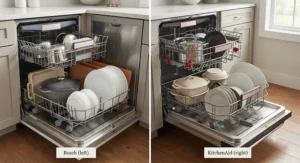
Choosing between a Bosch and KitchenAid dishwasher comes down to six practical questions. Answer these honestly, and the decision mostly makes itself.
- Measure your tolerance for noise. If your kitchen opens onto a living or dining area, lean Bosch — its noise floor runs consistently lower across nearly every comparable price tier, especially at the Bosch 800 Series (SHX78CM5N) and Bosch Benchmark (SHX9PCM5N) end.
- Think about what you actually wash. Households with heavily soiled cookware and baked-on casserole dishes often prefer KitchenAid’s more aggressive multi-jet wash systems, like the one on the KitchenAid KDTS424SPS.
- Check your plastics habit. If your cupboard is full of reusable containers and kids’ cups, Bosch’s condensation and CrystalDry drying protects plastic better than fan-assisted heat over years of daily use.
- Decide if styling matters. KitchenAid’s PrintShield finishes and panel-ready options like the KitchenAid KDPM604KPS suit buyers building a matched kitchen aesthetic; Bosch leans toward hidden, minimalist controls instead.
- Set a real budget, not an aspirational one. Entry Bosch and entry KitchenAid land within about C$100-C$150 of each other, but the gap widens fast once you climb toward Benchmark or panel-ready tiers.
- Weigh warranty coverage honestly. If long-term parts protection on the tub and circuit board matters to you, Bosch’s published multi-year structure is more concrete than KitchenAid’s model-dependent terms.
Setting Up and Maintaining Your New Dishwasher
Getting a new Bosch or KitchenAid dishwasher installed correctly, and keeping it running well, matters more than any single spec on the box — a beautifully engineered machine still underperforms if it’s leveled wrong or never cleaned.
During installation, confirm the unit is perfectly level front-to-back and side-to-side using its adjustable feet; an unlevel dishwasher, on either brand, drains poorly and can develop door-seal leaks within months rather than years. Run an empty first cycle with just detergent before loading real dishes — this clears manufacturing residue from the tub and spray arms and lets you confirm the water supply and drain lines are functioning properly before you commit a full load to a brand-new machine. For the first 30 days, avoid overloading racks while you learn how each model’s spray pattern actually reaches dishes; both Bosch and KitchenAid rack systems clean best when items don’t block the rotating arms’ path.
Monthly maintenance matters more than most owners realize: run a dedicated cleaning cycle, or a cycle with a dishwasher-safe cleaner and no dishes, to clear detergent residue and food particles from the filter — a step reviewers across both brands’ aggregated feedback consistently point to as the fix for lingering odour complaints. Wipe the door gasket dry after particularly greasy loads, and check the spray arm holes periodically for clogs, since a single blocked jet can quietly reduce cleaning performance for months before anyone notices the pattern.
Real-World Scenarios: Which Dishwasher Fits Your Household
The downtown condo couple with an open-concept kitchen: Living room and kitchen share one space, and every appliance noise carries straight into movie night. For them, the Bosch 300 Series (SHE53C85N) or, budget permitting, the Bosch 800 Series (SHX78CM5N), keeps the dishwasher from competing with the TV.
The family of five with a baking habit and reusable lunch containers: Between casserole dishes, muffin tins, and a rotating fleet of plastic containers, this household needs both aggressive cleaning and gentle drying. The KitchenAid KDTS424SPS‘s FreeFlex rack handles the odd-shaped bakeware, while its ProWash sensor adjusts automatically for baked-on messes without babysitting the cycle settings.
The renovating homeowner building a custom kitchen island: With cabinetry already ordered and a strict no-visible-appliances design brief from their contractor, the KitchenAid KDPM604KPS panel-ready option is really the only choice that fits both the aesthetic and the plumbing rough-in already in place. That said, the Bosch Benchmark (SHX9PCM5N)‘s near-silent operation is worth a second look for households prioritizing quiet over a fully hidden panel — the two goals occasionally pull in different directions during the actual planning process.
Common Mistakes When Buying a Bosch or KitchenAid Dishwasher
- Judging noise level from the spec sheet alone. A 44 dBA rating means little without context — cabinet construction, flooring, and kitchen layout all affect how loud a dishwasher actually sounds in your specific space.
- Assuming higher tier always means better cleaning. As the premium brands review above shows, the jump from the Bosch 300 Series (SHE53C85N) to the Bosch Benchmark (SHX9PCM5N) buys quiet and convenience far more than cleaning power.
- Ignoring the third rack’s actual design. A flat utensil shelf and a purpose-built rack like the KitchenAid KDTS424SPS‘s FreeFlex system solve very different storage problems, even when both get marketed as “third racks.”
- Skipping panel-ready cost math. Buyers of the KitchenAid KDPM604KPS frequently forget to budget for the custom cabinet panel itself, which is ordered and priced separately from the appliance.
- Overlooking installation compatibility. Older homes may lack the dedicated electrical circuit or drain height newer models expect; CTV News’ guide to the best dishwashers in Canada is a useful sanity check before booking delivery, alongside confirming exact measurements with your specific retailer.
Problem → Solution: Common Dishwasher Issues and Fixes
Problem: Dishes come out with cloudy spots. Solution: This is usually hard water mineral buildup rather than a machine defect; check whether your model, like the Bosch Benchmark (SHX9PCM5N), includes a built-in water softener, or add a rinse aid and periodic citric-acid cleaning cycle to strip mineral deposits from the spray arms.
Problem: Plastic containers stay damp after every cycle. Solution: Reposition items closer to the fan or heating element on KitchenAid models, or confirm AutoAir or CrystalDry is actually enabled on Bosch models like the Bosch 500 Series (SHPM65Z55N) — these features sometimes get disabled if a previous cycle was interrupted.
Problem: Persistent odour despite regular use. Solution: Run a monthly cleaning cycle with a dishwasher-safe cleaner and check the bottom filter for trapped food debris — a clogged filter is the single most common cause of lingering smell on both brands.
Problem: Water pools at the bottom after the cycle ends. Solution: A small amount is normal on some models, but persistent pooling usually points to a clogged drain hose or a check valve issue; confirm the unit is level first, since drainage problems often trace back to installation rather than a mechanical fault.
Problem: The dishwasher seems louder than its advertised dBA rating. Solution: Confirm shipping brackets were removed during installation and that the unit sits flush against cabinetry on both sides — a poorly secured dishwasher vibrates against surrounding cabinets, adding noise the rated dBA figure doesn’t account for.

FAQ
❓ Is Bosch or KitchenAid a better dishwasher brand?
❓ Which is quieter, a Bosch or KitchenAid dishwasher?
❓ Do Bosch dishwashers really skip a heating element?
❓ How long do Bosch and KitchenAid dishwashers typically last?
❓ Is a premium Bosch or KitchenAid dishwasher worth the extra cost?
Conclusion
There’s no universal winner in the Bosch vs KitchenAid dishwasher debate — just a better answer for your specific kitchen, noise tolerance, and drying habits. If quiet operation and plastics-safe drying top your list, a Bosch model like the budget-friendly Bosch 300 Series (SHE53C85N) or the near-silent Bosch Benchmark (SHX9PCM5N) earns its reputation. If you’d rather have aggressive multi-jet cleaning power and flexible rack engineering built around your actual dish shapes, a KitchenAid model like the KitchenAid KDTS424SPS or the panel-ready KitchenAid KDPM604KPS makes more practical sense.
What matters most is matching the machine to how your household actually washes dishes, not to whichever brand has the flashier showroom display. Measure your noise tolerance, count how many plastic containers you own, and be honest about whether you’re chasing a matched kitchen look or just reliable, quiet cleaning — the seven dishwashers above cover every answer those questions can produce, from budget-conscious entry models to genuinely luxurious, near-silent machines.
✨ Ready to Upgrade Your Kitchen? ✨
🍽️ Check today’s availability and current pricing on any of these seven dishwashers before your next dinner party turns into a hand-washing marathon!
Recommended for You
- Portable vs Built-In Dishwasher: 7 Picks Ranked for 2026
- Front Load vs Top Load Washer: 7 Best Picks for 2026
- Compact Ventless Dryer: 7 Best Picks for Canada in 2026
Disclaimer: This article contains affiliate links. As an Amazon Associate, I earn from qualifying purchases. If you purchase products through these links, we may earn a small commission at no additional cost to you.
✨ Found this helpful? Share it with your friends! 💬🤗
