
In This Article
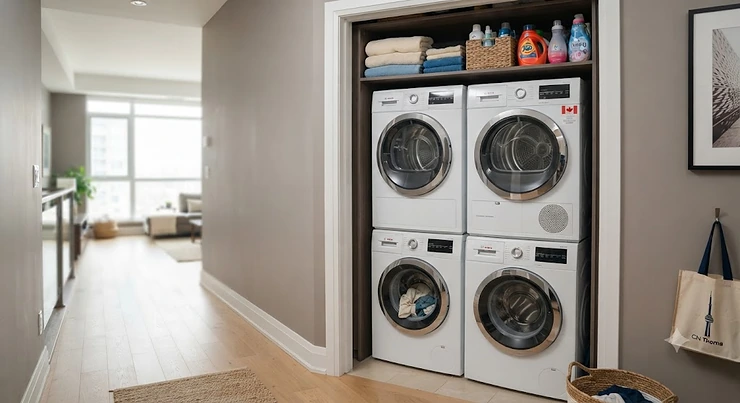
A stackable washer dryer for condo living is a paired front-load washer and dryer, or a single all-in-one unit, engineered to fit a narrow 24-inch footprint and stack vertically to save floor space — the go-to laundry format for condos, high-rises, and other small homes where a side-by-side pair simply won’t fit. If you’ve ever measured a laundry closet three times just to make sure a machine will clear the door frame, you already know why this category exists.
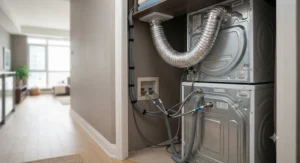
Here’s the thing nobody tells you before your first appliance showroom visit: “stackable” doesn’t mean “identical.” Some units need external venting through an exterior wall. Others condense moisture into a drain line and skip the vent entirely. A few combine washing and drying into one drum so you never touch a second machine. Each approach solves a different condo problem, and picking the wrong one can mean a dryer that never quite gets your towels dry, or a wash cycle that runs two hours because your building’s electrical panel can’t feed a bigger motor.
This guide walks through seven real, currently available machines — from budget-friendly all-in-one combos to premium German-engineered pairs — with honest analysis of who each one actually suits. We’ll cover setup, condo board rules, long-term costs, and the mistakes that trip up first-time buyers in Toronto, Vancouver, and everywhere in between. Every price mentioned is a range in Canadian dollars, since retailers adjust pricing constantly; always check current price before you commit.
Quick Comparison Table: Stackable Washer Dryer for Condo at a Glance
| Model | Type | Capacity (Washer) | Venting | Price Range (CAD) | Best For |
|---|---|---|---|---|---|
| LG WashTower WKE100HWA | Single-unit tower | 5.2 cu. ft. | Vented | C$2,000-C$2,300 | Tech-savvy condo owners |
| Bosch 300 Series (WAT28400UC/WTG86403UC) | Stacked pair | 2.2 cu. ft. | Ventless (condensing) | C$2,300-C$2,800 (pair) | Shared-wall units, noise-sensitive |
| Blomberg WMD24400W | All-in-one combo | 1.96 cu. ft. | Ventless | C$1,800-C$2,200 | Tightest closets, single-plug setups |
| Miele W1 Softronic | Stacked pair | 2.26 cu. ft. | Vented | C$4,000-C$5,000+ (pair) | Long-term durability seekers |
| Electrolux ELFW4222AW pair | Stacked pair | 2.4 cu. ft. | Vented | C$2,200-C$2,600 (pair) | Balanced capacity and quiet |
| Danby DWM120WDB-3 | All-in-one combo | 2.7 cu. ft. | Ventless | around C$1,400 | Budget-conscious renters |
| GE GFQ14ESSNWW | All-in-one combo | 2.4 cu. ft. | Ventless | C$1,300-C$1,600 | Value-focused first-time buyers |
Looking at the spread above, the split really comes down to venting and drum count before it comes down to brand. The Blomberg WMD24400W, Danby DWM120WDB-3, and GE GFQ14ESSNWW solve the “no exterior wall” problem by combining wash and dry in a single ventless drum, which keeps installation dead simple but caps how much you can dry per cycle. The Bosch 300 Series, Miele W1 Softronic, and Electrolux ELFW4222AW pair go the traditional stacked-pair route, trading a bit more footprint for faster drying and, in Miele’s case, a build quality meant to outlast a mortgage. The LG WashTower splits the difference: full separate wash and dry drums, but housed in one connected tower with a shared control panel.
💬 Just one click — help others make better buying decisions too!😊
Top 7 Stackable Washer Dryers for Condos: Expert Analysis
1. LG WashTower WKE100HWA — best all-in-one tower for smart-home condos
The standout here is the single-tower design with LG’s Centre Control panel sitting between the washer and dryer, so you’re never bending to the floor or stretching overhead to change a cycle. Specs worth pausing on: a 5.2 cu. ft. washer and 7.4 cu. ft. dryer, both housed in a 27-inch-wide footprint, with AI DD sensors that read fabric type and load size before selecting a wash motion — in practice, that means fewer re-washes for mixed loads of towels and delicates, since the machine adjusts instead of applying one generic setting to everything.
Based on the spec comparison with the rest of this list, the WashTower is the only model here offering true full-size drum capacity in a stacked footprint, which matters if your household does bedding or bulky winter coats regularly. Reviewers on major Canadian retailer sites consistently note the ThinQ app’s remote-start feature as genuinely useful for condo dwellers juggling gym schedules or work-from-home days, though a handful mention the touchscreen panel can feel overly sensitive to accidental taps for households with young kids.
Pros:
- ✅ Full-size 5.2/7.4 cu. ft. capacity in a stacked footprint
- ✅ AI fabric sensors reduce guesswork on cycle selection
- ✅ ThinQ app remote start and monitoring
Cons:
- ❌ Requires standard external venting, not ideal for interior closets
- ❌ Touchscreen sits at a premium price point versus dial-based competitors
At the time of research, this WashTower typically lists in the C$2,000-C$2,300 range, positioning it as a premium buy — but for anyone doing family-sized loads weekly, the capacity-per-dollar math holds up better than it looks at first glance.

2. Bosch 300 Series (WAT28400UC washer / WTG86403UC dryer) — quietest stack for shared condo walls
What most buyers overlook about this pairing is how much Bosch has engineered around noise, not just cleaning power. The washer’s rigid anti-vibration side panels and wave-shaped drum are built specifically to keep spin cycles from thumping through a shared condo wall, while the WTG86403UC dryer uses condensing (ventless) technology so there’s no external duct run to plan for.
The 2.2 cu. ft. washer drum handles roughly 16 towels per load — smaller than the LG, but the 15.4 lb wash capacity is realistic for a one- or two-person condo household doing laundry twice a week rather than a big weekly haul. On paper, this means shorter, more frequent loads rather than fewer marathon ones, which many condo dwellers actually prefer since it avoids letting laundry pile up in a small space. Aggregated reviewer sentiment across retailer sites frequently praises the SpeedPerfect mode for cutting wash time by roughly 40% versus standard heavy-soil cycles, though several buyers note the smaller drum means bulky items like a queen duvet won’t comfortably fit.
Pros:
- ✅ Anti-vibration design keeps noise down for shared walls
- ✅ Ventless dryer needs no external duct installation
- ✅ SpeedPerfect mode meaningfully cuts wash time
Cons:
- ❌ 2.2 cu. ft. drum is tight for bedding and bulky items
- ❌ Combined pair sits at a higher price than single all-in-one units
Expect the pair to fall in the C$2,300-C$2,800 range at the time of research, which puts Bosch solidly in mid-premium territory — a fair trade if quiet operation is non-negotiable for your building.
3. Blomberg WMD24400W — best single-plug ventless combo for tight closets
The short version: this is one washer and one dryer built into a single drum, so there’s genuinely nothing to stack — just one 24-inch unit that needs one water line, one drain, and one standard outlet. That single-plug simplicity is the real advantage for condos where running a second 240V line or an external vent isn’t realistic.
Blomberg’s inverter motor technology and automatic water-adjustment system mean the washer calculates load size before filling, so a half-load of gym clothes doesn’t use the same water as a full load of jeans — in practice that translates into a lower water bill over a year of regular use, particularly relevant since Blomberg’s washers carry ENERGY STAR certification confirming they use meaningfully less water and energy than conventional models, a standard maintained by Natural Resources Canada’s ENERGY STAR program. Reviewer sentiment on Canadian appliance retailer sites tends to highlight the water-cooled condensing dryer as genuinely effective for a ventless unit, though several note that dry times for a full 8kg wash load run notably longer than a vented dryer would need.
Pros:
- ✅ Single unit, single plug — simplest possible installation
- ✅ ENERGY STAR certified water and energy efficiency
- ✅ Woolmark-certified gentle cycle for delicates
Cons:
- ❌ Combined wash-then-dry cycle takes considerably longer than separate machines
- ❌ 5kg drying capacity is noticeably smaller than the 8kg wash capacity
At the time of research, pricing for the WMD24400W tends to sit in the C$1,800-C$2,200 range, though Coast Appliances notes Ontario pricing may vary by store — worth a quick call before you commit.
4. Miele W1 Softronic — most durable premium choice for long-term condo owners
The Miele name carries a specific promise in this category: a honeycomb-drum stainless tub and componentry designed to outlast the typical 8-10 year appliance lifespan by a wide margin. The W1 Softronic washes at 1,300 RPM spin speed with a 24-inch footprint, built to European engineering tolerances that Miele has used since bringing compact laundry to North American condos.
Here’s what the spec sheet won’t tell you, but long-time owners consistently note in aggregated reviews: Miele’s compact machines are frequently found in luxury condo developments as builder-installed appliances specifically because they’re rated for a longer duty cycle than mass-market compact units, which matters if you plan to stay in your unit for a decade rather than flip it in three years. The honeycomb drum pattern is engineered to cushion fabric during the spin cycle rather than dragging it across flat steel, and reviewers frequently cite reduced pilling on knitwear as a result. The tradeoff is obvious: this is the most expensive pairing on this list by a significant margin.
Pros:
- ✅ Honeycomb stainless drum reduces fabric wear over time
- ✅ Engineered for a notably longer service life than typical compacts
- ✅ Frequently specified in luxury condo builds for a reason
Cons:
- ❌ Highest price point on this list by a wide margin
- ❌ Parts and service technicians are less common outside major cities
The pair typically runs in the C$4,000-C$5,000+ range at the time of research — a genuine investment, and one that only pencils out if you’re planning to stay put for years rather than months.
5. Electrolux ELFW4222AW (washer) + matching compact dryer — best balance of quiet and capacity
Electrolux’s Perfect Balance System is the standout feature here, engineered specifically so the washer can run on upper floors or near bedrooms without the thumping vibration that plagues cheaper compact machines — the company backs this with what it calls a Second Floor Guarantee. The 2.4 cu. ft. washer drum splits the difference between Bosch’s tighter 2.2 cu. ft. and the LG’s full-size capacity, making it a reasonable middle ground for a couple doing regular laundry.
What most buyers overlook about this pairing is how much the ventless dryer’s actual dry time matters in daily use — multiple verified condo owners specifically call out that the ventless dryer paired with this washer dries noticeably faster than other ventless units they’ve used, which is a meaningful real-world data point since ventless drying is often assumed to be categorically slower. Buyers should still budget for a separately purchased stacking kit, which isn’t always bundled with the appliances themselves.
Pros:
- ✅ Second Floor Guarantee quiet operation, verified by condo owner reviews
- ✅ Ventless dryer performs faster than typical for the category
- ✅ Two-year parts warranty with registration
Cons:
- ❌ Stacking kit is sold separately, adding to total cost
- ❌ 2.4 cu. ft. drum still limits bulky bedding loads
Expect the pair to land in the C$2,200-C$2,600 range at the time of research, making it a strong middle-tier pick between the budget combos and the premium Bosch or Miele options.
6. Danby DWM120WDB-3 — most affordable ventless combo for renters
The 2.7 cu. ft. all-in-one ventless combo plugs into a standard 120V wall outlet — no dedicated 240V circuit required — which is the single biggest reason this unit shows up so often in rental condos and secondary suites where electrical upgrades aren’t an option. Fourteen wash cycles paired with a “My Cycle” memory setting mean you set your preferred program once and the machine remembers it going forward, cutting down on repeated manual selection.
Based on the spec comparison with pricier combos on this list, the tradeoff for that standard-outlet convenience is a genuinely long combined wash-and-dry cycle, since drying 27 lbs of washed laundry in a single small drum takes real time regardless of how efficient the condensing system is. Reviewers on Canadian retailer sites frequently mention this unit as a practical first-apartment or rental-condo solution specifically because of the plug-and-go installation, while noting that anyone doing large households’ worth of laundry weekly will find the drying side slow going.
Pros:
- ✅ Standard 120V outlet — no electrical upgrade needed
- ✅ MSRP among the lowest of any ventless combo here
- ✅ Stainless steel drum and childproof lock included
Cons:
- ❌ Combined cycle time runs long for larger loads
- ❌ Smaller real-world drying capacity than the wash capacity suggests
Danby lists this at an MSRP around C$1,400, and several Canadian retailers price it in the C$1,300-C$1,500 range at the time of research — one of the more accessible entry points into ventless condo laundry.
7. GE GFQ14ESSNWW — best value all-in-one for first-time condo buyers
GE’s all-in-one combo covers the essentials without extras: 14 wash cycles, a sanitize cycle rated to reduce 99.8% of bacteria, and a non-vented condensing dry system that needs no external ducting. The stainless steel drum resists the peeling and cracking that can develop in painted-steel drums over years of use, and the steam-assisted stain wash option adds real cleaning power for a budget-tier machine.
What the spec sheet won’t tell you is how this unit tends to perform in practice for smaller households: reviewers commonly describe it as a dependable, no-fuss option for one or two people doing laundry a few times a week, rather than a heavy-duty machine for large families. The 2.4 cu. ft. capacity and 20-amp requirement mean it’s worth confirming your unit’s electrical setup can support it before ordering, since GE specifies this amperage explicitly in its published specs.
Pros:
- ✅ Stainless steel drum resists peeling and cracking
- ✅ Sanitize cycle rated for 99.8% bacteria reduction
- ✅ No external venting required
Cons:
- ❌ Requires confirming 20-amp electrical capacity beforehand
- ❌ Entry-level cycle count compared to premium competitors
Retailers frequently bundle promotional discounts on this model, and at the time of research it typically falls in the C$1,300-C$1,600 range — a genuinely competitive entry point for anyone prioritizing budget over bells and whistles.
Closet Laundry Solutions: Making a Stacked Set Actually Fit
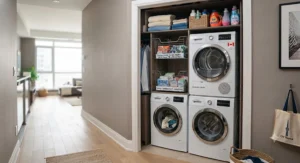
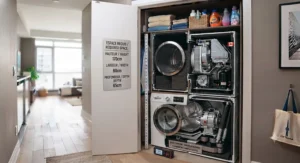
A closet laundry solution starts with a tape measure, not a shopping cart. Most 24-inch stackable washers and dryers need roughly 74-77 inches of vertical clearance once stacked, plus a few extra inches of tilt room to manoeuvre the dryer into place on delivery day — something that trips up more condo buyers than any spec on a data sheet. Before ordering anything, measure your closet’s height to the ceiling, the door swing clearance, and confirm whether your unit has a floor drain or relies on a standpipe for the washer’s discharge hose.
Ventless models like the Blomberg WMD24400W, Danby DWM120WDB-3, and GE GFQ14ESSNWW solve the biggest closet-laundry headache outright: no vent duct means no need to cut through a wall or coordinate with your condo’s exterior venting bylaws. That said, ventless drying works by condensing moisture into either a small internal reservoir or directly into your drain line, so confirming your closet has a functioning drain connection matters just as much as the electrical outlet.
For the vented options — LG WashTower, Bosch 300 Series, Miele W1 Softronic, and Electrolux ELFW4222AW — check whether your unit was built with an existing dryer vent stub. Retrofitting a vent through a concrete condo wall is possible but often requires condo board approval and a professional contractor, adding real cost and delay most buyers don’t budget for upfront.
Real-World Scenarios: Who Actually Fits Each Machine
The downtown Toronto professional in a 480-square-foot unit: With a shallow bedroom closet and no existing vent, a ventless all-in-one combo like the Danby DWM120WDB-3 or GE GFQ14ESSNWW solves the space problem without triggering condo board venting approval — the standard 120V plug means installation day is quick, and doing smaller, more frequent loads suits a single person’s laundry volume anyway.
The Vancouver couple in a two-bedroom high-rise with kids: Bulkier loads — bedding, towels for two bathrooms, kids’ sports gear — favour the larger drum capacity of the LG WashTower or the balanced Electrolux ELFW4222AW pair. Noise matters more here too, since shared walls with neighbours below and above mean the anti-vibration engineering built into Electrolux’s Second Floor Guarantee or Bosch’s rigid side panels genuinely earns its keep.
The long-term condo owner planning to stay 10+ years: For someone who’s done the math on cost-per-year of ownership rather than sticker price alone, the Miele W1 Softronic or Bosch 300 Series make more sense than a budget combo that may need replacing twice in the same span. Reviewers who’ve owned Miele units for a decade-plus consistently frame the higher upfront cost as the whole point, not a drawback.
How to Choose a Stackable Washer Dryer for Your Condo
- Confirm your electrical setup first. Most stacked pairs need a dedicated 240V circuit, while several all-in-one combos like the Danby and Blomberg models run on a standard 120V outlet — check your unit’s panel before falling for a machine you can’t actually wire.
- Measure vertical clearance, not just width. A 24-inch-wide unit still needs 74+ inches of stacked height and tilt room for delivery — a narrow closet with a low ceiling can rule out otherwise perfect machines.
- Decide vented versus ventless early. Ventless saves you a wall-venting project and condo board paperwork; vented dries faster but needs an existing duct or a retrofit.
- Match capacity to household size, not aspiration. A single person doing two loads a week doesn’t need a 5.2 cu. ft. drum; a family of four managing bedding and towels genuinely does.
- Weigh noise tolerance against your neighbours. Anti-vibration engineering (Bosch’s rigid side panels, Electrolux’s Second Floor Guarantee) is worth paying for in shared-wall buildings.
- Budget for the stacking kit separately. Several manufacturers, including Electrolux, sell the kit apart from the appliances — factor it into your total cost before comparing sticker prices.
- Read the warranty fine print. Compact and combo units sometimes carry shorter or more limited coverage than full-size laundry pairs; confirm before you buy, not after something breaks.
Stackable Washer Dryer for Toronto and Vancouver Condos
Toronto and Vancouver share a problem that shapes this entire category: shrinking unit sizes paired with growing demand for in-suite laundry. CBC Radio has reported that Toronto condo units have been getting smaller for over two decades even as buyers increasingly expect the conveniences of a full home, laundry included — which is exactly why 24-inch stackable and all-in-one combo units have become the default recommendation from condo developers and appliance retailers alike in both cities.
The two markets do differ in practical ways. Many older Toronto high-rises, especially pre-2010 builds, were designed without in-suite laundry venting at all, making ventless combos like the Blomberg WMD24400W or GE GFQ14ESSNWW the realistic path for retrofitting a unit that never had laundry hookups. Vancouver’s newer high-rise stock, by contrast, more frequently includes a dedicated laundry closet with existing venting already roughed in, which opens the door to faster-drying vented pairs like the Bosch 300 Series or LG WashTower without needing board approval for new ductwork. Either way, checking your building’s condo declaration and bylaws before purchase — specifically around noise limits, drain access, and any venting restrictions — will save you a returned appliance and a testy email from your property manager.
Ventless vs Vented: Which Wins for High-Rise Apartment Living
The core tradeoff is simple in theory and messy in practice. Ventless (condensing) dryers, used in the Blomberg, Danby, and GE combos on this list, pull moisture out of the air inside the drum and either collect it in a small tank or route it to your drain — meaning no hole in an exterior wall, no condo board sign-off, and no risk of lint buildup in a shared vent stack that runs through multiple units. The cost is time: a full load typically takes noticeably longer to fully dry than the same load in a vented machine.
Vented dryers, as used in the LG WashTower, Bosch 300 Series, Miele W1 Softronic, and Electrolux pair, push hot, moist air out through ducting to the building’s exterior. Drying times are meaningfully faster and drums tend to run cooler overall, but you’re dependent on your unit actually having (or being able to install) a vent run — a real constraint in older high-rise apartment buildings where shared vent stacks are already at capacity or simply don’t exist on your floor. For most high-rise apartment dwellers without existing venting, ventless wins on practicality even if it loses slightly on speed; for those with venting already in place, vented is very hard to argue against on performance alone.
What to Expect: Real-World Performance in Small Spaces
Specs on a page rarely match the lived experience of doing laundry in 250 square feet of closet. In practice, a 2.2-2.4 cu. ft. compact washer drum — the size used by Bosch, Electrolux, GE, and Danby’s units here — comfortably handles about 8-10 lbs of laundry per load, meaning towels, sheets, and a week’s worth of clothing for one or two people fit fine, but a queen-size duvet generally won’t. The LG WashTower’s larger 5.2 cu. ft. drum is the exception on this list, built to handle that bulkier load without a special trip to the laundromat.
Noise is the other variable that matters more in condo life than in a detached house, since a spin cycle thumping through a shared wall becomes a genuinely awkward conversation with a neighbour. Reviewers consistently describe well-engineered compact washers — particularly Bosch and Electrolux models — as quiet enough to run late at night or early morning without complaint, while cheaper units without anti-vibration engineering can transmit noticeably more vibration through shared flooring and walls.
Common Mistakes When Buying a Stackable Washer Dryer for Condo
The single most common mistake is measuring width but not height, ceiling clearance, or the tilt space needed to walk the dryer into place — appliance delivery crews report this as a leading cause of failed installations in condo buildings. A close second is assuming every “stackable” washer and dryer pair actually stacks together; manufacturers design stacking kits for specific model pairings, and mixing brands or series often voids the stacking hardware compatibility entirely.
Buyers also frequently skip checking their condo’s bylaws before ordering a vented dryer, only to discover that drilling a new vent through an exterior wall requires board approval that can take weeks. On the electrical side, assuming a unit will “just plug in” without confirming voltage and amperage requirements is a recurring and entirely avoidable problem — GE, for instance, explicitly lists a 20-amp requirement for its GFQ14ESSNWW combo, information easily missed if you’re comparing machines purely on price and capacity.
Long-Term Cost & Maintenance
The sticker price is only the opening bid in the true cost of condo laundry. ENERGY STAR certified washers, a designation held by several models on this list, use meaningfully less water and energy per load than non-certified machines — and Natural Resources Canada notes that pairing a certified washer with a certified dryer compounds those savings further over the appliance’s lifespan. For a household running four to six loads weekly, that efficiency gap can add up to real annual savings on utility bills, particularly in cities with higher electricity rates.
Maintenance costs diverge sharply by tier. Budget combo units like the Danby and GE models are generally inexpensive to service but may have shorter practical lifespans under heavy use, since a single shared drum handling both wash and dry cycles faces more mechanical wear than two dedicated machines. Premium pairs, especially the Miele W1 Softronic, are built around the opposite bet: higher upfront cost offset by a substantially longer service life and componentry designed to avoid the failure points that shorten cheaper machines’ lifespans. Filter and lint-trap maintenance also differs by design — ventless condensing dryers need their internal condenser filter cleaned more frequently than a vented dryer’s simple lint trap, a maintenance step several first-time ventless owners report overlooking until drying performance noticeably drops.
Safety, Building Rules & Regulations for Condo Laundry
Before installing any stacked washer and dryer, confirm your condo corporation’s specific bylaws around in-suite laundry, since rules vary significantly building to building and province to province. Common requirements include a certified installer for any new electrical circuit, mandatory floor pans or leak-detection trays beneath the unit to protect the units below yours, and, in many buildings, advance notice to property management before installation day.
CSA certification matters here in a very concrete way: any washer or dryer installed in a Canadian condo should carry CSA (or equivalent recognized) certification confirming it meets Canadian electrical safety standards, which most major manufacturers on this list — LG, Bosch, Miele, Electrolux, Blomberg, Danby, and GE — build into their appliances by default for the Canadian market. Ventless dryers add one more safety consideration: since they don’t vent to the exterior, proper drain routing for condensed water is essential to avoid moisture buildup inside a closet, which over time can contribute to mould risk in a poorly ventilated space.
Frequently Asked Questions
❓ Can I put any washer and dryer in a stacked configuration?
❓ Do stackable washer dryers for condos need special electrical work?
❓ Is a ventless dryer as effective as a vented one in a condo?
❓ How much does a stackable washer dryer for condo cost in Canada?
❓ Do condo boards need to approve a new washer and dryer installation?
Conclusion
Choosing a stackable washer dryer for condo living really comes down to three honest questions: what’s your electrical setup, do you have existing venting, and how much laundry does your household actually generate in a week. Budget-conscious renters and single-occupant units tend to do well with ventless combos like the Danby DWM120WDB-3 or GE GFQ14ESSNWW, while households with more laundry volume or noise-sensitive neighbours should lean toward the Bosch 300 Series, Electrolux pair, or the full-capacity LG WashTower. Anyone planning to stay in their unit for the long haul has a genuine case for stretching the budget toward the Miele W1 Softronic.
Whichever direction you go, measure twice, confirm your condo’s bylaws before ordering anything that needs venting, and don’t skip the stacking kit and installation costs when comparing sticker prices between models.
💬 Found the right match for your space? A little research now saves a lot of hassle on delivery day. 😊
Recommended for You
- Stackable Washer Dryer: 7 Best Picks for Canadian Apartments 2026
- Dishwasher Save Money Hydro Bill: 7 Picks That Cut Costs (2026)
- Energy Star Smart Dishwasher: 7 Best Picks for 2026 (Canada)
Disclaimer: This article contains affiliate links. As an Amazon Associate, I earn from qualifying purchases. If you purchase products through these links, we may earn a small commission at no additional cost to you.
✨ Found this helpful? Share it with your friends! 💬🤗
