
In This Article
There’s a specific kind of laundry-day defeat that only a mud-caked hockey jersey or a toddler’s “art project” overalls can deliver. You toss it into a sleek, whisper-quiet impeller washer, pull it out an hour later, and the stain is… still there, just politely rearranged. That’s usually the moment someone starts googling a top load washer with agitator, half-convinced they’re chasing a nostalgia trip rather than a genuinely better cleaning tool.
They’re not wrong to look. A top load washer with agitator relies on a central post that twists back and forth through a full tub of water, physically scrubbing fabric against fabric the way your grandmother’s machine did — minus the flood-your-basement water bills. It’s a mechanical, no-nonsense approach that still beats gentler high-efficiency designs on heavily soiled loads, work clothes, and anything that needs a proper thrashing rather than a gentle massage.
This guide walks through seven real, currently available models — from a no-frills budget pick to a commercial-grade machine that outlasts mortgages — with honest analysis pulled from spec sheets and aggregated owner feedback, not marketing copy. Canadian shoppers get metric-first specs, CAD price ranges (never exact figures, since those shift constantly), and guidance on where an agitator machine actually earns its keep versus where you’d be better served elsewhere. Whether you’re outfitting a growing family’s laundry room or replacing a machine that finally gave up the ghost, you’ll leave with a shortlist and the reasoning behind it — no fluff, no rewritten Amazon listings, just the analysis you can’t get from a product page.
Quick Comparison Table
| Product | Capacity | Best For | Price Range (CAD) |
|---|---|---|---|
| BLACK+DECKER BTLW41MW | 4.1 cu. ft. (116 L) | Tightest budgets | Under C$700 |
| Kenmore 4.4 cu. ft. Triple Action Agitator | 4.4 cu. ft. (125 L) | Best all-round value | C$650–C$850 range |
| GE GTW585BSVWS | 4.5 cu. ft. (127 L) | Custom water control | C$750–C$900 range |
| Whirlpool WTW8127LC | 5.2 cu. ft. (147 L) | Flexibility (agitator or impeller) | C$1,000–C$1,350 range |
| Samsung WA49B5205AW | 4.9 cu. ft. (139 L) | Quiet operation | C$900–C$1,150 range |
| Maytag MVW6500MBK Pet Pro | 4.7 cu. ft. (133 L) | Homes with pets | C$1,100–C$1,400 range |
| Speed Queen TC5003WN | 3.2 cu. ft. (91 L) | Commercial-grade durability | C$1,400–C$1,650 range |
Looking across this table, a pattern jumps out fast: capacity and price don’t move together in a straight line. The Speed Queen TC5003WN has the smallest drum of the bunch yet the highest price tag, because you’re buying a 25-year design philosophy, not cubic footage. Meanwhile the Whirlpool WTW8127LC and Samsung WA49B5205AW sit in the middle of both scales, trying to be the sensible compromise for buyers who don’t want to choose between size and features. If your priority is simply “biggest tub for the least money,” the GE GTW585BSVWS and Kenmore 4.4 cu. ft. Triple Action Agitator deliver the best cubic-foot-per-dollar math in this lineup.
💬 Just one click — help others make better buying decisions too!😊
Top 7 Top Load Washers With Agitator: Expert Analysis
1. BLACK+DECKER BTLW41MW — most affordable full-size agitator washer
The standout here is simple: this is a genuine 4.1 cu. ft. full-size machine, not a dorm-room compromise, and it undercuts most agitator competitors by hundreds of dollars. The stainless steel wash tub resists rust and pitting far better than the painted or plastic tubs found on some budget machines, and the 10 cycle selections — including Heavy Duty, Bulky, and Tub Clean — cover the basics without a confusing wall of buttons. A 24-hour delay start means you can load it before bed and have it finish right as you’re pouring coffee.
Based on the spec comparison, what you’re giving up compared to pricier machines is water-level intelligence and wash-action variety — there’s no dual-action or triple-action agitator here, just a straightforward single post doing straightforward work. Reviewers consistently note that it’s genuinely loud on the spin cycle and lacks any smart or app-connected features, but almost nobody complains about cleaning performance for the price. This is the machine for a first apartment, a rental property, or anyone who wants an agitator’s cleaning power without agitator-adjacent sticker shock.
Pros:
- ✅ Full 4.1 cu. ft. capacity at a genuine budget price
- ✅ Stainless steel tub resists rust long-term
- ✅ 24-hour delay start for flexible scheduling
Cons:
- ❌ Noticeably louder during spin than pricier models
- ❌ No water-level customization beyond preset cycles
Expect a price in the under-C$700 range at the time of research, making it one of the cheapest genuine agitator machines on amazon.ca. For anyone furnishing a laundry room on a first-apartment budget, that value proposition is hard to beat.

2. Kenmore 4.4 cu. ft. Triple Action Agitator — best value heavy duty cleaning
The Triple Action Agitator earns its name honestly: spray jets hit dirt from multiple angles while the wash basket itself rocks back and forth in addition to the agitator’s twist, layering three distinct motions into one cycle. That’s a meaningfully different mechanical approach than a single-post agitator, and it shows up in how thoroughly ground-in soil gets worked out of denim and towels.
What most buyers overlook about this model is the Accela Wash feature, which Kenmore states can cut full-load wash times by up to roughly half by optimizing wash, rinse, and spin phases together rather than running each on a fixed timer. Aggregated owner sentiment across major retailers points to consistently high satisfaction — the model carries thousands of positive reviews referencing reliable stain removal and the soft-close glass lid, which prevents the classic slammed-lid startle. The main friction point in review threads is the Express Wash cycle sacrificing some cleaning depth for speed, which makes sense given the physics involved. For a family cycling through multiple loads a week without wanting to babysit a fancy control panel, this lands near the sweet spot of the category.
Pros:
- ✅ Three distinct wash actions in one cycle
- ✅ Accela Wash meaningfully cuts full-load time
- ✅ Soft-close glass lid avoids lid-slam noise
Cons:
- ❌ Express Wash trades some cleaning depth for speed
- ❌ Fewer smart features than premium competitors
Prices typically fall in the C$650–C$850 range depending on colour and retailer promotions at the time of research, positioning it as the value pick for households doing frequent, heavily soiled loads.
3. GE GTW585BSVWS — best deep fill water control
This GE model puts water-level decisions directly in your hands rather than leaving them entirely to sensors. Press the Deep Fill button once for an extra 3 gallons (about 11 litres), or press and hold to fill the full drum to roughly 26 gallons (98 litres) — genuinely useful when you’re washing a single bulky comforter that needs to actually float and turn rather than sit half-submerged.
Here’s what to weigh: the Dual Action Agitator splits into two independently moving sections, with the top half guiding clothes downward while the bottom half handles the actual scrubbing motion. On paper this means better circulation without one section fighting the other, and reviewers testing the machine describe solid, middle-of-the-pack stain removal on the Normal and Delicate cycles alongside a noticeably tougher Heavy Duty setting — tough enough that a few owners mention visible extra wear on delicate fabrics run through it repeatedly. The Auto Soak option, which pre-soaks for up to two hours before the wash cycle kicks in automatically, is the kind of unglamorous feature that quietly saves a load from becoming a re-wash. Annual energy use sits around 207 kWh, translating to roughly C$35–C$45 per year in typical Canadian electricity costs depending on your province’s rates.
Pros:
- ✅ True manual water-level control, not just presets
- ✅ Auto Soak handles pre-treatment automatically
- ✅ Dual Action Agitator improves clothing circulation
Cons:
- ❌ Heavy Duty cycle can be rough on delicate fabrics
- ❌ Middle-of-pack stain performance on Normal cycle
Expect a price in the C$750–C$900 range at the time of research, making it a reasonable mid-tier pick for buyers who specifically want water-level control without paying for a full smart-appliance package.
4. Whirlpool WTW8127LC — best hybrid agitator/impeller flexibility
The industry-first 2-in-1 Removable Agitator is a genuinely clever bit of engineering: pull the agitator post out entirely and the machine becomes an impeller washer with dramatically more usable drum space, or leave it in for traditional deep-clean action on heavily soiled loads. You’re effectively buying two washer personalities in one chassis, which matters if your laundry swings between muddy work gear one week and a king-size comforter the next.
Reviewers consistently note that removing the agitator and switching to impeller mode noticeably reduces fabric wear while still cleaning acceptably — Consumer Reports’ testing found the impeller configuration handled stain removal well and was gentler overall, while the agitator configuration scored strongly on tough, ground-in soil. What the spec sheet won’t tell you, but reviewers do, is that reinserting the agitator takes a genuine physical step each time, so households that constantly toggle between modes may find the novelty wears thin. The Deep Water Wash option adds significant extra water for loose-soil breakdown, and the built-in dual-temperature faucet with pretreat brush is a legitimately useful touch for spot-treating stains before they set. Some owner reviews flag that even on the deep-fill setting, water levels feel lower than older-generation machines, a common friction point with high-efficiency-era agitator washers generally.
Pros:
- ✅ Swap between agitator and impeller wash action
- ✅ Built-in faucet and brush for pretreating stains
- ✅ ENERGY STAR certified with WiFi app control
Cons:
- ❌ Swapping agitator in and out requires manual effort
- ❌ Some owners find deep-fill water levels underwhelming
Price typically lands in the C$1,000–C$1,350 range at the time of research depending on finish and seasonal rebates, positioning this as a premium pick for households that genuinely want both wash styles rather than committing to one.
5. Samsung WA49B5205AW — quietest agitator wash action
Samsung’s ActiveWave Agitator is shaped differently than a traditional straight post — its contoured profile is specifically engineered to reduce the clunking and vibration that agitator washers are historically known for, paired with Vibration Reduction Technology+ ball bearings that dampen spin-cycle rattle. The practical result: you can plausibly run a load at 10 p.m. without waking anyone two rooms over, which is not something you could confidently say about most agitator machines a decade ago.
Based on the spec comparison, the Active WaterJet faucet built into the lid lets you pretreat directly inside the drum, and the Super Speed Wash cycle claims a full load in as little as 28 minutes by adjusting water pressure and spin dynamics rather than just cranking the heat. What most buyers overlook is that this quieter wash action comes from a gentler agitation profile than old-school straight-post designs, so reviewers describe performance as strong on everyday soil but slightly behind the most aggressive agitator machines (like the Speed Queen below) on genuinely caked-in stains. The soft-close lid and self-clean cycle round out a machine clearly built for households layering convenience on top of traditional wash power rather than chasing maximum brute force.
Pros:
- ✅ Noticeably quieter operation than typical agitators
- ✅ Active WaterJet enables in-drum pretreating
- ✅ Super Speed Wash cuts cycle time significantly
Cons:
- ❌ Slightly less aggressive on the toughest set-in stains
- ❌ Premium price relative to its 4.9 cu. ft. capacity
Prices generally fall in the C$900–C$1,150 range at the time of research, making this the pick for buyers who want agitator-style cleaning without agitator-style household noise complaints.
6. Maytag MVW6500MBK Pet Pro — best for pet hair removal
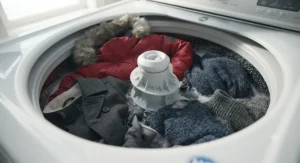
If you share your home with a dog or cat that treats shedding as a full-time job, the standout feature here solves a problem no other machine on this list even attempts: a dedicated filter built into the pole agitator itself that physically traps pet hair during the wash rather than letting it redistribute onto every other item in the load. Reviewed.com’s testing team specifically noted it handled the sheddings of a Bernese Mountain Dog — not a small ask.
The Pet Pro option adds extra water and a deeper rinse specifically to activate that filter, and Maytag’s own testing claims roughly five times more pet hair removed compared to a standard cycle without the feature engaged — a specific, checkable number rather than vague marketing language. Aggregated owner reviews from Best Buy and Maytag’s own site skew heavily positive, with repeat mentions of the built-in faucet’s prespot button and the see-through lid as small conveniences that add up. Reviewed.com’s independent testing found cleaning and stain performance landed roughly average among peers, which is a fair trade if pet hair is genuinely your household’s primary laundry headache rather than an afterthought. The trade-off worth flagging honestly: that pet hair filter needs manual emptying, and skipping that maintenance step undercuts the entire selling point.
Pros:
- ✅ Dedicated in-agitator filter traps pet hair effectively
- ✅ Built-in faucet with prespot button for stains
- ✅ 10-year warranty on the motor and drive system
Cons:
- ❌ Average overall stain performance versus category leaders
- ❌ Pet Pro filter requires regular manual cleaning
Expect a price in the C$1,100–C$1,400 range at the time of research. For multi-pet households specifically, that premium over a standard agitator machine is arguably the most targeted, justifiable upgrade on this entire list.
7. Speed Queen TC5003WN — most durable, commercial-grade build
Everything about this machine is a deliberate rejection of the smart-appliance trend. No WiFi, no touchscreen, no app — just an all-metal build, a porcelain outer tub over a stainless inner drum, and a transmission-driven agitator producing an aggressive 210-degree wash stroke at 60 strokes per minute, the same wash action used in commercial laundromats. Speed Queen states the components are engineered for roughly 10,400 duty cycles, which the company translates to about 25 years of average household use.
What the spec sheet won’t tell you, but the reviews consistently confirm, is how much owners value the absence of a lid lock — you can pop the lid open mid-cycle to toss in a forgotten sock, and agitation simply pauses until you close it again, no error codes involved. The Deep Fill and Extra Rinse options let you push well past standard water-saving fill levels when a load genuinely needs it, and the solid steel base with heavy-duty springs keeps the machine planted even on an uneven laundry-room floor. Here’s the honest trade-off: it’s not ENERGY STAR certified, water use runs noticeably higher than high-efficiency competitors, and the 3.2 cu. ft. drum is the smallest capacity in this lineup. Reviewers who prioritize longevity over everything else — including P.C. Richard & Son’s own testing team — consistently frame this as the machine you buy once and never think about again.
Pros:
- ✅ Commercial-grade components rated for ~25 years’ use
- ✅ No lid lock — add items any time mid-cycle
- ✅ Five-year parts and in-home labour warranty
Cons:
- ❌ Smallest drum capacity of the seven models here
- ❌ Not ENERGY STAR certified; higher water use
Prices typically land in the C$1,400–C$1,650 range at the time of research, the highest on this list — a premium buyers are explicitly paying for durability rather than features or capacity.
Practical Usage Guide: Setting Up and Maintaining Your Agitator Washer
The first 30 days set the tone for years of performance, and most of the mistakes people make happen right out of the gate. Level the machine first — every agitator washer has adjustable feet, and even a slight tilt causes off-balance spin cycles that hammer the suspension system over time. Use a torpedo level front-to-back and side-to-side before running a single load.
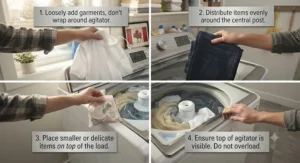
Overloading is the single most common early mistake with a heavy duty top load washer, and it’s counterintuitive because these machines look like they can swallow anything. Clothes need room to actually rotate through the water and past the agitator post; jam the drum full and you get poor rinsing, tangled fabric, and a machine straining against a load it physically can’t move. As a maintenance rhythm, run an empty hot-water cycle with a washing-machine cleaner monthly to prevent detergent buildup and musty odours in the tub — this matters even more for agitator machines than high-efficiency drums, since standing water around the post is a classic mildew breeding ground. Check inlet hoses for cracking or bulging every six months, and replace them proactively every five years regardless of appearance; a burst hose while you’re at work is a genuinely expensive afternoon. Finally, wipe down the fabric softener and bleach dispensers after every few loads — dried residue there is the number-one cause of dispensers that stop dispensing properly.
Real-World Scenarios: Matching the Right Washer to Your Household
Picture three very different Tuesday mornings. First, a young couple in a Halifax rental with no dedicated laundry hookups drama, doing two or three loads a week between them — the BLACK+DECKER BTLW41MW fits that footprint perfectly, delivering genuine agitator cleaning without asking them to finance an appliance the way they’d finance a car.
Now picture a family of five outside Calgary, coaching three different kids’ sports schedules, running loads almost daily, and constantly fighting grass stains and mud. That household needs the Kenmore 4.4 cu. ft. Triple Action Agitator or the GE GTW585BSVWS — enough capacity to avoid running the machine every single day, tough enough wash action to handle genuinely soiled uniforms, and a price point that doesn’t punish frequent use. Finally, imagine a retired couple in rural Ontario who’ve watched three “modern” washers fail within a decade and have decided they’re done with planned obsolescence. For them, the Speed Queen TC5003WN isn’t overkill — it’s a rational response to being burned before, purchased once with the explicit expectation of never buying another washer again.
How to Choose a Top Load Washer With Agitator
Choosing among agitator models comes down to weighing a handful of factors against your actual laundry habits rather than chasing the longest feature list. Here’s the reasoning behind each:
- Capacity first, features second. A 3.0–3.5 cu. ft. drum suits one or two people; 4.1–4.5 cu. ft. is the realistic sweet spot for a family of three or four; anything above 4.7 cu. ft. earns its keep for large households or anyone regularly washing bulky bedding.
- Decide how aggressive you actually need the wash action to be. Contractors, athletes, and pet owners genuinely benefit from stronger agitation; households doing mostly everyday laundry may find a gentler dual-action design perfectly adequate and easier on fabric longevity.
- Check the warranty structure, not just the length. A 10-year warranty that only covers the motor isn’t the same protection as Speed Queen’s 5-year parts-and-labour coverage — read what’s actually included before comparing numbers.
- Weigh water use against your utility rates. Non-ENERGY STAR agitator machines use noticeably more water per load, which matters more in provinces with higher water or sewer surcharges than in areas where it’s a flat municipal fee.
- Confirm the deep fill option is manual, not just a marketing label. Some machines let you genuinely control water depth; others just relabel a slightly higher preset — check the actual gallon or litre figures in the spec sheet.
- Factor in noise if your laundry space is near living areas. Contoured or dual-action agitator designs run noticeably quieter than older straight-post mechanisms.
- Match the price to how long you plan to keep the machine. A washer you’ll replace in five years doesn’t need commercial-grade components; one you want to own for two decades absolutely does.
The Government of Canada’s ENERGY STAR certified clothes washer guidance notes that certified machines use on average 25% less energy and 33% less water than standard models — a useful baseline when comparing an agitator washer’s specs against that standard, even for models that don’t carry the certification themselves.
Top Load Washer With Agitator vs Impeller Models
The agitator-versus-impeller debate isn’t really about which is “better” in the abstract — it’s about which mechanical approach suits your actual laundry. An agitator uses a central post that twists back and forth through a fully submerged load, physically scrubbing fabric against fabric via water displacement and friction. An impeller uses a low-profile cone or disc at the bottom of the tub that spins clothes past each other in a shallower pool of water, relying on friction between garments rather than a mechanical post doing the scrubbing.
In practice, that mechanical difference shows up clearly in testing: agitator machines consistently win on heavily soiled loads, work clothes, and anything caked in dried mud or grease, because that twisting motion generates more direct scrubbing force. Impeller machines win on capacity — without a post occupying the drum’s centre, they hold noticeably more per load — and they’re gentler on delicate fabrics and less prone to tangling long sleeves or drawstrings. For households split between “we need this genuinely clean” and “we need to fit this queen comforter in one load,” the honest answer is that neither format wins outright; it depends which problem shows up more often in your laundry basket. The Whirlpool WTW8127LC‘s removable-agitator design exists specifically because Whirlpool recognized this isn’t a one-size-fits-all decision.
Common Mistakes When Buying a Traditional Agitator Washer
The most frequent mistake is buying based on capacity alone without checking wash-action intensity — a large-drum agitator machine with a gentle motion won’t outperform a smaller machine with genuinely aggressive agitation on tough stains, and buyers comparing spec sheets by cubic footage alone miss this entirely. A close second is ignoring installation space: agitator washers are typically taller than impeller or front-load models because of the post’s clearance requirements, and more than a few buyers have discovered their new machine doesn’t clear an existing shelf or cabinet by inches.
Skipping the warranty fine print is another recurring pitfall — “10-year warranty” sounds reassuring until you discover it covers only the motor and drive components, not the electronics, control board, or labour, all of which are common failure points. Buyers also frequently underestimate water costs in provinces or municipalities that meter water separately from a flat rate, where a non-ENERGY STAR agitator machine’s higher water draw compounds meaningfully over hundreds of loads per year. Finally, plenty of shoppers assume all agitator washers are interchangeable in cleaning power, when in reality single-post, dual-action, and triple-action designs genuinely differ in how thoroughly they scrub — that’s not marketing fluff, it’s a real mechanical distinction worth reading past the headline spec.
✨ Take the guesswork out of laundry day — compare these seven agitator washers side by side before you decide!
🔍 Don’t Miss These Exclusive Deals!
Ready to stop fighting stains and start winning laundry day? Click on any highlighted model above to check current pricing and availability on amazon.ca. These machines are built to deliver the genuinely deep clean your household actually needs. 🧺✨
Long-Term Cost & Maintenance
The sticker price is only the opening chapter of what a washer actually costs you. Water and energy use compound over hundreds of loads a year, and this is exactly where agitator machines’ reputation takes a hit — Natural Resources Canada’s household appliance data shows top-loading washers consumed almost twice as much energy on average as front-loading washers in recent tracked years, even as top-load efficiency has improved substantially over the past two decades.
That said, “twice as much” on a genuinely small base number still lands modestly on most utility bills, and it needs weighing against the other side of the ledger: repair frequency and machine lifespan. A commercial-grade design like the Speed Queen TC5003WN, with its simple mechanical components and minimal electronics, has dramatically fewer failure points than a WiFi-connected machine with sensor arrays and a touchscreen — fewer parts to fail generally means fewer service calls over a decade. Run the math over the machine’s realistic lifespan, not just year one: a C$1,500 washer that lasts 20 years without a single repair call can genuinely out-value a C$700 machine that needs a C$300 control-board replacement in year six. Budget roughly C$10–C$20 a year for washing-machine cleaner and inlet hose replacement every five years as baseline maintenance costs regardless of which model you choose.
Heavy Duty Top Load Washer: Where Robust Cleaning Action Actually Matters
Not every household needs a heavy duty top load washer, and it’s worth being honest about that before spending extra on capability you won’t use. If your laundry is mostly everyday office clothes, bedsheets, and the occasional wine spill, a mid-tier agitator machine handles that without breaking a sweat. But for contractors, mechanics, farm households, hockey and football parents, or anyone regularly dealing with genuinely ground-in soil, robust cleaning action isn’t a marketing phrase — it’s the entire reason to choose an agitator washer over a gentler alternative in the first place.
That robust cleaning action comes specifically from the mechanical scrubbing force of the agitator post working against a fully water-submerged load, which is a fundamentally more aggressive process than the friction-based cleaning of impeller or front-load drum tumbling. The Speed Queen TC5003WN‘s 210-degree transmission-driven stroke and the Kenmore 4.4 cu. ft. Triple Action Agitator‘s layered wash motions both represent different engineering paths to the same goal: maximizing scrub force without shredding fabric in the process. The honest trade-off is fabric wear — that same aggressive action that pulverizes a grass stain will, over hundreds of cycles, wear synthetic and delicate fabrics faster than a gentler wash. The practical solution most heavy-duty households land on is running a dedicated Heavy Duty or Whites cycle for genuinely soiled loads while switching to a Delicate or Permanent Press setting for everything else — using the machine’s full range rather than defaulting to Normal for every load.
Deep Fill Option and the Traditional Washing Method Explained
The deep fill option exists to solve a specific, common complaint about modern high-efficiency machines: not enough water to properly submerge and turn a bulky load. Genuine deep fill functionality — like the GE GTW585BSVWS‘s press-and-hold to fill roughly 26 gallons (98 litres), or the Speed Queen TC5003WN‘s dedicated Deep Fill and Rinse setting — gives you meaningfully more water than the machine’s default sensor-driven fill level, which matters enormously for the traditional washing method an agitator is built around.
The traditional washing method, in essence, depends on clothes floating and circulating freely through a substantial volume of water while the agitator post does its work; skimp on water and even the best agitator can’t turn the load properly, leading to the “washed but not really clean” complaint you’ll see in some owner reviews of high-efficiency agitator models. According to Wikipedia’s overview of washing machine mechanics, modern machines automate a process that historically demanded an entire day of manual labour — and the agitator format is arguably the closest mechanical descendant of that original hand-washing motion, using water and physical agitation together rather than relying primarily on friction or steam. Understanding that lineage explains why deep fill isn’t a gimmick add-on; it’s restoring the water volume the traditional washing method was actually designed around, which high-efficiency defaults deliberately reduce to save water and energy.
Traditional Agitator Washer Reviews: What Real Owners Actually Say
Aggregated review sentiment across major retailers and independent testing labs paints a consistent picture: traditional agitator washer reviews cluster around two recurring themes — genuine praise for stain removal, and genuine frustration with lower water levels compared to decades-old machines. Reviewers testing the Whirlpool WTW8127LC specifically noted that even the deep-fill setting feels stingier than pre-high-efficiency-era washers, a sentiment echoed across several models in this lineup and rooted in real regulatory water-use limits rather than any single brand’s design choice.
On the positive side, review consensus is notably strong on reliability for commercial-inspired designs — the Speed Queen TC5003WN carries a widely cited 4.7-out-of-5 rating across thousands of verified reviews, with owners repeatedly framing it as “the washer that just works.” Pet-owning reviewers of the Maytag MVW6500MBK consistently single out the Pet Pro filter as the deciding factor in their purchase, describing visibly less hair on finished loads. Where traditional agitator washer reviews turn critical, it’s almost always about one of three things: fabric wear on delicate items run through aggressive cycles, water levels feeling low relative to expectations set by older machines, or noise during spin on entry-level models lacking vibration-dampening hardware. None of these are dealbreakers so much as trade-offs worth going in with eyes open — which is exactly why matching the model to your actual laundry habits matters more than chasing the highest star rating in isolation.
Buyer’s Decision Framework
If you’re still torn, use this simplified logic: if your laundry regularly includes heavily soiled work or sports clothing, choose an aggressive single-post or triple-action agitator like the Kenmore 4.4 cu. ft. or Speed Queen TC5003WN, because raw scrubbing force is your priority. If you own pets and pet hair is a daily laundry problem, choose the Maytag MVW6500MBK Pet Pro, because no other machine here targets that specific pain point. If noise or a shared-wall laundry space is your constraint, choose the Samsung WA49B5205AW, because its contoured agitator and vibration dampening exist specifically for that scenario. If you genuinely can’t decide between agitator power and impeller capacity, choose the Whirlpool WTW8127LC and let the removable design solve the dilemma for you. And if budget is the single deciding factor, the BLACK+DECKER BTLW41MW delivers legitimate agitator cleaning without the premium price tag attached to the rest of this list.
Safety, Regulations & Certification Guide for Canadian Buyers
Washing machines sold in Canada fall under federal energy efficiency regulations administered by Natural Resources Canada, meaning any model sold new must meet minimum performance standards regardless of brand or agitator versus impeller design. Look for the CSA mark on the appliance’s rating plate — it confirms the unit has been tested to Canadian electrical safety standards, which matters given these machines draw significant current on 120V circuits and handle substantial water volumes simultaneously.
For energy-conscious households, NRCan’s Energy Use in Canada data on major household appliances shows that the average annual energy consumption of electric clothes washers actually dropped by roughly 84% between 2000 and 2019, driven largely by regulatory tightening — meaning even a non-ENERGY STAR agitator model bought today is dramatically more efficient than a comparable machine from two decades ago. Practically speaking, always confirm your installation meets manufacturer clearance requirements around the water inlet and drain standpipe, use a grounded three-prong outlet as required by code, and inspect inlet hoses annually regardless of the machine’s age — a burst supply line is the single most common cause of home water damage claims tied to laundry appliances.
What to Expect: Real-World Performance
Specs on paper only tell part of the story, so here’s the translation into everyday terms. A normal cycle on a mid-range agitator machine like the GE GTW585BSVWS typically runs 45 to 60 minutes depending on load size and soil level selected, noticeably longer than a Quick Wash but delivering meaningfully deeper cleaning on real-world dirt rather than lab-test stains alone. Spin speeds in the 700–850 RPM range, common across this lineup, translate to noticeably shorter dryer times than older, slower-spinning agitator machines — expect roughly 10 to 15 fewer minutes in the dryer compared to a machine spinning below 650 RPM.
Day-to-day, the biggest adjustment for anyone switching from an impeller or front-load machine is sorting habits: agitator washers genuinely perform best with balanced loads of similar-weight items, since pairing heavy jeans with lightweight t-shirts in the same load increases tangling and can trigger off-balance error pauses on some models. Noise is the other tangible difference — even the quietest agitator machines on this list, like the Samsung WA49B5205AW, produce more audible mechanical sound during agitation than a front-load drum, simply because of how the wash action physically works. None of this should be a dealbreaker, but going in with accurate expectations beats the disappointment of comparing an agitator washer’s sound profile to a front-loader’s and assuming something’s broken.

FAQ
❓ What's the difference between an agitator and impeller top load washer?
❓ Are agitator washers still available to buy in 2026?
❓ How long does a top load washer with agitator typically last?
❓ Do agitator washers use more water than other types?
❓ Can an agitator washer damage delicate clothing?
Conclusion
Choosing a top load washer with agitator ultimately comes down to being honest about what your laundry actually needs rather than what looks impressive on a spec sheet. If your household genuinely wrestles with tough, ground-in stains week after week, that mechanical scrubbing action earns its reputation, and this guide’s seven models cover the realistic range from first-apartment budget to buy-it-once durability.
There’s no single “best” pick here — the right answer depends on whether you’re optimizing for price, pet hair, quiet operation, flexibility, or sheer mechanical longevity, and the honest analysis throughout this guide was built to help you weigh those trade-offs rather than push you toward one machine. Revisit the comparison tables, match your own laundry patterns against the buyer’s decision framework, and check current pricing before deciding — because while specs stay fairly stable, promotions and availability on amazon.ca shift regularly. Whichever model you land on, you’re choosing a wash technology with genuine mechanical advantages for tough laundry, backed by real owner data rather than marketing promises.
Recommended for You
- Most Energy Efficient Washer: 7 Picks That Cut Hydro Bills (2026)
- Steam Washer for Allergies: 7 Best Picks That Actually Work (2026)
- Extra Large Capacity Washer: 7 Best Picks for Big Families 2026
Disclaimer: This article contains affiliate links. As an Amazon Associate, I earn from qualifying purchases. If you purchase products through these links, we may earn a small commission at no additional cost to you.
✨ Found this helpful? Share it with your friends! 💬🤗
