
In This Article
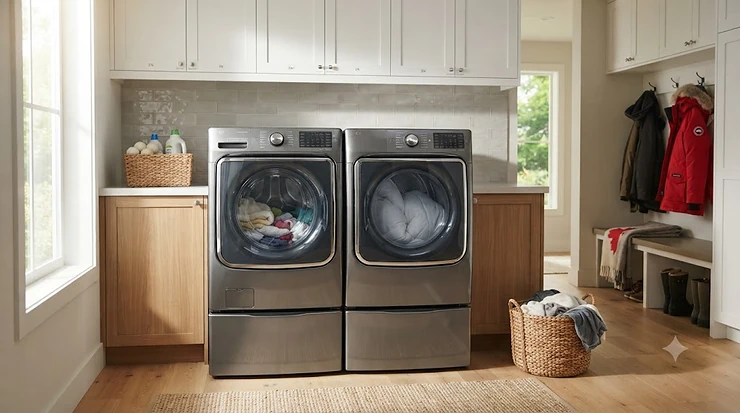
If your laundry hamper regrows overnight like some kind of cursed garden, you don’t need a pep talk about “doing laundry smarter.” You need a machine that can actually swallow a king-size duvet without staging a mutiny halfway through the spin cycle. That’s the whole appeal of an extra large capacity washer: fewer trips back and forth to the laundry room, fewer half-loads that waste water and electricity, and a lot more Saturday morning left over for things that aren’t socks.

An extra large capacity washer is generally any front load or top load machine with a drum of roughly 5.0 cubic feet (about 142 litres) or more — large enough to wash a queen-sized comforter, a dozen towels, or an entire hockey team’s worth of jerseys in a single cycle, instead of splitting the job across two or three loads. For Canadian households with kids, pets, or anyone who just generates an alarming volume of dirty gym clothes, that extra drum space adds up to real time saved every single week.
This guide walks through seven real, currently available washers sold in Canada, from budget-friendly top loaders to premium AI-equipped front loaders, with honest analysis pulled from manufacturer specs and aggregated review sentiment — not fabricated hands-on claims. We’ll also cover why choosing an efficient large-capacity machine matters for your utility bill, not just your free time — household appliances account for a meaningful share of energy used in the average Canadian home. According to Natural Resources Canada, the right washer choice genuinely moves the needle on both fronts.
Quick Comparison Table
| Washer | Capacity | Type | Best For | Price Range (CAD) |
|---|---|---|---|---|
| Whirlpool 5.8 Cu. Ft. Load & Go XL | 5.8 cu. ft. | Front load | Largest single-load capacity | C$1,300-C$1,700 |
| LG Mega Capacity TurboWash 360 | 5.8 cu. ft. | Front load | Tech-forward busy households | C$1,400-C$1,800 |
| Maytag 5.5 Cu. Ft. Steam Front Load | 5.5 cu. ft. | Front load | Durability and long warranty | C$1,100-C$1,400 |
| LG WM3600HWA Ultra Large | 5.2 cu. ft. | Front load | Quiet operation, mid-budget | C$900-C$1,150 |
| Electrolux ELFW7637AW | 5.2 cu. ft. | Front load | Stain-fighting performance | C$1,000-C$1,300 |
| Samsung WF45R6100AP | 5.2 cu. ft. | Front load | Shallow-depth installs | C$950-C$1,200 |
| GE GTW720BSNWS | 4.8 cu. ft. | Top load | Budget big-family pick | C$750-C$950 |
Looking at the spread above, the two 5.8 cubic foot front loaders from Whirlpool and LG sit at the top of the capacity ladder, but they also carry the steepest price tags — worth it mainly if you’re washing bulky items like duvets or sports gear weekly. Mid-range picks like the LG WM3600HWA and Electrolux ELFW7637AW hit a sweet spot around 5.2 cubic feet, giving most large families more than enough room without the premium price. If budget is the priority, the GE GTW720BSNWS top loader proves you don’t need a four-figure price tag to get genuinely large capacity.
💬 Just one click — help others make better buying decisions too!😊
Top 7 Extra Large Capacity Washers: Expert Analysis
1. Whirlpool 5.8 Cu. Ft. Front Load Washer with Load & Go XL — largest front-load drum on the market
The Whirlpool 5.8 Cu. Ft. Front Load Washer with Load & Go XL currently holds the title of the largest capacity front loader Whirlpool sells, and that extra headroom is genuinely noticeable when you’re stuffing in a king comforter. The Load & Go XL dispenser holds enough detergent for roughly 40 loads before a refill, and the intuitive control panel lets you save up to 35 custom cycle combinations — handy if different household members have wildly different fabric-care standards. A 12-hour FanFresh option keeps a finished load from developing that musty smell if nobody’s around to move it to the dryer right away.
Based on the spec comparison, this is the machine for households that regularly wash bulky, oversized items — bedding, winter coats, dog beds — rather than just high-volume everyday laundry. Reviewers consistently note strong satisfaction with the dispenser’s convenience and the large drum’s ability to handle bedding without needing a second load, though some mention the touch controls take a cycle or two to learn. At around C$1,300-C$1,700, it commands a premium price for a machine without steam, so budget-focused buyers may find better value one tier down.
Pros:
- ✅ Largest front-load capacity available for bulky items
- ✅ Detergent dispenser lasts roughly 40 loads
- ✅ Up to 35 customizable wash cycle combinations
Cons:
- ❌ Premium price with no built-in steam function
- ❌ Touchscreen learning curve for new users
Given the drum size, expect to pay towards the top of the range — worth it primarily if oversized loads are a weekly, not occasional, occurrence.
2. LG Mega Capacity Smart Front Load with TurboWash 360 — fastest big-load cycle in this lineup
The LG Mega Capacity Smart Front Load with TurboWash 360 matches Whirlpool’s 5.8 cubic foot drum but adds a genuinely useful trick: five jets spraying from multiple angles to clean big loads in under 30 minutes. Built-in AI sensors detect fabric texture, soil level, and load size, then auto-select the wash motion and temperature — no more guessing whether “Normal” or “Heavy Duty” is the right call for a mixed load of jeans and delicates.
What most buyers overlook about this model is the Smart Pairing feature, which lets the washer communicate with a compatible LG dryer over Wi-Fi to select a matching drying cycle automatically — a small thing, but it removes one more decision from laundry day. On paper, this means less manual cycle-selection and fewer mismatched wash/dry settings ruining a load. Aggregated review sentiment points to strong satisfaction with wash speed and quietness, with the recurring caveat that the smart features require both machines to be registered and connected to Wi-Fi to actually work. Expect to pay in the mid-to-high C$1,000s, positioning it as one of the pricier options here.
Pros:
- ✅ Cleans large loads in under 30 minutes
- ✅ AI sensors auto-select wash settings by fabric
- ✅ Smart Pairing coordinates with compatible dryers
Cons:
- ❌ Smart features require Wi-Fi and app setup
- ❌ Among the most expensive options in this roundup
3. Maytag 5.5 Cu. Ft. Front Load Washer with Steam — best warranty backing in this class
The Maytag 5.5 Cu. Ft. Front Load Washer with Steam is built around one central promise: durability that outlasts the flashier features on competing machines. Maytag rates the drum at enough space to clean roughly 30 towels in a single load, and backs the direct-drive motor and stainless steel wash basket with a 10-year limited parts warranty — noticeably longer than what most competitors offer.
Here’s what the spec sheet won’t tell you outright: the Advanced Vibration Control Plus system, which pairs a ball-bearing balancing ring with a six-point suspension, is specifically engineered to keep oversized, unbalanced loads (think one soaked bath towel bunched in a corner) from turning into a thumping mess mid-cycle. Steam permeates fabric fibres for tougher stain removal when paired with the Extra Power button. Reviewers consistently highlight the long warranty and sturdy build as the standout reasons to choose Maytag over flashier rivals, while some note the steam cycle adds noticeable time to an already lengthy wash. At C$1,100-C$1,400, it’s a strong middle ground between the ultra-premium and mid-range tiers.
Pros:
- ✅ 10-year limited parts warranty on motor and basket
- ✅ Advanced vibration control handles unbalanced loads well
- ✅ Steam option boosts stain-fighting power
Cons:
- ❌ Steam cycles noticeably extend total wash time
- ❌ Pricier than similarly sized non-steam competitors
4. LG 5.2 Cu. Ft. Ultra Large Capacity Front Load (WM3600HWA) — quietest operation for shared-wall homes
The LG 5.2 Cu. Ft. Ultra Large Capacity Front Load trades a bit of drum space compared to the Mega Capacity model above in exchange for a noticeably lower price and, notably, dedicated quiet-operation engineering. LG’s True Balance Anti-Vibration and LoDecibel systems are specifically built to keep even large loads from rattling the house — a real consideration if your laundry room shares a wall with a bedroom or sits above a living room.
Based on the spec comparison, this model is the practical choice for buyers who want AI-assisted cycle selection and a genuinely large drum without paying for the 5.8 cubic foot flagship tier. The NeveRust stainless steel drum sidesteps the chipping and rust issues that can eventually plague porcelain-coated tubs. Reviewers consistently report satisfaction with how quiet the unit runs even during high-speed spin, which matters more than most buyers expect until they’ve lived with a loud washer on a second floor. At C$900-C$1,150, it represents one of the better value plays in the premium-brand tier.
Pros:
- ✅ Genuinely quiet operation even at high spin speeds
- ✅ AI fabric and soil sensors automate cycle selection
- ✅ NeveRust stainless drum resists long-term wear
Cons:
- ❌ Smaller drum than LG’s own 5.8 cu. ft. flagship
- ❌ Lacks the TurboWash 360 fast-cycle jets
5. Electrolux ELFW7637AW Front Load Washer — sharpest stain-fighting chemistry
The Electrolux ELFW7637AW Front Load Washer takes a different angle on “large capacity done well”: rather than leading with size alone, it leads with SmartBoost premixing technology, which blends water and detergent before the cycle starts so the detergent hits fabric already activated instead of slowly dissolving mid-wash. Paired with the 5.2 cubic foot drum, that means big loads get proportionally more cleaning power per scoop of detergent.
What most buyers overlook about this model is the Optic Whites cycle, which Electrolux claims keeps whites brighter than a standard bleach cycle without the fabric-damaging harshness of bleach itself — a genuinely useful feature for households doing frequent loads of school uniforms or bedsheets. The Pure Rinse setting is designed to reduce leftover detergent residue that can irritate sensitive skin, without using extra water. Aggregated review sentiment tends to favour the stain-removal results, with occasional notes about the control panel layout taking some adjustment. Reversible doors and stackability add flexibility for tight laundry rooms. Price sits around C$1,000-C$1,300.
Pros:
- ✅ SmartBoost premixing improves detergent effectiveness
- ✅ Optic Whites cycle brightens without bleach
- ✅ Reversible door suits tight or awkward layouts
Cons:
- ❌ Control panel layout has a learning curve
- ❌ No AI auto-cycle detection like LG’s flagship
6. Samsung 5.2 Cu. Ft. Front Load Washer with Steam (WF45R6100AP) — best fit for shallow laundry closets
The Samsung 5.2 Cu. Ft. Front Load Washer with Steam solves a very specific, very common Canadian condo problem: not every laundry nook has room for a deep-bodied washer. Samsung built this model with a shallower cabinet depth while widening the drum itself, so you get the same 5.2 cubic foot capacity as bulkier competitors without needing extra clearance behind the machine.
On paper, this means renters and condo owners with tight utility closets don’t have to sacrifice capacity just because their space is sacrificing depth. The steam function releases directly from the drum rather than through a separate reservoir, aiming for more even fabric saturation on tough stains without a lengthy pretreat step. Reviewers consistently mention the sleek, low-profile design as a standout, particularly in stacked installations where the control panel needs to stay visible and reachable. Some review threads flag that Samsung’s touch controls can occasionally register accidental taps if brushed while loading laundry. Price typically lands around C$950-C$1,200.
Pros:
- ✅ Shallower depth fits tight condo laundry spaces
- ✅ Steam releases directly into the drum for stains
- ✅ Wider drum preserves full 5.2 cu. ft. capacity
Cons:
- ❌ Touch controls occasionally register accidental taps
- ❌ Fewer smart-home integrations than LG’s competing model
7. GE GTW720BSNWS 4.8 Cu. Ft. Top Load Washer — best value for big families on a budget
Rounding out this list is the GE GTW720BSNWS 4.8 Cu. Ft. Top Load Washer, and it earns its spot by proving large capacity doesn’t require a front-load price tag. Independent lab testing from appliance review outlet Reviewed found this model’s stain removal performance above average, ranking it as the top performer among top-load washers the outlet tested and the strongest pick under $1,000 in that comparison — a meaningful data point for budget-conscious big families.
The dedicated Tide PODS dispenser uses a targeted water jet to pierce and activate detergent pods faster than tossing them loose into the drum, and soft-close hinges prevent the lid-slam that eventually cracks cheaper glass lids. Reviewed’s testing also noted that occasional load-balancing hiccups can stretch cycle times longer than the display estimates — worth knowing going in rather than being surprised by it. For households prioritizing raw value over smart features or steam, this is the pragmatic pick. Price in Canada typically runs C$750-C$950, making it the most accessible entry point in this roundup by a wide margin.
Pros:
- ✅ Best-tested top loader under C$1,000 in independent testing
- ✅ Dedicated pod dispenser speeds detergent activation
- ✅ Soft-close hinges reduce long-term lid wear
Cons:
- ❌ Load-balancing issues can extend cycle times
- ❌ Top-load agitation is harder on delicate fabrics
Practical Usage Guide: Getting the Most From Your New Machine
Bringing home any extra large capacity washer is only half the job — setup and first-month habits determine whether you actually get the time-saving laundry benefits you paid for. Start by levelling the machine properly; an unlevel washer with a full 5+ cubic foot load will walk across the floor during spin, and that’s not a myth, it’s basic physics fighting your flooring. Most manufacturers, including Whirlpool and LG, recommend rechecking the level after the first few loads once the machine has settled into its final position.
For the first 30 days, resist the urge to max out every load “just because you can.” Front loaders in particular need room for clothes to tumble freely — overpacking a Maytag or Electrolux drum to save one extra load actually reduces cleaning performance and increases wear on the bearings. Run a monthly cleaning cycle (Affresh tablets for Maytag, Tub Clean settings on Samsung and LG) to prevent the musty smell that plagues sealed front-load door gaskets. Leave the door and detergent drawer cracked open between washes so moisture can escape instead of breeding mildew — a five-second habit that saves a much bigger headache later.
Finally, match detergent type to machine type. High-efficiency (HE) detergent is mandatory for every washer on this list; regular detergent oversudses and can trigger error codes or leave residue on your first several loads.
Real-World Scenarios: Which Extra Large Washer Fits Your Household
Choosing among a washing machine for big family use really comes down to matching the machine to your actual weekly laundry pattern, not the spec sheet in isolation.
The hockey/soccer family of five: Between practice gear, muddy jerseys, and towels after every game, this household benefits most from the Whirlpool 5.8 Cu. Ft. or LG Mega Capacity models — the extra drum space handles bulky gear bags’ worth of laundry in one go, and the Load & Go dispenser means nobody has to remember to refill detergent mid-week.
The condo-dwelling family of four: Space is the constraint here, not budget. The Samsung WF45R6100AP‘s shallower depth solves the physical clearance problem while still delivering 5.2 cubic feet of capacity — full-size performance in a footprint that fits a standard condo laundry closet.
The budget-conscious growing family: For households prioritizing value over smart features, the GE GTW720BSNWS delivers genuinely large 4.8 cubic foot capacity and independently tested strong stain removal, all well under C$1,000 — proof that high-volume washing doesn’t have to break the budget.
The allergy-conscious household: Families managing eczema, sensitive skin, or seasonal allergies should lean toward the Electrolux ELFW7637AW‘s Pure Rinse cycle or the Maytag‘s steam-and-sanitize combination, both aimed at reducing detergent residue and allergens left behind in fabric.
✨ Don’t Miss These Exclusive Deals!
🔍 Take your laundry routine to the next level with these carefully selected extra large capacity washers. Click on any highlighted model to check current pricing and availability, and start saving hours every week.
How to Choose an Extra Large Capacity Washer
Picking the right model comes down to seven practical criteria, in roughly this order of importance for most Canadian households:
- Actual drum capacity, not marketing labels. “Large” and “extra large” aren’t standardized terms, so compare cubic feet directly — anything from 4.8 to 5.8 cu. ft. genuinely qualifies as extra large for residential use.
- Front load vs. top load. Front loaders generally offer better capacity-to-footprint ratios and gentler fabric care; top loaders load faster and don’t require bending, which matters for accessibility.
- Installation footprint and depth. Measure your laundry space before falling for a 5.8 cu. ft. model that physically won’t clear your doorway or utility closet.
- Cycle time versus load size. A bigger drum sometimes means longer average cycle times, especially on steam or sanitize settings — factor this into your actual weekly laundry schedule.
- Energy and water ratings. Look specifically for ENERGY STAR certification, since certified washers use meaningfully less power and water per load than non-certified equivalents.
- Warranty length on the motor and drum. Maytag’s 10-year parts warranty on its direct-drive motor is a genuine differentiator worth weighing against upfront price.
- Smart features you’ll actually use. AI cycle detection and app pairing sound great in a showroom, but only pay the premium if you’ll realistically use them — otherwise that budget is better spent on capacity or warranty coverage.
5.5 Cu Ft Front Load Washer vs Top Load Giants
When people search specifically for a 5.5 cu ft front load washer, they’re usually trying to decide between two fundamentally different approaches to “big capacity” — and the differences go well beyond drum size.
| Factor | Front Load (5.2-5.8 cu. ft.) | Top Load (4.8-5.3 cu. ft.) |
|---|---|---|
| Fabric care | Gentler tumbling action | More agitation, harder on delicates |
| Water/energy use | Typically lower per load | Typically higher per load |
| Installation | Stackable, tighter footprint | Requires overhead clearance |
| Load/unload | Requires bending | No bending required |
| Best For | LG Ultra Large, Maytag Steam | GE GTW720BSNWS |
The analysis here is straightforward: front loaders like the Maytag 5.5 Cu. Ft. and LG WM3600HWA consistently use less water and energy to move the same volume of laundry, because they rely on gravity and tumbling rather than fully submerging every load. That efficiency advantage compounds fast for a household running five-plus loads a week. Top loaders like the GE GTW720BSNWS trade some of that efficiency for faster load times and zero bending, which genuinely matters for anyone with mobility concerns or simply hates crouching to grab wet laundry. Neither approach is objectively “better” — it’s a real trade-off between water/energy savings and physical convenience.
Common Mistakes When Buying a High-Volume Washer
Even smart shoppers trip on the same handful of mistakes when buying for high-volume washing needs. First: assuming bigger is automatically better. A 5.8 cu. ft. drum is wasted capacity if your household realistically does small, frequent loads — you’ll end up running a half-empty Whirlpool or LG flagship, which doesn’t actually save water or time compared to a right-sized 4.8 cu. ft. model.
Second: skipping the doorway and hallway measurement. Extra large washers are physically bigger appliances, and more than a few buyers have discovered — after delivery — that a 5.8 cu. ft. front loader simply won’t clear a narrow basement stairwell. Third: ignoring stacking compatibility if you’re pairing with a dryer later; not every washer/dryer combination stacks safely without a specific stacking kit, and buying mismatched brands can void that option entirely.
Fourth: underestimating detergent costs. HE detergent isn’t optional, and buyers moving from an older standard-agitator machine sometimes don’t budget for the switch. Fifth, and most common: chasing smart features you won’t use instead of prioritizing the warranty and build quality that actually determines how many years the machine lasts.
What to Expect: Real-World Performance and Fewer Loads Per Week
The math behind fewer loads per week is simple but worth spelling out. A household running seven loads weekly on a standard 3.5-4.0 cu. ft. washer can often consolidate to four or five loads on a genuine 5.2-5.8 cu. ft. extra large capacity washer, since more clothing fits per cycle without sacrificing wash quality. That’s not marketing spin — it’s a direct function of drum volume, provided the machine’s motor and suspension are actually engineered to handle a fully loaded large drum, which is exactly what features like Maytag’s Advanced Vibration Control Plus and LG’s True Balance system are designed to support.
In practical terms, expect a genuinely large-capacity machine to comfortably handle a queen-size comforter alone, or 12-15 bath towels in a single cycle — loads that would require two or three separate runs on a standard-size washer. The trade-off is cycle length: some large-capacity cycles, particularly on steam or sanitize settings, run 60-90 minutes rather than the 30-40 minutes typical of smaller quick-wash cycles. Reviewers across multiple large-capacity models consistently note that the time savings show up in fewer total trips to the laundry room per week, even if any single cycle takes a bit longer.
Time-Saving Laundry: Features That Actually Cut Your Weekly Workload
Not every feature marketed as a “time saver” actually saves meaningful time, so it’s worth separating genuine time-saving laundry innovations from marketing fluff. Detergent auto-dispensers, like Whirlpool’s Load & Go XL and LG’s ThinQ-connected models, genuinely eliminate a weekly task — measuring detergent — by pre-loading up to 40 loads’ worth at once. That’s a real, measurable time saving, not a gimmick.
TurboWash-style fast-cycle jets, as found on LG’s Mega Capacity model, are also legitimately useful: cutting a large-load cycle to under 30 minutes means less total laundry-day time even accounting for the extra load size. On the other hand, some “smart” features — app notifications, voice control, remote start — save essentially no time for most households and mainly exist to justify a higher price point. Here’s what to weigh: if a feature removes a physical task (measuring, refilling, checking a lid), it saves time. If it just moves information onto your phone, it’s convenience, not efficiency. Prioritizing the former over the latter is how you actually get more free time out of your washer purchase, rather than just more notifications.
Long-Term Cost & Maintenance
Sticker price is only part of the total cost of ownership for any extra large capacity washer. ENERGY STAR certified clothes washers can save up to $530 in energy costs over their lifetime compared to non-certified equivalents, according to a 2025 BC Hydro household survey — a meaningful gap that should factor into any comparison between similarly priced models. Every washer in this roundup carries ENERGY STAR certification, but efficiency still varies model to model, so it’s worth checking the specific EnerGuide rating on the yellow label before buying.
Maintenance costs also diverge sharply by brand and design. Maytag’s 10-year parts warranty on the motor and basket effectively caps a major repair cost that owners of shorter-warranty machines may eventually face out of pocket. Front loaders generally require more routine maintenance than top loaders — monthly tub-clean cycles and gasket wiping are non-negotiable to prevent mildew buildup — but that maintenance is inexpensive (a bottle of tub cleaner runs a few dollars) compared to the water and energy savings compounding over years of use. When comparing cost-per-load, a C$1,700 front loader using less water and energy per cycle can genuinely undercut a C$900 top loader’s total five-year cost, depending on local utility rates. As CBC News reports, ENERGY STAR labelling remains a useful shorthand for these long-term savings even as the underlying certification program evolves.
Safety, Regulations & Compliance Guide
Extra large capacity washers sold in Canada must meet specific regulatory and safety standards before they can legally reach a Canadian retail floor. Any washer plugged into a Canadian home should carry CSA (Canadian Standards Association) certification or an equivalent recognized mark, confirming the appliance meets Canadian electrical safety requirements — always check for this mark on the rating plate before installation, particularly with imported or grey-market units.
On the efficiency side, Natural Resources Canada regulates minimum energy performance standards for household clothes washers under federal Energy Efficiency Regulations, meaning every legally sold washer in Canada — including every model in this roundup — already clears a baseline efficiency threshold before it can be sold at all. ENERGY STAR certification, which all seven washers here carry, goes further, generally requiring roughly 25% less energy and 33% less water than the federal minimum standard.
For installation safety, always use the braided steel supply hoses included with new washers rather than reusing old rubber hoses, which degrade over time and are a leading cause of basement flooding claims. If installing in a multi-unit building, confirm with your building management that your unit’s electrical circuit and drain capacity can handle a large-capacity machine before delivery day — some older Canadian apartment buildings weren’t wired for higher-draw appliances.
Problem → Solution Guide
Problem: Loads coming out with detergent residue. Solution: switch to HE detergent if you haven’t already, and run the Pure Rinse or Extra Rinse cycle available on the Electrolux and Samsung models — both are specifically designed to address this.
Problem: Musty smell developing in the drum. Solution: run a monthly cleaning cycle (Affresh for Maytag, Tub Clean for LG and Samsung), and leave the door cracked between loads to let the gasket dry fully.
Problem: Washer walking or vibrating during spin. Solution: re-level the machine using a bubble level and the adjustable feet — this is especially common with large-capacity front loaders like the Whirlpool 5.8 Cu. Ft. during the first few weeks before the machine settles.
Problem: Cycle times longer than expected. Solution: check for load imbalance (redistribute bulky single items like one comforter across the drum) and avoid overpacking, which forces extended balancing attempts on models like the GE GTW720BSNWS.
Problem: Uncertain whether a 5.8 cu. ft. model will fit your space. Solution: measure doorways, stairwells, and the final install location in centimetres before ordering, and confirm stacking-kit compatibility if pairing with a dryer.
FAQ
❓ What is an extra large capacity washer?
❓ How many cubic feet is a large family washer?
❓ Are front load washers really better for big families?
❓ Do extra large washers cost more to run?
❓ What size washer do I need for a family of five?
Conclusion
Choosing the right extra large capacity washer really comes down to matching drum size, budget, and feature set to how your household actually does laundry — not to the biggest number on the spec sheet. Big, bulky-item households will get real value out of the Whirlpool 5.8 Cu. Ft. or LG Mega Capacity flagships; tight-budget big families will do just as well with the honestly excellent GE GTW720BSNWS; and anyone dealing with condo-sized laundry closets should look hard at the Samsung WF45R6100AP‘s shallower footprint.
What all seven models share is the core promise of this category: fewer loads per week, less time hovering around the laundry room, and genuine ENERGY STAR-backed efficiency gains that add up over years of ownership. Measure your space, be honest about your household’s actual weekly laundry volume, and prioritize warranty coverage over flashy smart features you may never use — that combination will get you to the right machine faster than chasing the single biggest drum on the shelf.
✨ Don’t Miss These Exclusive Deals!
🔍 Take your laundry routine to the next level with one of these carefully selected extra large capacity washers. Click on any highlighted model to check current pricing and availability, and reclaim your weekends starting this week!
Recommended for You
- 7 Best Large Capacity Front Load Washer Picks for 2026
- 7 Best stackable washer dryer under 2000 Picks for Canada (2026)
- Stackable Washer Dryer for Condo: 7 Best Picks for 2026
Disclaimer: This article contains affiliate links. As an Amazon Associate, I earn from qualifying purchases. If you purchase products through these links, we may earn a small commission at no additional cost to you.
✨ Found this helpful? Share it with your friends! 💬🤗
